
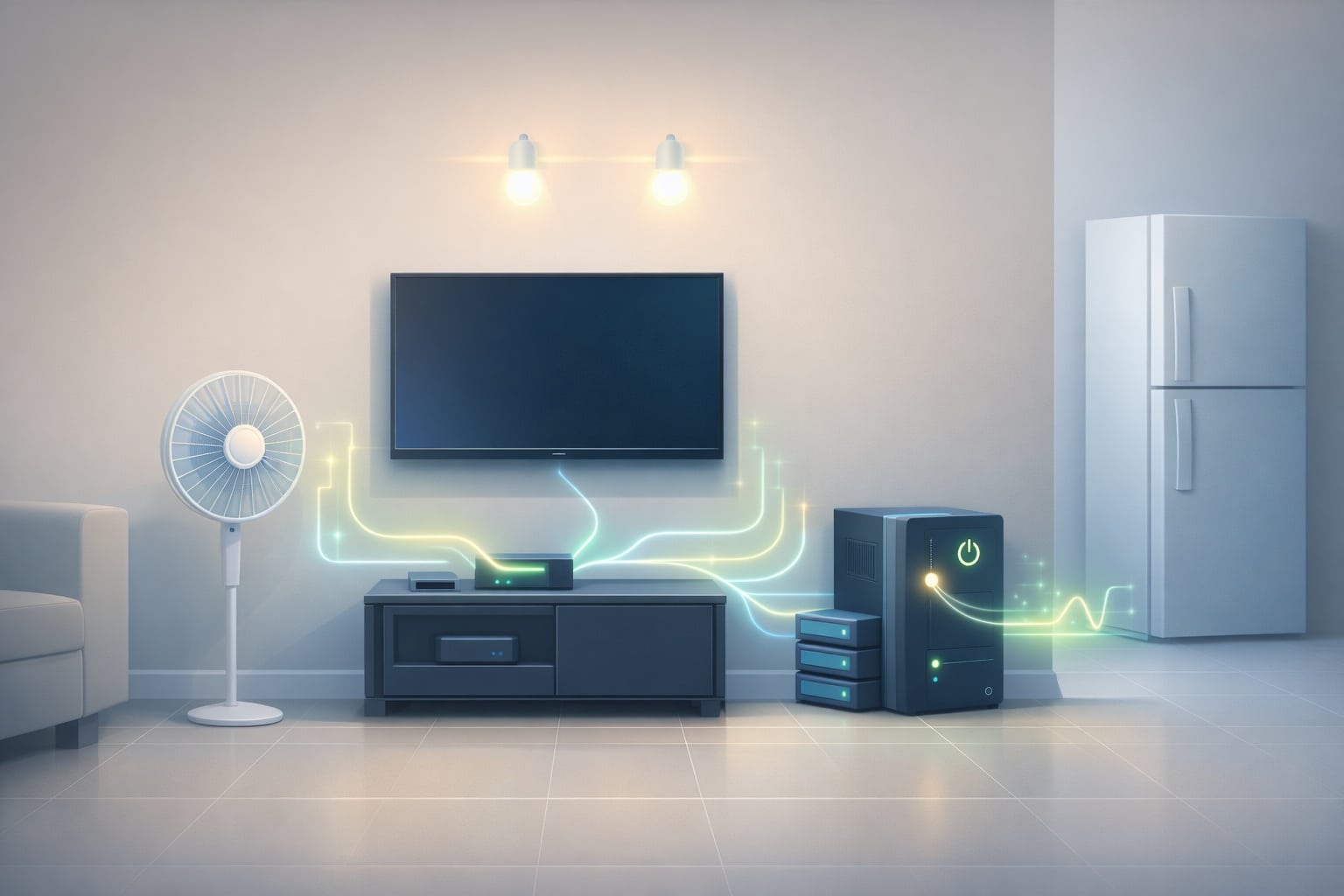
INVERTER FOR 1 BEDROOM APARTMENT NIGERIA
The best inverter for 1 bedroom apartment Nigeria is a 1.5kVA inverter paired with one 200Ah battery. This setup powers your lights, ceiling fans, TV, decoder, phone chargers, and a small fridge for 4 to 10 hours depending on load, and pays for itself within 4 to 6 months compared to running a petrol gdenerator.
WHY 1.5KVA IS THE RIGHT SIZE FOR A 1 BEDROOM APARTMENT
When searching for an inverter for 1 bedroom apartment Nigeria, the most common mistake is oversizing. Many buyers end up with 2.4kVA or 3.5kVA systems that cost more upfront, require two batteries instead of one, and operate at barely 20% capacity, wasting money on headroom they never use.
A 1.5kVA inverter on a 12V DC topology is purpose-built for the load profile of a standard Nigerian 1-bedroom apartment. The typical electrical demand in this configuration sits between 150W (background, like lights and a fan) and 500W (peak, with everything on simultaneously). The Mercury 1.5kVA inverter delivers 1500W of continuous output power (at power factor 1.0), which provides comfortable headroom above the actual demand without the cost penalty of a larger system.
TECHNICAL SPECIFICATIONS: MERCURY 1.5KVA INVERTER
The Mercury 1.5kVA Solar Hybrid Inverter integrates a pure sine wave inversion circuit with a built-in charge controller. Standard household electronics like SMPS power supplies in TVs and laptops, ceiling fan motors, LED drivers, and small fridge compressors all operate within acceptable thermal limits on this waveform.
- Input Voltage (DC): 12V (Requires 1x 12V Battery).
- Output Voltage (AC): 220V to 230V Nominal.
- Continuous Output: 1500W (depending on power factor).
- Changeover Time: Less than 10ms (UPS Mode), preventing PC reboots and decoder resets.
- Charging Current: 10A to 15A (Grid), sufficient for overnight recharge during available grid windows.
- Battery Requirement: 1x 200Ah 12V Deep Cycle (AGM or Gel). See our guide on which battery is best for an inverter.
DETAILED LOAD PROFILE AND WATTAGE ANALYSIS
To validate the 1.5kVA sizing, we calculate the Total Connected Load (TCL) versus the Simultaneous Maximum Demand (SMD). In a 1-bedroom apartment, not all appliances operate concurrently at peak rating.
| Appliance | Qty | Rated Watts | Total Watts | Duty Cycle |
|---|---|---|---|---|
| LED Lighting | 4 | 9W | 36W | 100% |
| Ceiling Fan | 2 | 70W | 140W | 100% |
| 32 to 43 inch LED TV | 1 | 50W | 50W | 100% |
| Decoder/Router | 1 | 20W | 20W | 100% |
| Phone Charging | 2 | 10W | 20W | Intermittent |
| Small Fridge (100 to 150L) | 1 | 80W | 80W | 40% (Thermostat) |
| TOTAL PEAK LOAD | 346W |
With a peak load of approximately 346W, the 1.5kVA inverter operates at 33 to 38% of its rated capacity. This is the sweet spot. High enough for efficient power conversion, low enough to avoid thermal stress on the MOSFETs and transformer core. The result is quieter operation, less heat output, and a longer inverter lifespan.
SURGE CURRENT AND FRIDGE COMPATIBILITY
The primary concern when sizing an inverter for 1 bedroom apartment Nigeria is the Lock-Rotor Ampere (LRA) spike generated by refrigeration compressors at start-up. A small fridge (100 to 150L) rated at 80W running power may draw 400W to 600W for 200 to 500 milliseconds during compressor engagement.
The Mercury 1.5kVA unit can absorb this transient spike without triggering overload protection, provided the fridge is within the 150L range. For a deeper breakdown of which fridges work with which inverters, see our guide on whether an inverter can carry a fridge. For larger fridges (200L+) or standalone freezers with higher compressor ratings, the surge demand may exceed the inverter’s peak capacity, and in that case a 2.4kVA system on a 24V configuration becomes necessary.
Rule of thumb: If you only have a small table-top or single-door fridge, the 1.5kVA handles it. If you have a double-door fridge or a separate chest freezer, size up to 2.4kVA.
BATTERY AUTONOMY: ONE 200AH BATTERY
The energy reservoir for the 1.5kVA system is a single 12V 200Ah Deep Cycle battery (AGM or Gel). Using one battery instead of two cuts the upfront cost significantly while still providing adequate overnight autonomy for a 1-bedroom apartment.
Runtime Calculation
Using standard efficiency assumptions and a 80% Depth of Discharge (DOD) limit to preserve battery cycle life (learn more about how to extend your inverter battery lifespan):
- Total Capacity: 12V x 200Ah = 2400 Watt-hours (Wh).
- Usable Capacity (80% DOD): 1920 Wh.
- Inverter Efficiency (~85%): 1920 Wh x 0.85 = 1632 Wh delivered.
At full load (346W): 1632 Wh / 346W = approximately 4.7 hours.
At average overnight load (approximately 200W with fridge cycling, fans, and lights): 1920Wh / 200W = approximately 8 hours.
At minimal load (approximately 150W with fans and lights only, no fridge): 1920 Wh / 150W = approximately 10 hours.
For most 1-bedroom apartments, the overnight period (11 PM to 5 AM) with fans, a few lights, and a cycling fridge draws approximately 150 to 200W average. This yields 8 to 10 hours of runtime, which is sufficient to cover the critical sleeping hours during a grid outage. You can calculate your exact runtime using our inverter battery runtime calculator.
Need more runtime? You can always add a second 200Ah battery in parallel to double your energy reservoir without changing the inverter. Parallel connection keeps the system at 12V but increases total capacity to 400Ah, extending overnight autonomy to 10 to 14 hours under the same load conditions. See our guide on connecting inverter to battery for wiring instructions. This makes it a practical upgrade path if your power outages worsen or your usage increases over time.
SOLAR UPGRADE PATH
The Mercury 1.5kVA unit supports solar integration through its built-in charge controller. The advantage of the 12V system is simplicity. A single panel can charge the battery directly without complex series/parallel configurations. For step-by-step wiring instructions, see our guide on how to connect a solar panel to a battery.
Recommended Panel: 1x 300W Monocrystalline Panel.
Daily Yield: At Lagos irradiance levels (4 to 5 peak sun hours), a single 300W panel generates approximately 1.2kWh to 1.5kWh per day. This is enough to recharge the 200Ah battery from 50% to 100% during daylight hours while supporting light daytime loads.
Cost: Adding one 300W panel with mounting hardware typically costs 80,000 to 120,000 NGN, making it an affordable second-phase investment.
ROI ANALYSIS: INVERTER VS. GENERATOR
With fuel prices at current levels, the economic case for an inverter system over a petrol generator is overwhelming, even before considering noise, fumes, and maintenance costs.
Monthly Cost Comparison
- Petrol Generator (1.0kVA Portable):
- Fuel Price: approximately 998 NGN/Litre.
- Consumption: approximately 0.5 Litres/Hour at 50% load.
- Nightly Cost (6 Hours): 0.5 x 6 x 998 = 2,994 NGN/Night.
- Monthly Cost (30 nights): approximately 89,820 NGN.
- Grid Charging (Inverter System):
- Tariff: approximately 209 NGN/kWh (NERC Band A).
- Daily Recharge Energy (1.2kWh + charging losses): approximately 1.5 kWh.
- Daily Cost: 1.5 x 209 = 314 NGN/Day.
- Monthly Cost: approximately 9,420 NGN.
Monthly Savings: approximately 80,000 NGN compared to generator usage. A complete Mercury 1.5kVA + 1x 200Ah battery system (estimated installation cost 350,000 to 500,000 NGN depending on battery brand and installation complexity) achieves full Return on Investment within 4 to 6 months.
WHEN TO CONSIDER UPGRADING TO 2.4KVA
The 1.5kVA system is the correct specification for a standard 1-bedroom apartment. However, there are specific conditions where a 2.4kVA system (24V, 2x batteries) becomes necessary:
- Large refrigeration: A 200L+ fridge or standalone chest freezer with a high-draw compressor exceeds the 1.5kVA surge capacity.
- Microwave or electric kettle use: These appliances draw 800W to 1500W and cannot run on a 1.5kVA system.
- Extended autonomy requirement: If you need 10+ hours of runtime with the fridge running, the single 200Ah battery cannot deliver. A 24V 200Ah bank (2x batteries in series) doubles the energy reservoir.
- Future expansion: If you anticipate moving to a 2-bedroom apartment or adding heavy loads within 12 months.
For everyone else with just lights, fans, TV, decoder, phone charging, and a small fridge, the 1.5kVA with one 200Ah battery is the engineering-correct and cost-efficient choice.
CONCLUSION
The right inverter for 1 bedroom apartment Nigeria is a 1.5kVA inverter paired with a single 200Ah deep cycle battery. This configuration matches the actual electrical load profile of a standard apartment, provides 8 to 10 hours of overnight autonomy, and delivers a return on investment within 4 to 6 months against generator running costs. The system accepts solar panel integration for future grid independence, and can be installed in under 2 hours by a qualified technician.
Inverter for 1 Bedroom Apartment Nigeria FAQ
Can a 1.5kVA inverter power a fridge in a 1-bedroom apartment?
Yes, the Mercury 1.5kVA inverter can handle a small to medium fridge (up to 150L) alongside lights and fans. However, a 200L+ fridge with a high-draw compressor may trigger the overload protection during startup surges. For apartments with large fridges or freezers, a 2.4kVA system is recommended instead.
How long will one 200Ah battery last on a 1.5kVA inverter?
With a typical 1-bedroom load of fans, lights, TV, and a phone charger (approximately 200W average), a single 12V 200Ah battery at 50% Depth of Discharge provides approximately 4 to 5 hours of runtime. With only lights and fans running (approximately 100W), runtime extends to 8 to 10 hours. Use our battery runtime calculator for your exact load.
Is it necessary to install solar panels immediately?
No. The system functions as a standalone power backup using grid power (PHCN/NEPA) to charge the battery. Solar panels can be added later to reduce grid dependence or to provide charging during prolonged outages. A single 300W panel is sufficient for this system. See our guide on how to connect a solar panel to a battery.
What cable size should be used for installation?
For the DC side (battery to inverter), 16mm squared pure copper cables are sufficient for the 1.5kVA system, as peak current draw on a 12V system is approximately 60 to 70 Amps. For the AC output wiring, standard 2.5mm squared cables are adequate for the apartment distribution. For full wiring instructions, see our inverter installation guide.
Does this inverter require a separate stabilizer?
Most Mercury inverters include an internal Automatic Voltage Regulator (AVR) with a range of 170V to 260V. However, given the volatility of the Nigerian grid, an external servo stabilizer is recommended in areas with frequent voltage spikes above 260V to protect the inverter’s charging circuit.
Should I get a 1.5kVA or 2.4kVA for my 1-bedroom apartment?
For a standard 1-bedroom apartment running lights, fans, TV, phone chargers, and a small fridge, the 1.5kVA is the correct size. It costs less, uses only one battery instead of two, and operates efficiently within the load range. Only upgrade to 2.4kVA if you need to power a large freezer, washing machine, or microwave simultaneously.
Ready to Power Your 1-Bedroom Apartment?
Get the Mercury 1.5kVA inverter and 200Ah battery delivered and installed. Chat with our team for a free load assessment and quote. Have more questions? Check our Inverter FAQ.
Buy Mercury 1.5kVA Inverter →