
DO I NEED A SERVO STABILIZER IN NIGERIA?
Quick Answer
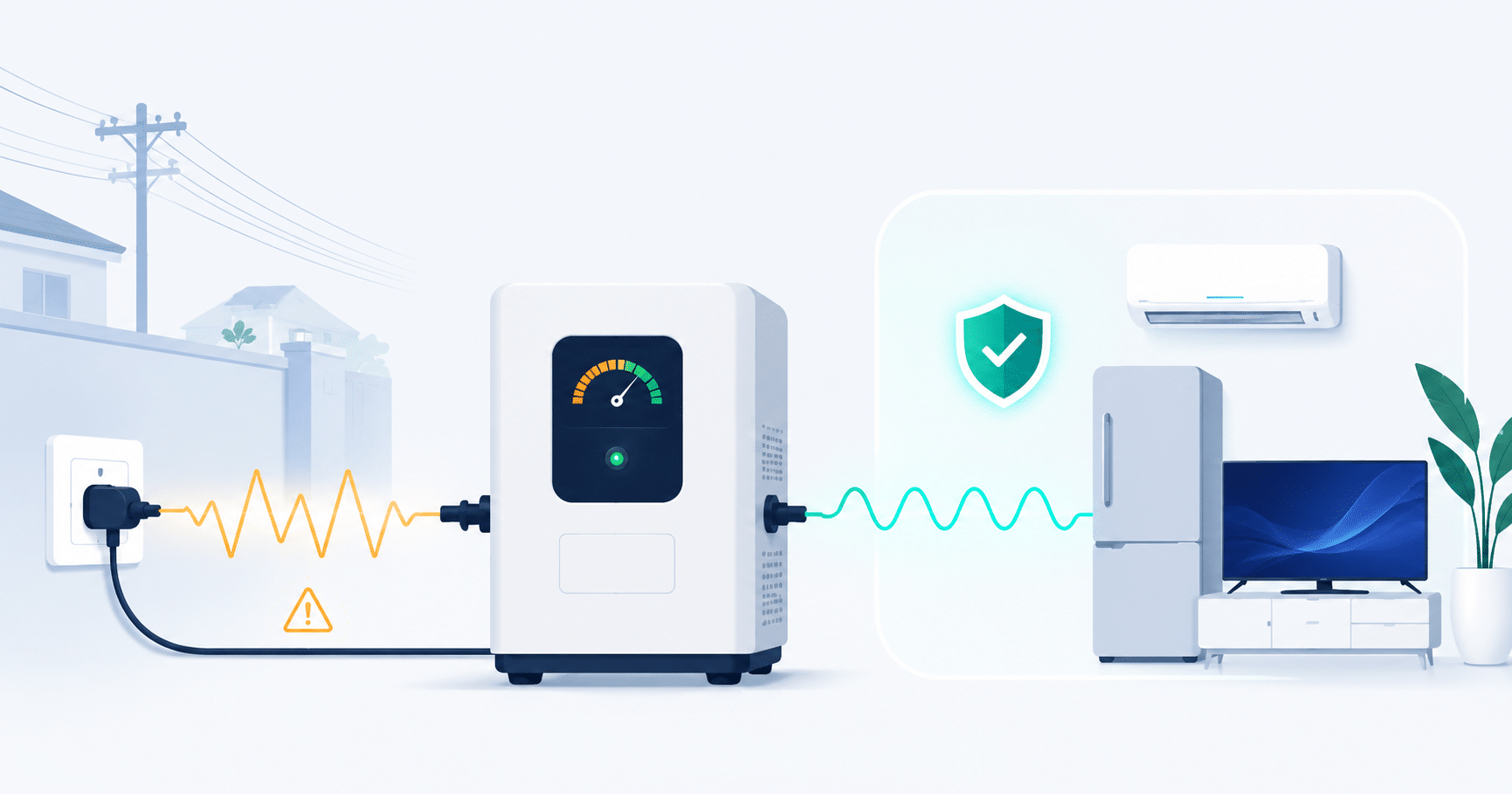
You need a servo stabilizer if you are protecting expensive, sensitive electronics or heavy motorised equipment, and your supply is present but its voltage swings badly and continuously. A servo stabilizer uses a motor-driven variable transformer to correct voltage smoothly and continuously, instead of jumping between fixed taps the way a relay stabilizer does.
Be honest about which problem you actually have. A stabilizer only conditions power that already exists. If your complaint is that NEPA is off for hours at a time, a stabilizer will do nothing for you, and an inverter system is the correct buy. If your supply is reasonably steady but the voltage is wild, the stabilizer is the correct buy. This guide helps you tell the two apart.
What Nigerians commonly call “low current” is actually low voltage. The distinction matters, because a motor starved of voltage can draw more current, not less, and that is exactly what cooks its windings.
The grid comes back at 160V, the compressor in your fridge tries to start anyway, the windings overheat, and three months later you are buying a new fridge. Sound familiar? That is the problem a stabilizer is designed for. The question is whether you need the expensive kind.
WHY NIGERIAN VOLTAGE IS THE REAL APPLIANCE KILLER
Nigeria’s declared standard is 230V phase to neutral with a tolerance of plus or minus 6 percent, so roughly 216V to 244V, as set out in the Nigerian Electricity Supply and Installation Standards Regulations. Plenty of Nigerian homes do not live inside that band.
Weak feeders, overloaded transformers, long service drops and abrupt restoration after an outage all leave customers seeing substantial voltage variation. On a heavily loaded street in the evening, voltage at the far end of a transformer sags badly. Late at night when that load falls away, the same line can sit uncomfortably high.
Both extremes cause damage, in different ways:
- Low voltage (undervoltage) is the worse of the two for anything with a motor. Under load, an induction motor operating at low voltage can draw excessive current, run hotter and damage its insulation. This is why fridges, freezers, air conditioners and water pumps fail so often here.
- High voltage (overvoltage) stresses power supplies and electronics. Televisions, decoders, routers and chargers have a much harder life on a line that regularly sits well above nominal.
- Rapid swinging is what wears out the protection itself. Voltage that hovers right on the edge of a stabilizer’s switching threshold makes cheap relay units click endlessly until the contacts burn.
WHAT A SERVO STABILIZER ACTUALLY DOES
A servo stabilizer is not simply a better relay stabilizer. It works on a different principle.
Inside the unit there is a variable autotransformer, a variac, with a carbon brush riding on its winding. A small servo motor moves that brush. A control circuit measures the output voltage continuously, and when it drifts, the motor drives the brush along the winding, adding or subtracting voltage through a buck-boost transformer. Because the brush can sit anywhere along the winding rather than on one of four or five fixed taps, the correction is continuous rather than stepped.
That is where the high accuracy figure comes from. A properly specified wide-input servo stabilizer can typically hold its output close to 230V across a much wider input range than a conventional relay stabilizer, and it does so without a single audible click.
A relay stabilizer, by contrast, has a handful of fixed transformer taps and a bank of relays that jump between them. Correction is real but coarse, output accuracy is typically in the range of 5 to 10 percent, and every correction involves an audible mechanical relay switching between fixed taps.
One point worth understanding before you compare data sheets. Servo stabilizer speed is quoted in two different ways, and manufacturers are not always clear about which one they mean. Detection or response time is how quickly the control circuit notices an error, and that can be well under 20 milliseconds. Correction rate is how fast the motor can physically move the brush, and it is usually quoted in volts per second, commonly in the region of 20 to 30 V/s. Those are very different numbers. A 50V error is not corrected in 20 milliseconds, because the shaft still has to turn. Always compare correction rate, not response time.
SERVO STABILIZER VS RELAY STABILIZER: WHAT ACTUALLY CHANGES
| Feature | Servo Stabilizer | Relay Stabilizer |
|---|---|---|
| Voltage correction | Smooth and continuous | Coarse, step by step |
| Output accuracy | High, model dependent, often quoted around 1 to 2 percent | Standard, typically 5 to 10 percent |
| Correction speed | Motor driven, specified in volts per second, varies by model | Very fast step change between taps |
| Input range handled | Wider, but check the specific model’s rated input window | Narrower |
| Noise in operation | Quiet, a faint motor hum | Audible clicking on every correction |
| Maintenance | Carbon brush and variac track need periodic service | Relay contacts burn, usually replaced whole |
| Cost and size | Expensive, heavy, bulky | Affordable, compact, wall mounted |
| Best used for | Mainline setups and premium equipment | A single appliance: TV, fridge, AC |
DO I NEED A SERVO STABILIZER? THE HONEST ANSWER
Yes, buy the servo
- High-end medical or industrial equipment. CNC machines, laboratory analysers, imaging equipment, printing presses and commercial refrigeration. These have tight input specifications and replacement costs that dwarf the stabilizer.
- Whole-house or mainline protection. One heavy-duty unit protecting everything behind the distribution board, instead of six separate boxes scattered around the house.
- Constant “in-between” fluctuation. If your voltage sits just outside the safe band all evening, relay stabilizers click nonstop and burn their contacts within months. This is the single clearest case for going servo.
- Sensitive audio and video gear. Premium home theatre, studio monitors and recording equipment.
- Three phase supply with unbalanced phases. A three phase servo stabilizer with independent phase correction handles this. Most relay units cannot.
No, save your money
- One standard household appliance. A correctly rated relay stabilizer is fine for a single fridge, TV or air conditioner, at a fraction of the price.
- Sudden, instantaneous spikes. A servo stabilizer turns a physical shaft. For lightning or switching transients that arrive in microseconds, the motor has barely begun to move. That job belongs to dedicated surge protection at the distribution board, not to a stabilizer.
- Your real problem is outages. Covered below, and this is the case for most Nigerian homes.
- Equipment that already accepts a wide input range. Many modern electronic appliances tolerate a wider voltage range than older equipment, but the acceptable range varies considerably by model. Check the appliance nameplate or manual before assuming it does, or does not, need a stabilizer.
WHAT SIZE SERVO STABILIZER DO I NEED?
Undersizing is the most common and most expensive mistake. A stabilizer that is too small for the connected load will trip, overheat, or fail to hold voltage at exactly the moment the compressor kicks in and the appliance is most vulnerable.
Proper sizing is a six step job, and it is worth doing properly:
- Total the normal running VA of everything the unit will feed, taken from the equipment nameplates rather than from a generic table wherever possible.
- Identify the largest single motor or compressor starting requirement. This is usually your biggest air conditioner or your water pump, and it sets the peak the stabilizer must ride through.
- Decide whether several motors can restart simultaneously after supply is restored. In Nigeria they very often do, because everything comes back at once when NEPA returns.
- Check the manufacturer’s derated capacity at your lowest expected input voltage. Servo stabilizers do not deliver full rated output at the bottom of their input window, and this step is the one most installers skip.
- Add practical operating headroom for the loads you will inevitably add later.
- Move up to the next available standard kVA size.
Quick initial estimate
For a rough first figure before a proper survey, this will get you into the right bracket. Treat it as an initial estimate, not an engineering sizing:
0.8 is a typical power factor for mixed household load.
Then apply steps 2 to 4 above before you actually buy anything.
| Appliance | Running Watts | Start-up Surge | Voltage sensitive? |
|---|---|---|---|
| 1.5HP split air conditioner | 1,200W | Up to 3,600W | Yes, high priority |
| 2HP split air conditioner | 1,500W | Up to 4,500W | Yes, high priority |
| Double door refrigerator | 350W | Up to 1,050W | Yes, high priority |
| Chest freezer, 200L | 250W | Up to 750W | Yes, high priority |
| 1HP water pump | 750W | Up to 2,250W | Yes, high priority |
| Washing machine | 500W | Up to 1,200W | Yes |
| Microwave oven | 1,200W | 1,200W | Yes |
| 55 inch LED television | 120W | 120W | Yes |
| Home theatre system | 200W | 200W | Yes |
| Laptop, router, decoder | 100W | 100W | Check nameplate |
| LED lighting, 12 points | 120W | 120W | No |
Worked example. A three bedroom flat with two 1.5HP air conditioners, a fridge, a freezer, a water pump, a TV and lighting comes to roughly 1,200 + 1,200 + 350 + 250 + 750 + 120 + 120 = 3,990W.
Largest starting requirement: 1.5HP AC at up to 3,600W
Both ACs and the pump can restart together when NEPA returns
Derating at low input voltage reduces usable output further
Realistic answer for this flat: a 10kVA mainline servo stabilizer, not 7.5kVA.
Do not skip step 4, oga. The 5kVA unit that holds fine at 220V input may only manage a fraction of its nameplate rating at 150V input. That is precisely the condition you bought it for. Ask the supplier for the derating curve, and if they cannot produce one, ask somebody else.
Send us your appliance list and we will calculate the correct servo size free of charge. Nameplate photos are ideal. We will tell you the size you need, and we will tell you if a relay stabilizer would do the same job for less. Send your list on WhatsApp.
SERVO STABILIZER VS INVERTER: WHICH PROBLEM ARE YOU SOLVING?
This is the part most stabilizer guides leave out, and it is the part that saves people the most money.
A stabilizer and an inverter are not competitors. They fix different faults:
- A servo stabilizer fixes bad voltage. When supply is present but the voltage is wrong, it corrects it. When supply is off, the stabilizer is a dead metal box.
- An inverter fixes no voltage. It stores energy and supplies your house during outages, and while it is inverting, your appliances receive regulated AC output generated by the inverter itself.
There is an important distinction to understand here, and it is worth being precise about it. Regulating the AC an inverter generates is not the same thing as regulating utility AC while the unit is passing grid power through to the loads. Architectures differ, and in many designs the pass-through path connects the incoming source to the loads fairly directly.
What matters practically is the AC input window. Depending on the Mercury model and how its AC input range is configured, the inverter can reject grid voltage that falls outside its acceptable window and transfer the load to battery and inverter operation, where the appliances receive regulated output. Confirm the input range and transfer behaviour for the specific model you are buying, and we will give you those figures before you order.
So the buying order for a typical Nigerian home is:
- Long outages, and voltage problems too. Buy the inverter system first. Check what a 3.5kVA inverter can power or what a 5.5kVA can carry to match your load.
- Decent supply hours, wild voltage, heavy motor loads. Buy the mainline servo stabilizer. This is the right answer for shops with commercial freezers, clinics, and homes on a bad feeder that still get long supply hours.
- Equipment that can tolerate neither bad voltage nor any interruption. You need both, with the stabilizer upstream of the inverter.
Wondering about the fridge specifically? The most common stabilizer purchase in Nigeria is a small relay unit bought after a fridge compressor died. Read can an inverter carry a fridge before you spend, because the surge maths matters more than the badge on the box.
THE COST MATH: WHAT YOUR GENERATOR MONEY COULD BUY
This section exists for one reason: to show why somebody whose real problem is outages should not spend money solving the wrong problem. A stabilizer will not save you one naira in fuel, because it does not run when the grid is off.
Worked example. We are using a 5kVA-class petrol generator consuming 1.5 litres per hour, run eight hours a day, at ₦1,300 per litre. Actual consumption varies significantly by generator model, age, condition and electrical load. If you know what your generator actually consumes, substitute your own figure.
12 × ₦1,300 = ₦15,600 per day
₦15,600 × 30 = ₦468,000 per month
₦468,000 a month. Every month. Gone into a fuel tank.
Now set that against a representative solar and inverter system at around ₦3.4 million. The exact figure depends on the inverter size, the battery chemistry and how many panels you fit, but as a round number:
Read that figure carefully. It is a simple fuel-offset comparison, not a complete investment-return calculation. It does not account for battery replacement, maintenance, grid charging or the residual value of either asset. It answers one narrow question: how many months of your current petrol spending would add up to the price of the system.
The commercial point is not that solar is free. It is that you are not necessarily finding new money to buy it. In many cases you are redirecting money that is already disappearing every month into a fuel tank towards an asset you still own at the end of it.
Run it with your own numbers
Substitute your own consumption, your own daily hours and today’s pump price. Petrol has been running between roughly ₦1,230 and ₦1,299 per litre across Lagos and Abuja in late August 2026, after Dangote raised its gantry price to ₦1,200 with effect from 26 August, so the ₦1,300 used above is a round figure at the top of that band. Prices move constantly, so use today’s. Our generator running cost guide works through more scenarios.
And note what none of this says about stabilizers. A servo stabilizer would not have saved a single litre of that petrol, because it does nothing at all when the grid is off. That is the whole point of the distinction this article is built on. If your evenings are dark, the stabilizer is not the product you are looking for. If your evenings are merely flickering, it is.
BATTERY CAPACITY IF YOU GO THE INVERTER ROUTE
If you choose the inverter route, battery capacity determines how many hours of backup you get. Runtime depends on battery voltage, Ah capacity, usable depth of discharge, inverter efficiency and your actual load, so there is no single answer that fits every house. Use the Mercury Direct battery runtime calculator for your own appliances. The battery lifespan guide covers how to make a bank last, and which battery is best for an inverter compares the chemistries.
INSTALLATION AND MAINTENANCE NOTES
- Mainline placement. A whole-house servo stabilizer goes between the meter and the distribution board, on its own isolator. It should not sit downstream of an inverter output, since the inverter is already producing regulated voltage and the stabilizer will only add losses and heat.
- Ventilation. Servo units run warm and need clearance on all sides. Do not box one into a cupboard.
- Carbon brush service. Have the brush and variac track inspected every 12 to 18 months. A worn brush causes arcing, and arcing is what turns a stabilizer into a fire risk.
- Add surge protection separately. A servo stabilizer is not lightning protection. Use properly specified surge protection at the distribution board. The appropriate SPD type and its coordination with your earthing depends on the installation and its lightning exposure, and should be selected by a qualified electrician.
- Check the earth and neutral first. A good share of the “voltage fluctuation” complaints we are called out to in Lagos turn out to be a bad neutral connection or a missing earth rod. Fix that before buying anything.
If your inverter is beeping rather than your appliances failing, the problem is usually input voltage or battery state, not the stabilizer. Our guide on why an inverter beeps continuously walks through the causes in order.
DO I NEED A SERVO STABILIZER: THE SHORT VERSION
Buy the servo stabilizer if you are protecting serious equipment, on a mainline, on a feeder whose voltage is bad but present. Buy a relay stabilizer if it is one appliance. Buy neither, and buy an inverter instead, if your evenings are spent in darkness rather than in flicker.
Many Nigerian homes fall into that last group, but not all of them, and we would rather size you the right box than the expensive one. If you are still weighing it up, the Mercury inverter buying guide and why pure sine wave matters cover the same appliances a stabilizer protects. For smaller loads see what a 1.5kVA inverter can power; for larger properties, what an 11kVA can handle. Background on depth of discharge and cycle life is well documented at Battery University.
DO I NEED A SERVO STABILIZER FAQ
Do I need a servo stabilizer for my house in Nigeria?
You need one if your supply is usually present but its voltage swings widely and continuously, and you are protecting either a whole house or expensive equipment. If you only want to protect one fridge, one TV or one air conditioner, a correctly rated relay stabilizer is enough and costs far less. If your supply is off for hours at a time, neither type will help and you need an inverter.
What size servo stabilizer do I need?
Total the running VA from your equipment nameplates, identify the largest motor starting requirement, allow for several motors restarting together when supply returns, then check the manufacturer’s derated capacity at your lowest expected input voltage before choosing a size. A typical three bedroom flat with two air conditioners, a fridge, a freezer and a pump has roughly 5,000 VA of running load and needs a 10kVA mainline servo stabilizer once surge and derating are allowed for. Send us your appliance list and we will size it free.
Is a servo stabilizer better than an inverter?
They solve different problems. A servo stabilizer fixes bad voltage but gives you nothing when supply is off. An inverter fixes no voltage by supplying power during outages, and while inverting it delivers regulated AC output to your appliances. If your main complaint is darkness rather than flicker, buy the inverter system first.
How fast does a servo stabilizer correct voltage?
Faster than people expect to notice, but slower than the marketing figures suggest. Detection can be under 20 milliseconds, but the motor then has to physically move the brush, and that correction rate is typically quoted in the region of 20 to 30 volts per second. Compare correction rate rather than response time when you read data sheets, because they are not the same specification.
Can a servo stabilizer protect against lightning and power surges?
No, and this is an important distinction. A servo stabilizer corrects voltage using a physical motor that turns a shaft, so a lightning strike or switching transient arriving in microseconds will pass straight through. A servo stabilizer is not lightning protection. Use properly specified surge protection at the distribution board, with the SPD type selected by a qualified electrician to suit the installation and its lightning exposure.
Why does my relay stabilizer keep clicking and cutting?
Constant clicking means your voltage is hovering right on the edge of the stabilizer’s switching threshold, so the relays keep flipping between taps. Every click wears the contacts, and burnt relay contacts are a very common stabilizer failure. This is the exact symptom that justifies moving to a servo stabilizer, or to an inverter that disconnects from the grid entirely when input is out of range.
WHICH ONE DO YOU ACTUALLY NEED?
Supply is usually on, but the voltage is bad
Lights dimming and surging, stabilizers clicking constantly, motors and compressors failing, but you do get long supply hours.
You need a mainline servo stabilizer, 10kVA and above.
Supply is off for hours at a time
You are running a generator most evenings, or sitting in darkness. Voltage quality is a secondary annoyance.
You need an inverter system, not a stabilizer.
Not Sure Which One You Need? Ask Us.
Send your appliance list and your typical supply hours. We will tell you honestly which one solves your problem, and we will say so even when the answer is the cheaper option. Fire your generator, not your staff.
Call 07037451701 | Nationwide delivery and installation across Nigeria