
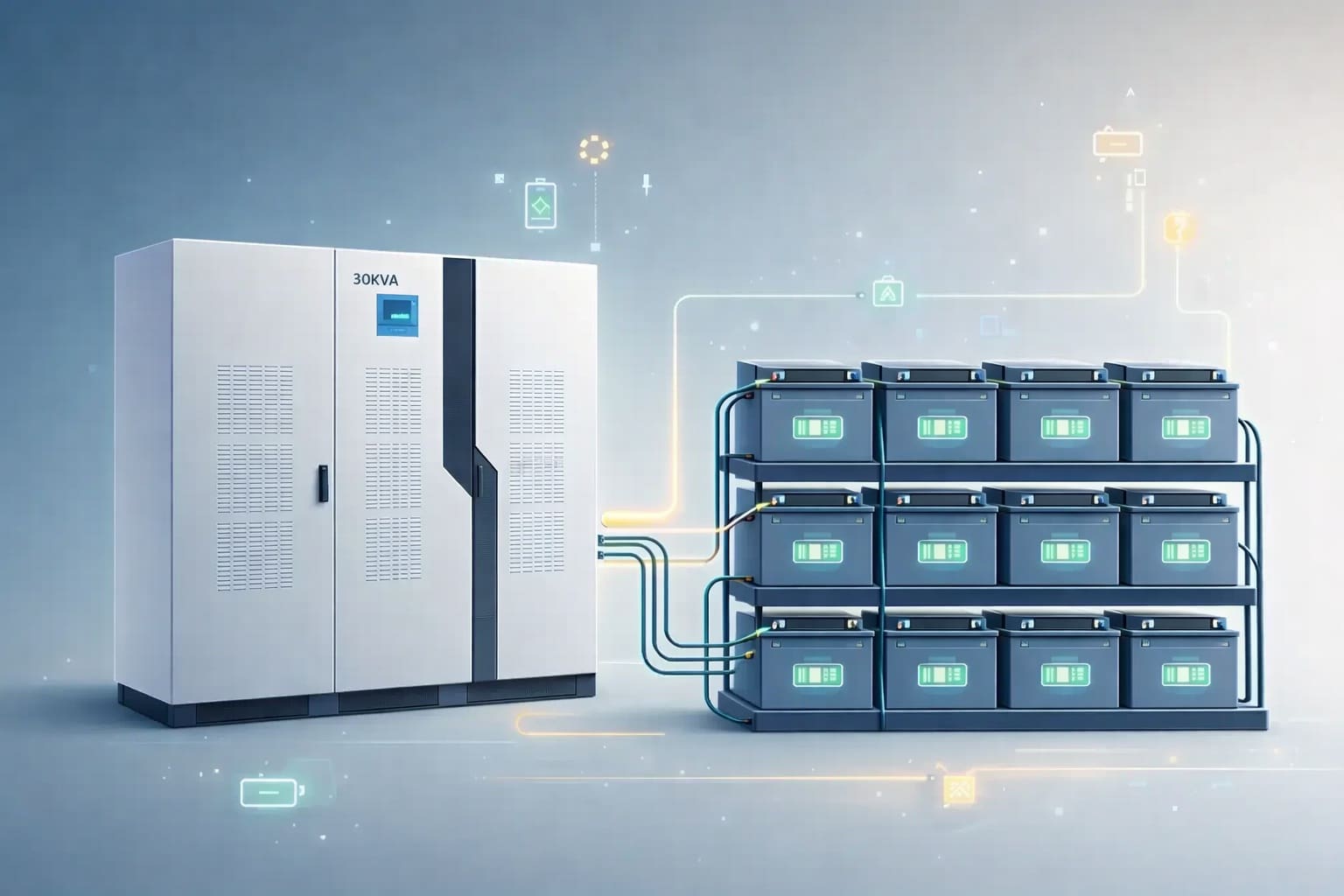
HOW MANY BATTERIES FOR 30KVA INVERTER
The Mercury 30kVA Online UPS uses a 384V DC battery system, so the minimum is 32 matching 12V batteries wired in series. In many commercial installations, that 32-battery bank is enough to run critical loads like a lift, but backup time depends on the actual battery capacity, site load, and how much of the building the system is carrying. Where longer runtime is required for ACs, pumps, hotel circuits, or broader commercial loads, 64 batteries (two parallel strings) may be the more practical configuration. The biggest mistake businesses make is assuming the minimum battery count automatically means long backup time for the entire site.
UNDERSTANDING 30KVA BATTERY REQUIREMENTS
If you are running a hotel, factory, supermarket, or large office in Nigeria, you already know that NEPA is not coming to save you. A 30kVA inverter is a serious piece of commercial equipment, and the battery bank behind it is what determines whether you get two hours of backup or eight. Don’t skip this section, oga.
Unlike residential inverters that run on 12V, 24V, or 48V systems, a 30kVA commercial inverter operates at a much higher DC voltage. The standard configuration is 384V DC, requiring 32 x 12V batteries wired in series. Some models support 192V (16 batteries), but this is less common for 3-phase units. Always verify your inverter’s specification sheet before purchasing batteries.
30kVA Inverter Core Specifications
| Specification | Details |
|---|---|
| Rated Power | 30,000VA / 27,000W (PF 0.9) to 30,000W (PF 1.0) |
| Battery Voltage | 384V DC (32 x 12V batteries) |
| Input/Output Voltage | 3-Phase 380/400VAC |
| Efficiency | >93% |
| Power Factor | 0.9 to 1.0 |
| Surge Capacity | 2x continuous (60kVA peak) |
WHAT DOES A 30KVA COMMERCIAL LOAD LOOK LIKE?
Before you size your battery bank, you need to know exactly what the inverter will carry. Here is a typical commercial load analysis for a medium-sized business premises in Lagos or Abuja:
| Appliance | Watts | Qty | Duty Cycle | Effective Watts |
|---|---|---|---|---|
| Split AC (2HP) | 1,800 | 6 | 60% | 6,480 |
| Central AC / Package Unit | 5,000 | 1 | 60% | 3,000 |
| Lighting (LED) | 40 | 50 | 100% | 2,000 |
| Desktop Computers | 200 | 15 | 80% | 2,400 |
| Printer / Copier | 800 | 2 | 30% | 480 |
| CCTV System | 150 | 1 | 100% | 150 |
| Water Pump (1HP) | 750 | 1 | 30% | 225 |
| Refrigerator / Freezer | 250 | 3 | 40% | 300 |
| Misc. (fans, chargers, POS) | 100 | 10 | 80% | 800 |
| Total Effective Load | 15,835W |
This example gives us roughly 16kW effective load. Your actual load could be 10kW for a small office complex or 25kW+ for a hotel or factory floor. Use our battery runtime calculator to work out your exact numbers.
BATTERY CONFIGURATIONS FOR 30KVA SYSTEMS
| Configuration | Batteries | Usable AC Energy (80% DoD, 85% eff) | Estimated Runtime at 15kW | Application |
|---|---|---|---|---|
| Minimum (200Ah) | 32 x 200Ah | 52.2 kWh | 2.8–3.5 hours | Medium commercial |
| Standard (2 strings) | 64 x 200Ah | 104.4 kWh | 6–7 hours | Large commercial |
| Heavy Duty (3 strings) | 96 x 200Ah | 156.6 kWh | 9–10 hours | Industrial / hotel |
HOW MANY BATTERIES FOR 30KVA INVERTER: THE FORMULA
Here is the exact formula used to calculate backup hours for any battery bank. This is the same calculation professional inverter installers use:
Backup Hours = (Battery Voltage x Ah x DoD x Efficiency) / Load in Watts
Worked Example: 32 x 200Ah at 15kW Load
- Battery Voltage: 384V (32 batteries x 12V)
- Capacity: 200Ah
- Depth of Discharge (DoD): 80% for GEL/tubular (50% for standard lead-acid, 80 to 95% for lithium LiFePO4)
- Inverter Efficiency: 85%
- Load: 15,000W
Calculation: (384 x 200 x 0.80 x 0.85) / 15,000 = 3.5 hours
In practice, expect slightly less due to cable losses, battery age, and temperature. A safe estimate for a 32-battery bank at 15kW is roughly 2.8 to 3.5 hours. For more on battery care and maximising that runtime, read our guide on how to increase inverter battery lifespan.
Runtime Quick Reference (32 x 200Ah)
| Load (kW) | Theoretical Hours | Practical Hours |
|---|---|---|
| 10kW | 5.2 | 4.2 |
| 15kW | 3.5 | 2.8 |
| 20kW | 2.6 | 2.1 |
| 25kW | 2.1 | 1.7 |
BATTERY COST COMPARISON FOR 30KVA SYSTEMS
| Battery Type | Unit Price (₦) | Cost for 32 (₦) | Lifespan | Best For |
|---|---|---|---|---|
| GEL 200Ah | ₦380,000 to ₦420,000 | ₦12.2M to ₦13.4M | 5 to 7 years | Maintenance-free reliability |
| Tubular 220Ah | ₦280,000 to ₦310,000 | ₦9.0M to ₦9.9M | 4 to 5 years | Budget commercial |
| LiFePO4 (100kWh system) | System pricing | ₦25M to ₦40M | 10 to 15 years | Long-term / solar hybrid |
| 2V Industrial Cells (192 cells) | ₦70,000 to ₦120,000/cell | ₦13.4M to ₦23.0M | 8 to 12 years | Maximum reliability |
For most Nigerian businesses, GEL batteries offer the best balance of cost and maintenance. Tubular batteries are cheaper upfront but need regular topping with distilled water. Lithium pays for itself over 10+ years if paired with solar. Read our battery comparison guide for the full breakdown.
TOTAL SYSTEM PRICING
| Configuration | Price Range (₦) | Includes |
|---|---|---|
| 30kVA + 32 tubular + installation | ₦15,000,000 to ₦17,000,000 | Inverter, batteries, cabling, changeover, commissioning |
| 30kVA + 32 GEL + installation | ₦18,000,000 to ₦20,000,000 | Inverter, batteries, battery rack, cabling, changeover |
| 30kVA + lithium + solar (premium) | ₦35,000,000 to ₦50,000,000 | Inverter, lithium bank, 18kW+ solar array, full installation |
GENERATOR VS 30KVA INVERTER: COST COMPARISON
Here is the question every business owner in Nigeria should be asking right now: at what point does running a generator cost more than installing a 30kVA inverter system? With petrol at ₦1,255 per litre in Lagos and diesel above ₦1,750 per litre (April 2026), the answer might surprise you.
A typical 30kVA diesel generator consumes 5 to 8 litres per hour depending on load. Let us compare running costs over 12 months:
| Cost Factor | 30kVA Diesel Generator | 30kVA Inverter (GEL) |
|---|---|---|
| Equipment Cost | ₦5,000,000 to ₦8,000,000 | ₦18,000,000 to ₦20,000,000 |
| Fuel / Electricity (monthly) | ₦1,050,000 to ₦1,680,000 | ₦80,000 to ₦150,000 (PHCN charging) |
| Maintenance (monthly) | ₦80,000 to ₦150,000 | ₦10,000 to ₦20,000 |
| Annual Running Cost | ₦13,560,000 to ₦21,960,000 | ₦1,080,000 to ₦2,040,000 |
| 5-Year Total Cost | ₦72,800,000 to ₦117,800,000 | ₦23,400,000 to ₦30,200,000 |
Fuel calculation: Generator running 8 hours/day x 6L/hr x ₦1,750/litre (diesel, April 2026) x 25 days/month = ₦1,050,000 to ₦1,680,000/month depending on load. Petrol generators cost even more at ₦1,255/litre (April 2026).
The maths is brutal. A diesel generator that costs ₦5M upfront will burn through ₦13M to ₦22M per year in fuel and maintenance alone. The inverter system pays for itself within 12 to 18 months. After that, your savings compound every single month. That is money you can put back into your business instead of pouring it into a fuel tank.
For a detailed breakdown of generator running costs, see our full analysis: Inverter Buying Guide Nigeria 2026.
INSTALLATION REQUIREMENTS FOR 30KVA BATTERY BANKS
A 30kVA system is not a plug-and-play residential setup. This is commercial-grade equipment that requires professional installation. Typical 30kVA installations often require heavy-gauge DC cabling, correctly rated breakers, proper ventilation, earthing, and in some cases dedicated battery-room safety measures. Final specs depend on inverter model, battery chemistry, and site design.
Here is what most commercial sites will need to plan for:
- Battery Room: Approximately 16m² floor space with adequate ventilation for lead-acid banks, or climate-controlled environments for lithium. Temperature management typically ranges 20–30°C depending on chemistry.
- DC Cabling: Heavy-gauge copper conductors sized for the inverter’s maximum DC current draw. Undersized cables cause voltage drop, overheating, and reduced efficiency.
- DC Protection: Properly rated DC breakers or fuses with arc-flash protection appropriate to the system voltage and current.
- Flooring: Acid-resistant epoxy coating recommended if using wet/tubular cells. GEL and lithium batteries have more flexible placement requirements.
- Safety Systems: Fire suppression and gas detection may be required for lithium installations, and are recommended for all large commercial battery rooms.
- Earthing: Proper earth bonding per NERC and Nigerian Electrical Installation Standards.
For wiring guidance, read our step-by-step guide on how to connect inverter to battery. If you are adding solar panels, our solar panel connection guide covers the full process.
SOLAR INTEGRATION FOR 30KVA SYSTEMS
Solar is where the real long-term savings happen for a 30kVA system. With the right panel array, your batteries charge for free during the day, and you only draw from them at night or during heavy cloud cover.
| Solar Array Size | Panels (450W) | Daily Generation (Lagos) | Purpose |
|---|---|---|---|
| Basic (18kW) | 40 panels | 72 to 90 kWh | Battery charging + light daytime loads |
| Recommended (27kW) | 60 panels | 108 to 135 kWh | Substantial grid independence |
| Full Independence (36kW+) | 80+ panels | 144 to 180 kWh | Near-complete off-grid operation |
Lagos gets 4 to 5 peak sun hours daily. With 60 x 450W panels, you generate 108 to 135kWh per day, enough to run your 15kW load during daytime and fully charge a 32-battery bank. Read our monocrystalline vs polycrystalline guide to choose the right panels for your roof.
HOW MANY BATTERIES FOR 30KVA INVERTER FAQ
Can I start with 16 batteries for a 30kVA system?
Only if your inverter supports 192V operation. Most 30kVA 3-phase inverters require 384V (32 batteries). Starting with 16 batteries on a 384V system will not power the inverter at all. Always verify your inverter specifications before purchase.
How long will 32 batteries last on a 30kVA inverter?
At 80% DoD and 85% efficiency with 32 x 200Ah batteries: 10kW load gives about 4.2 hours, 15kW gives about 2.8 hours, 20kW gives about 2.1 hours, and 25kW gives about 1.7 hours. Use our battery runtime calculator for your exact load.
What is the total cost for a 30kVA commercial setup?
Budget (32 tubular): ₦15,000,000 to ₦17,000,000. Standard (32 GEL): ₦18,000,000 to ₦20,000,000. Premium (lithium + solar): ₦35,000,000 to ₦50,000,000. All prices include inverter, batteries, cabling, and professional installation.
Can I use 2V tubular cells instead of 12V batteries?
Yes. 192 cells of 2V in series achieve 384V. Industrial 2V cells offer higher capacity (1,000Ah+), fewer connection points, and better long-term reliability. Cost is comparable to 12V batteries but lifespan is typically 8 to 12 years.
What solar array size for a 30kVA system?
Minimum: 40 x 450W panels (18kW) for charging plus light loads. Recommended: 60 x 450W (27kW) for substantial grid independence. See our solar panel guide for panel selection and sizing details.
How much space does a 30kVA battery bank need?
A 32-battery bank needs approximately 16m² floor space with adequate ventilation, temperature control (20 to 25°C optimal), and acid-resistant flooring if using wet cells. GEL and lithium batteries are more flexible on placement.
FIRE YOUR GENERATOR, NOT YOUR STAFF
At ₦1,750/litre diesel (April 2026), your generator is bleeding your business dry. Mercury Direct designs, supplies, and installs complete 30kVA commercial power systems across Nigeria. From deep cycle batteries to full solar arrays, we handle everything. Call 0703 745 1701 or chat on WhatsApp with your appliance list and backup target for a free site survey.
Request Commercial Quote →