
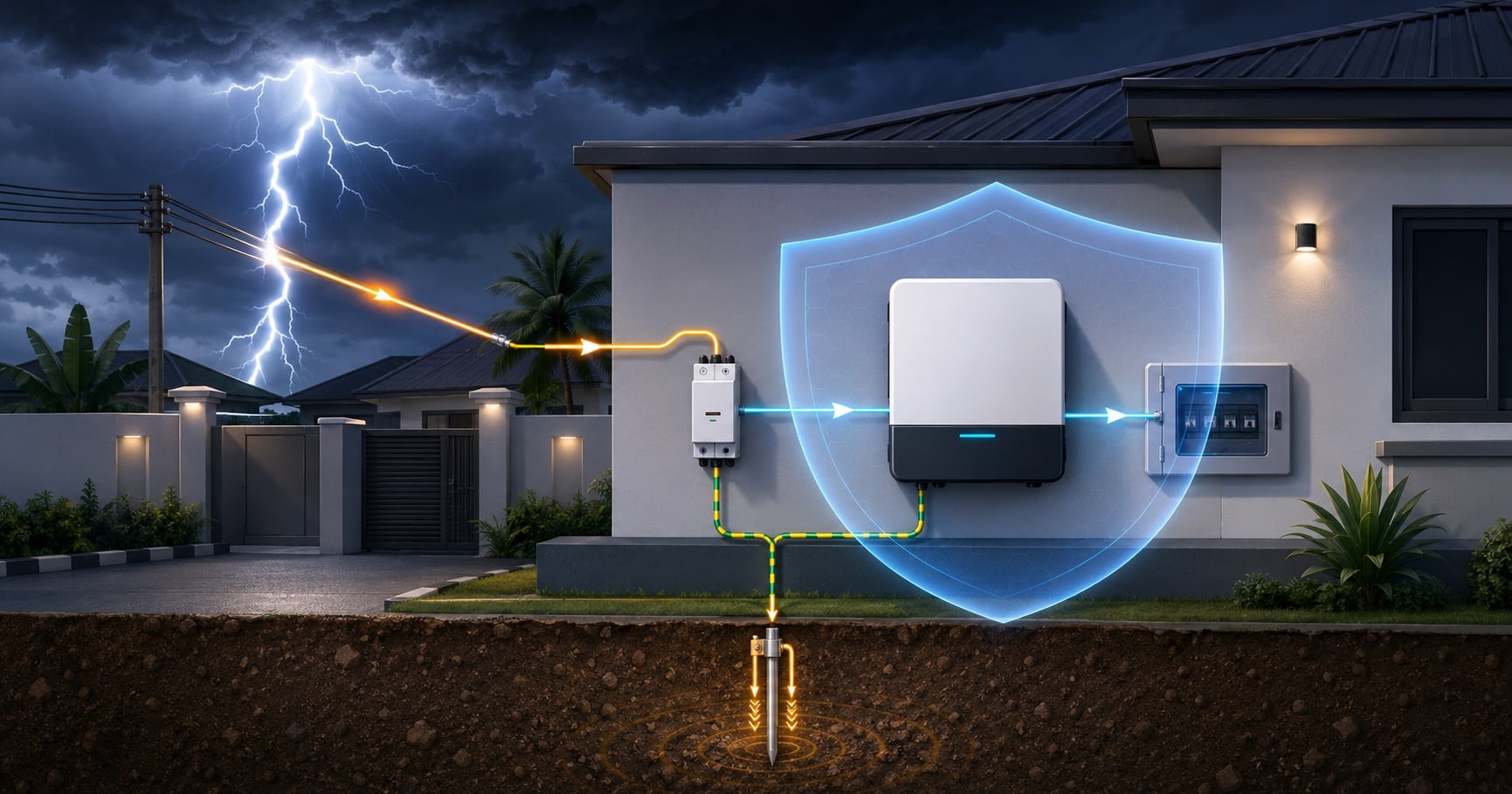
HOW TO PROTECT YOUR INVERTER FROM LIGHTNING IN NIGERIA
To protect your inverter from lightning, install correctly rated surge protection devices on both the AC and solar DC sides, connect them to a properly designed and bonded earthing system, and add an external lightning protection system where a professional risk assessment requires one. No single “thunder arrester” or SPD gives 100% protection, but these coordinated layers can substantially reduce the risk of inverter damage, fire and electric shock. If you are buying a new system, begin with a correctly sized Mercury inverter and include surge protection in the installation specification.
An inverter can be damaged by a surge from the utility grid, a nearby lightning strike or, in the worst case, a direct strike to the building or solar array. That is why you must protect your inverter from lightning on every route a surge can travel. Buying a good inverter helps, but no inverter brand can make a poorly protected installation safe.
Here is the thing: a lightning rod and an SPD do different jobs. The rod is intended to intercept a strike and conduct lightning current towards earth. An SPD limits a short voltage surge on a cable. Depending on the site, you may need both, together with correct bonding and earthing.
HOW TO PROTECT YOUR INVERTER FROM LIGHTNING
The protection must cover every route by which a surge can enter the inverter. That normally means the utility AC supply, solar DC cables and any communication or control cables. Protection should be coordinated rather than assembled from unrelated parts.
| Protection layer | Normal location | Main job | What it does not replace |
|---|---|---|---|
| External lightning protection | Building roof and exterior | Intercepts a strike and conducts lightning current towards earth | AC, DC and data-line SPDs |
| Type 1 or Type 1+2 AC SPD | Installation origin where required | Handles lightning current entering the electrical installation | Downstream protection and correct bonding |
| Type 2 AC SPD | Distribution board or close to inverter | Limits induced lightning and switching surges | External lightning protection where required |
| PV-rated DC SPD | Solar array, combiner or inverter DC input | Limits surges arriving through solar cables | Correct string design and DC isolation |
| Bonding and earthing | Throughout the installation | Controls dangerous voltage differences and provides a surge-current path | Correct SPD selection |
Important: A circuit breaker protects mainly against overcurrent and short circuit. An RCD protects mainly against electric shock caused by leakage current. Neither one replaces an SPD. Read our guide to why circuit breakers do not prevent every inverter failure.
1. EXTERNAL LIGHTNING PROTECTION
An external lightning protection system may include air terminals, down-conductors, bonding and an earth-termination network. It should be selected after a risk assessment and designed using IEC 62305 principles.
A rod should not simply be fixed at the highest point and connected to any available earth rod. The protected zone, conductor routes, number of down-conductors, separation distance from the solar array, joints and earth-termination system all matter.
If the required separation distance between the lightning protection system and the solar installation is not maintained, lightning current can flash across to panel frames or cables. This can increase danger instead of reducing it. A qualified lightning-protection professional should design the solution.
Not every house automatically requires an external system. Building height, location, occupancy, construction, surrounding structures, incoming services and lightning exposure should guide the decision. For broader planning, see our facts to know before going solar.
2. SOLAR DC SURGE PROTECTION
Solar cables run outdoors and can carry an induced surge directly to the inverter’s MPPT input. A PV-rated DC SPD should therefore be considered on each relevant DC input or combiner arrangement.
- String voltage: The SPD must suit the maximum open-circuit voltage of the complete solar string, including temperature effects.
- System topology: Selection must match the inverter’s DC arrangement, polarity and earthing design.
- Lightning exposure: The device type depends partly on whether direct lightning current can enter the PV wiring.
- Protection level: Check the voltage-protection level and discharge-current ratings, not only the large kA number printed on the front.
- Cable length: Long runs may require coordinated protection at both the array and inverter ends.
A 500 V or 1,000 V label alone does not prove that a device is correct for a particular inverter. Where an external lightning protection system is present and lightning current can enter the PV wiring, a coordinated Type 1+2 PV SPD may be required. Where separation is maintained and only induced surges are expected, Type 2 PV SPDs may be appropriate. The site design and equipment instructions must decide.
For correct panel-string planning, read how many solar panels a 5.5kVA inverter can accept. Panel quantity and wiring affect the DC voltage the protection device must withstand.
3. AC SURGE PROTECTION
The inverter is also exposed through its AC input, AC output and the building’s distribution system.
- Type 1 or Type 1+2 SPD: Normally considered at the installation origin where lightning current may enter, especially where the building has an external lightning protection system or an exposed overhead supply.
- Type 2 SPD: Normally installed at a distribution board to limit induced lightning and switching surges.
- Type 3 SPD: Used close to sensitive equipment as part of a coordinated system. It should not be the building’s only protection.
Where the inverter is some distance from the main distribution board, an additional coordinated SPD may be needed close to it. The AC SPD must match the supply voltage, phase arrangement, earthing system and available fault current. It must also have the backup breaker or fuse specified by its manufacturer.
You can view the Mercury Direct surge protector range, but do not select an SPD by price or kA rating alone. A qualified installer must match it to the site, supply, earthing arrangement and inverter.
Our seven inverter installation tips explain why protection, cable routing and commissioning should be treated as part of the system rather than optional extras.
4. EARTHING AND EQUIPOTENTIAL BONDING
An SPD does not make a surge disappear. It diverts current while limiting the voltage seen by the equipment. For that to work, the protective conductors, bonding network and earth-termination system must be correctly designed and connected.
Do not create unrelated earth pits for the grid, inverter, solar panels and lightning rod without an engineered design. During a lightning event, separate earths can rise to different voltages and create a dangerous flashover path through the inverter or building wiring. The installation should use coordinated equipotential bonding.
Earth resistance should be measured with the correct instrument and method, but one number is not proof that the complete system is safe. The required value depends on the installation design, soil conditions, protective devices and applicable rules. Continuity, conductor size, joints, corrosion protection and seasonal variation also matter.
Ask for documented test results, not a bucket-of-water demonstration. Pouring water around an earth rod can temporarily change a reading. It does not prove that the earthing system is correctly designed or durable. If an inverter casing gives you a shock, follow the immediate safety steps in our inverter casing shock guide.
5. PROTECT EVERY CONDUCTIVE ROUTE
Lightning surges do not enter only through power cables. Check every conductive connection to the inverter and the equipment around it.
- Networking: Ethernet, Starlink and other internet cables
- Battery communication: RS485, CAN and monitoring cables
- Security systems: CCTV, satellite, gate, intercom and alarm cables
- Generator controls: Auto-start, changeover and remote-control wiring
- Metal services: Pipes and structural metalwork that the design requires to be bonded
A surge can bypass well-protected AC and DC connections through one unprotected communication cable. Use correctly selected data-line SPDs or fibre isolation where appropriate.
HOW TO CHECK YOUR INVERTER PROTECTION
Do not settle for “we installed a thunder arrester.” Ask the installer to show you the design decisions and test evidence.
- Risk decision: The basis for deciding whether the building needs external lightning protection
- Device identity: The make, model and datasheet of every AC, DC and data-line SPD
- DC calculation: Evidence that the PV SPD suits the calculated maximum solar-string voltage
- SPD class: Confirmation of Type 1, Type 1+2, Type 2 or Type 3 and why it was selected
- Backup protection: The manufacturer-specified breaker or fuse for each SPD
- Connections: Short, direct SPD leads without unnecessary loops
- Bonding: Correct bonding of panel frames, enclosures and other required metalwork
- Test record: Dated earthing and continuity results with the instrument and test method identified
- Maintenance: A clear method for identifying and replacing failed SPD cartridges
For installation fundamentals, see how to install an inverter safely. In Nigeria, electrical installation work should be handled by qualified personnel, and NEMSA states that electrical technical personnel must be certified.
WARNING SIGNS OF A POOR INSTALLATION
- No documentation: A “lightning protector” has no recognisable manufacturer, datasheet or standard.
- Wrong application: An AC SPD has been fitted to a solar DC circuit.
- No voltage calculation: The DC SPD was chosen without calculating maximum solar-string voltage.
- Poor lead routing: SPD earth leads are long, coiled or sharply bent.
- Questionable materials: Copper-clad aluminium is passed off as solid copper, or painted iron is sold as a copper-bonded earth electrode.
- Separate earths: Several unbonded earth rods have been installed without a system design.
- One-sided protection: The installation protects only AC or only solar DC.
- Impossible promise: The installer describes the system as “100% lightning-proof.”
WHAT TO DO DURING A THUNDERSTORM
Do not go onto the roof, touch outdoor electrical equipment or attempt to disconnect live solar DC cables during a storm.
Switching off an inverter does not isolate every possible lightning path, and solar cables remain energised whenever panels receive light. If equipment must be disconnected, it should be done safely before the storm by someone who understands the installation. A permanent, correctly designed protection system is safer than last-minute manual action.
After a severe storm, check the system only when conditions are safe. If an SPD shows a red or failed status, the inverter reports a fault, there is a burning smell, or breakers trip repeatedly, keep the affected circuit isolated and call a qualified technician. Our inverter FAQ covers other common inverter warning signs.
COST TO PROTECT YOUR INVERTER FROM LIGHTNING IN NIGERIA
There is no honest single price. The scope can range from adding coordinated SPDs to designing a complete lightning protection system for a multi-storey building.
| Planning scope | Typical inclusions | Broad July 2026 range |
|---|---|---|
| Inverter-focused protection | Selected AC/DC SPDs, enclosures, backup protection, bonding corrections, earthing work and testing | ₦250,000 to ₦600,000 |
| Complete external and internal project | Site-specific air termination, down-conductors, earth termination, bonding, coordinated SPDs and testing | ₦700,000 to ₦1.8 million or more |
Planning figures, not quotations: Building height and shape, soil conditions, cable distances, solar-string count, supply phase, material quality, access equipment and testing can move the price substantially. A ₦15,000 rooftop rod is one component, not a designed, installed and tested protection system.
If you are still choosing the inverter itself, our best inverter for home in Nigeria guide explains how to match capacity to the actual load before protection accessories are specified.
MORE MERCURY DIRECT SAFETY GUIDES
- Before buying: Use the Mercury Direct inverter buying guide to avoid undersizing and mismatched batteries.
- Before installation: Read ten facts to know before going solar.
- During installation: Follow the Mercury inverter installation checklist.
- If something goes wrong: Start with the Mercury Direct inverter FAQ.
TECHNICAL REFERENCES
This guide is based on coordinated lightning and surge protection principles described by the following sources:
- IEC 62305-2:2024: Lightning risk management
- IEC 62305-3:2024: Physical protection of structures
- IEC 62305-4:2024: Protection of electrical and electronic systems
- IEC 61643-32:2017: Selection and coordination of SPDs for photovoltaic systems
- Schneider Electric: How surge protection devices work
- DEHN: Lightning and surge protection for rooftop PV systems
- NEMSA: Certification requirements for electrical technical personnel
PROTECT YOUR INVERTER FROM LIGHTNING FAQ
Can an SPD save an inverter from a direct lightning strike?
An SPD can form part of a system designed to carry and limit lightning current, but no standalone SPD guarantees that an inverter will survive a direct strike. Direct-strike protection requires coordinated external lightning protection, bonding, earthing and correctly selected Type 1 or Type 1+2 protection where applicable.
Is an SPD useless without a lightning rod?
No. An SPD can still reduce damage from indirect lightning and electrical switching surges. It needs correct selection, short connections, proper bonding and an effective earthing system.
Is a lightning rod enough on its own?
No. A properly designed lightning rod system helps protect the structure, but surges can still reach electronics through utility, solar and communication cables. Internal surge protection is also required where the design calls for it.
Will a circuit breaker stop a lightning surge?
No. A circuit breaker protects mainly against overcurrent and short circuit. An SPD is designed to respond to a very brief overvoltage surge. Both may be required, but they perform different jobs.
Should an SPD be replaced after a lightning storm?
Inspect the status indicator after a major storm and during routine maintenance. Replace any module showing failure or end of life and follow the manufacturer’s instructions. SPDs are sacrificial components and do not last forever.
PROTECT YOUR INVERTER BEFORE THE NEXT STORM
Need help reviewing the protection around your inverter or selecting a properly sized Mercury inverter system? Review the Mercury Direct surge protector range, then send us your location, inverter model, solar-array details and clear photographs of the inverter area and distribution boards. Call 07037451701 or use WhatsApp.
Disclaimer: This article provides general educational information. Lightning protection, earthing and electrical work should be designed, installed and tested by qualified professionals for the specific site.