
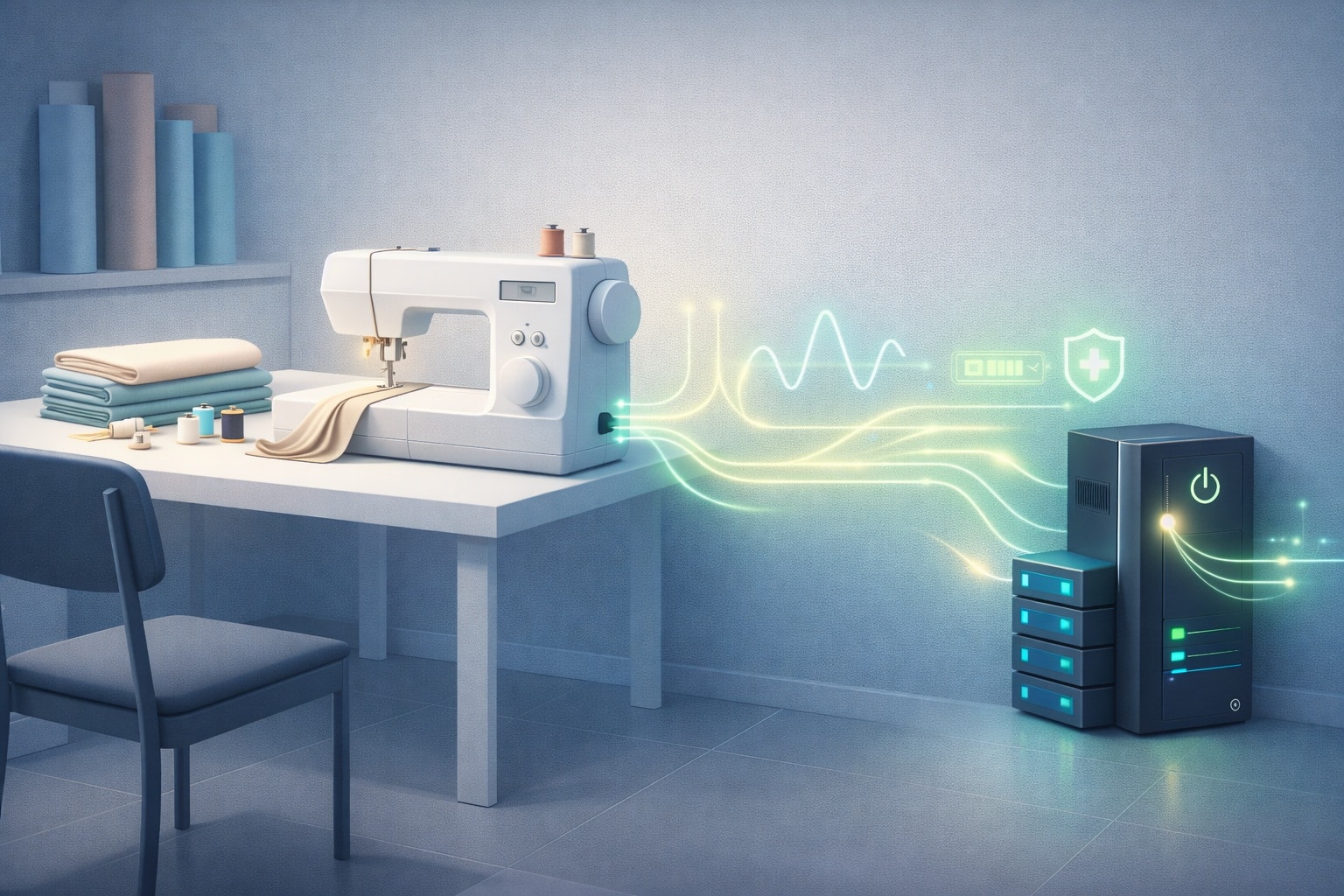
INVERTER FOR SEWING MACHINE
For a single domestic or industrial sewing machine, the Mercury 1.5kVA Hybrid Solar Inverter handles it with room to spare. Running 2 to 3 machines with lights, fans, and a TV? The Mercury 2.4kVA Complete System is the sweet spot for small to medium tailoring shops. For larger studios with industrial machines plus a fridge and AC, step up to the Mercury 3.5kVA. Always use a pure sine wave inverter if your machine has electronic controls or a computerised panel.
WHY TAILORS AND FASHION DESIGNERS NEED AN INVERTER
If you run a tailoring shop or fashion design studio in Nigeria, you know the drill. You’re in the middle of a rush order, aso ebi deadline in two days, and NEPA takes the light. The generator takes 5 minutes to start, fills the shop with fumes, and drowns out your phone calls with noise. Meanwhile your apprentices are sitting idle and the client is calling for updates.
An inverter for sewing machine use solves this completely. It switches on automatically (under 10 milliseconds, you won’t even notice), runs silently, produces no fumes, and costs a fraction of what you spend on generator fuel. For a sewing business where productivity is measured in garments per day, every minute of downtime during an outage costs you money. An inverter eliminates that downtime entirely.
SEWING MACHINE POWER CONSUMPTION BY TYPE
Before you choose an inverter, you need to know how much power your machines actually draw. Sewing machines vary enormously depending on whether they’re domestic, computerised, or industrial. Here’s a breakdown:
| Machine Type | Running Watts | Startup Surge | Motor Type | Pure Sine Wave Required? |
|---|---|---|---|---|
| Domestic / home sewing machine | 50 to 100W | 150 to 300W | AC motor (small) | Recommended |
| Computerised / embroidery machine | 75 to 150W | 200 to 400W | Servo + electronics | Required |
| Industrial straight-stitch | 250 to 400W | 500 to 800W | Servo or clutch motor | Recommended |
| Industrial overlock / serger | 300 to 500W | 600 to 1,000W | Servo motor | Recommended |
| Heavy-duty industrial (embroidery, multi-needle) | 500 to 1,200W | 1,000 to 2,500W | Servo + control board | Required |
Servo motors vs. clutch motors: If your industrial machine has the older-style clutch motor, it draws more power and runs at full speed regardless of your sewing speed. Servo motors (the standard on newer machines) only draw power proportional to how fast you’re sewing, which means dramatically lower average power consumption and longer battery runtime. If you’re buying a new industrial machine, insist on a servo motor.
Why pure sine wave matters for sewing: Any sewing machine with electronic controls, a computerised panel, an automatic thread cutter, or a servo motor should only run on pure sine wave power. Modified sine wave causes the motor to hum, run unevenly, overheat, and can damage the control board. For older mechanical machines with basic clutch motors and a foot pedal (no electronics), modified sine wave technically works, but pure sine wave is always the safer choice. All Mercury Hybrid inverters produce pure sine wave output.
TOTAL LOAD ANALYSIS: YOUR SEWING SHOP
Nobody runs just a sewing machine. A typical tailoring shop also has lights, fans, a TV or radio, phone chargers, and possibly an iron or a pressing machine. Here’s a realistic load table for three common shop sizes:
| Appliance | Watts | Small Shop (1 machine) | Medium Studio (2 to 3 machines) | Large Studio (4+ machines) |
|---|---|---|---|---|
| Sewing machine (industrial, servo) | 300 to 400W | 1 | 2 to 3 | 4 to 6 |
| LED lights (9W each) | 9W | 3 | 5 | 8 |
| Ceiling fan | 65W | 1 | 2 | 3 |
| TV / radio | 60W | 1 | 1 | 1 |
| Phone chargers | 10W | 2 | 3 | 4 |
| Steam iron (intermittent) | 1,000 to 2,000W | 0 | 0 to 1 | 1 |
| Total running load (no iron) | ~500W | ~1,000 to 1,500W | ~2,000 to 2,800W |
Important note about irons: A steam pressing iron draws 1,000 to 2,000W and should not run on inverter battery power unless you have a very large system (5.5kVA+). For most tailoring shops, use the iron only when grid power or solar is available, and reserve your inverter batteries for the sewing machines, lights, and fans. This is common practice and keeps your battery runtime high.
RECOMMENDED MERCURY INVERTER FOR SEWING MACHINE USE
| Your Setup | Recommended System | Why This Size | Price |
|---|---|---|---|
| 1 machine + basics Single domestic or industrial machine + lights + fan + TV | Mercury 1.5kVA Hybrid Solar + 1x200Ah battery (12V) | 1,500W continuous output. Handles one sewing machine plus shop essentials comfortably. See 1.5kVA load guide. | Inverter: ₦265,500 + battery |
| 2 to 3 machines Small to medium tailoring shop with multiple machines + lighting + fans | Mercury 2.4kVA Complete System Inverter + 2x200Ah batteries | Pure sine wave, 24V platform. Powers 2 to 3 industrial sewing machines plus all shop appliances. See 2.4kVA load guide. | ₦1,146,000 |
| 3+ machines + heavy loads Large studio with multiple industrial machines + fridge + 1HP AC | Mercury 3.5kVA Complete System Inverter + 2x200Ah batteries | 2,800W continuous, ~5,600W surge on 24V. Handles multiple machines plus AC and fridge. See 3.5kVA load guide. | ₦1,521,000 |
| Garment factory 6+ industrial machines + pressing + AC + full office | Mercury 5.5kVA Complete System Inverter + 4x200Ah batteries | 4,400W continuous, ~8,800W surge on 48V. Powers a full production floor. See 5.5kVA load guide. | ₦2,904,000 |
All Mercury Hybrid inverters include built-in MPPT solar charge controllers, so you can add solar panels later to charge your batteries from sunlight. For a tailoring shop that operates during daylight hours, solar is an ideal match because your peak sewing hours align with peak solar production. Not sure which size you need? Use our Inverter Buying Guide Nigeria 2026 to calculate your exact load.
BATTERY RUNTIME: HOW LONG CAN YOU SEW?
Formula: Backup Hours = (Battery Voltage x Ah x DoD x Inverter Efficiency) / Load Watts
For the Mercury 2.4kVA system with 2x200Ah batteries on a 24V bank:
Usable energy = 24V x 200Ah x 0.80 (DoD) x 0.85 (efficiency) = 3,264Wh
| Scenario | Load | Runtime |
|---|---|---|
| 1 industrial machine + lights + fan | ~500W | ~6.5 hours |
| 2 industrial machines + lights + fans + TV | ~900W | ~3.6 hours |
| 3 industrial machines + full shop load | ~1,400W | ~2.3 hours |
For the 1.5kVA system with 1x200Ah battery on a 12V bank: Usable energy = 12V x 200Ah x 0.80 x 0.85 = 1,632Wh. Running a single sewing machine at 350W plus lights and a fan (total ~500W), you get approximately 3.3 hours of backup. That’s enough to finish most rush jobs during an outage.
For precise calculations with your exact load, use our battery backup time calculator. For tips on maximising battery life, see our guide on how to extend your battery lifespan by up to 50%.
GENERATOR VS. INVERTER COST FOR A TAILORING SHOP
With petrol at approximately ₦850 per litre (March 2026), here’s what it costs to power a small to medium tailoring shop for 8 hours per day:
| Cost Item | Petrol Generator | Mercury 2.4kVA Inverter |
|---|---|---|
| Upfront cost | ~₦180,000 | ₦1,146,000 (complete system) |
| Daily fuel / charging (8 hrs) | ₦5,100 (0.75L/hr x 8hr x ₦850) | ~₦150 (grid charging) |
| Monthly operating cost | ₦153,000 + ₦15,000 maintenance | ₦4,500 |
| Annual operating cost | ₦2,016,000 | ₦54,000 |
| Annual savings | n/a | ₦1,962,000 |
| Noise | 75 to 85 dB (clients can’t hear you) | Silent |
| Fumes in workspace | CO risk, fabric absorbs fumes | None |
Annual savings: approximately ₦2 million. The Mercury 2.4kVA complete system pays for itself in under 7 months. After that, you’re saving nearly ₦170,000 every month. Adding solar panels eliminates the grid charging cost entirely, and since tailoring shops operate during daytime (peak solar hours), the match is ideal.
There’s another cost most people forget: generator fumes damage fabric. Petrol exhaust and soot settle on white and light-coloured fabrics, causing stains and odour. This is a real problem for tailors who handle aso-oke, lace, and delicate materials. An inverter eliminates this risk completely.
INSTALLATION TIPS FOR TAILORING SHOPS
- Keep the inverter away from lint and dust: Sewing produces enormous amounts of lint, thread scraps, and fabric dust. Install the inverter in a separate area or inside a ventilated cabinet away from the cutting and sewing stations. Lint clogging the inverter’s cooling fan will cause overheating and reduce lifespan.
- Dedicated circuits for sewing machines: Wire your sewing machines on their own circuit from the inverter’s distribution board. Don’t share circuits with the iron or other heavy appliances. This prevents voltage drops during sewing that can affect stitch quality.
- Use 4mm² cable on the AC output side: For circuits powering sewing machines. On the DC side (batteries to inverter), use 16mm² cables for 24V systems. See our battery connection guide.
- Surge protector for computerised machines: If you have a computerised embroidery machine or any machine with an electronic control panel, plug it into a quality surge protector between the inverter outlet and the machine. This protects the control board during power switchover.
- Solar panel sizing: For a 2.4kVA system, 2 to 4 panels at 300W each is sufficient to keep your batteries charged during daylight sewing hours. See our solar panel connection guide.
For the complete installation walkthrough, see our inverter installation guide.
Inverter for Sewing Machine FAQ
Can a modified sine wave inverter run my sewing machine?
It depends on the machine. Older mechanical sewing machines with basic clutch motors and no electronic controls can run on modified sine wave. However, any machine with computerised controls, a servo motor, automatic thread cutting, or an LCD panel requires pure sine wave. Modified sine wave causes motor humming, uneven stitching, overheating, and can permanently damage electronic control boards. Since most modern sewing machines (even “basic” ones) now have electronic speed control, pure sine wave is the safe choice for any machine. All Mercury Hybrid inverters produce pure sine wave output.
What size inverter do I need for 3 industrial sewing machines?
Three industrial sewing machines with servo motors draw approximately 900 to 1,200W running, with startup surges up to 2,400W. Add lights, fans, and a TV and your total load reaches approximately 1,400W. The Mercury 3.5kVA (2,800W continuous, ~5,600W surge) handles this comfortably. If you also want to run a fridge or AC alongside the machines, the 3.5kVA still manages it, but consider the 5.5kVA if you need more headroom. See the 3.5kVA load guide for the full breakdown.
How many hours can I sew on battery power?
With the Mercury 2.4kVA system (2x200Ah batteries, 24V, 80% DoD, 85% efficiency), you get 3,264Wh of usable energy. Running 1 industrial machine plus lights and a fan (~500W total), you get approximately 6.5 hours. Running 2 machines with full shop load (~900W), approximately 3.6 hours. For most tailoring shops, this covers a typical outage with room to spare. Use our battery backup time calculator for your exact setup.
Can I run a steam pressing iron on inverter?
A steam iron draws 1,000 to 2,000W, which is a very heavy load that drains batteries rapidly. On a 2.4kVA system, a 1,500W iron alone would drain the entire battery bank in about 2 hours, leaving nothing for your sewing machines. Our recommendation: use the iron only when NEPA power or solar is available, and reserve your battery backup for sewing machines, lights, and fans. If pressing is critical during outages, you’d need the Mercury 5.5kVA system with its larger 48V battery bank.
Can I add solar panels to power my tailoring shop?
Yes, and tailoring shops are one of the best use cases for solar. All Mercury Hybrid inverters have built-in MPPT solar charge controllers. Since most tailoring happens during daylight hours, solar panels generate power exactly when you need it. For a 2.4kVA system, 2 to 4 panels at 300W each (600 to 1,200W total) is sufficient to keep your batteries charged and potentially run the machines directly from solar during peak sunlight. See our solar panel connection guide and solar panel guide.
My inverter trips when I start the sewing machine. What’s wrong?
Your inverter trips because the sewing machine motor’s startup surge exceeds the inverter’s capacity. This is more common with older clutch motors (which start at full speed) than servo motors (which start gradually). Solutions: upgrade to a larger inverter, or if possible, replace your clutch motor with a servo motor (a common and relatively affordable upgrade for industrial machines). Also check that your batteries are fully charged, as low battery voltage reduces the inverter’s available surge capacity. Read more about why inverters beep and trip.
Keep Sewing Through Every Outage
The Mercury 2.4kVA Complete System (₦1,146,000) is the ideal setup for small to medium tailoring shops. It includes the inverter, 2x200Ah batteries, and all installation accessories. For single-machine setups, the Mercury 1.5kVA Hybrid (₦265,500 + battery) is the affordable entry point. Same-day delivery in Lagos, 48 hours nationwide, free professional installation, and a 12-month warranty. Call 07037451701 or WhatsApp us with your number of machines for a free load assessment. More questions? Check our Inverter FAQ.
Get the Mercury 2.4kVA for Your Shop →
I have 13 industrial machines with servo motors, 2 steam irons 4 A/C and lights, what the best to get!?