
What Is a BMS? The Safety Device That Helps Prevent Lithium Battery Fires
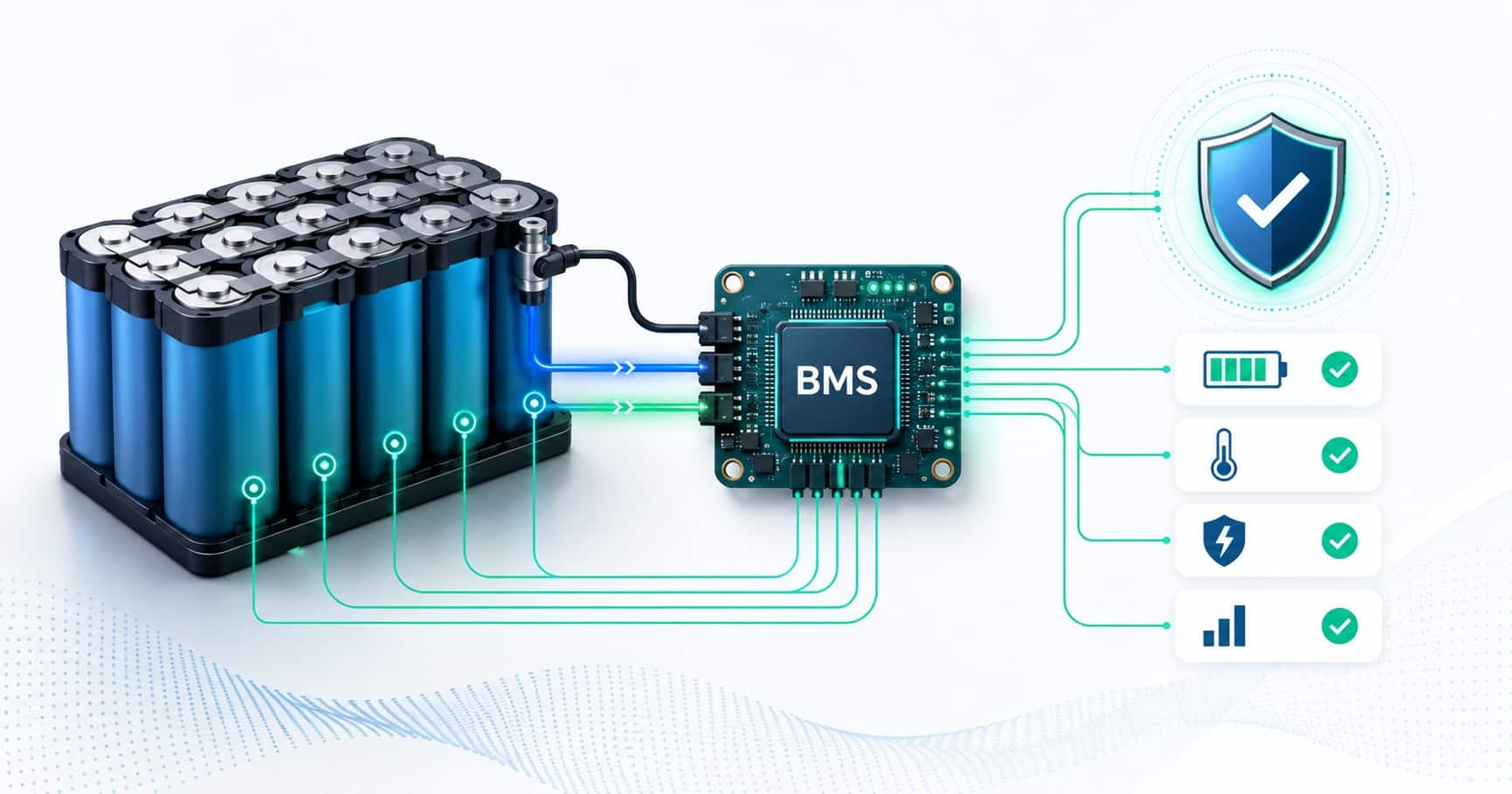
A BMS, or Battery Management System, is the safety brain inside a lithium battery. It watches cell voltage, current, and temperature, balances the cells, and can limit charging, limit discharging, trigger a fault, or disconnect the battery when unsafe conditions are detected. No lithium battery should be used for home backup in Nigeria without a proper BMS, correct inverter settings, and properly installed external protection. The Mercury lithium batteries supplied in our 5kVA with 10kWh Lithium complete system ship with a built-in BMS, a 6,000-plus cycle rating, and a 5-year warranty.
A BMS reduces risk, but it does not make a lithium battery impossible to damage or impossible to burn. Battery safety still depends on battery quality, correct inverter settings, cable sizing, DC breakers, ventilation, and professional installation.
Lithium batteries have changed the way Nigerian homes use solar power. They charge faster, last longer, give better usable capacity, and are far more efficient than traditional lead-acid batteries.
But there is one part of a lithium battery that most homeowners never see and rarely ask about. That part is the Battery Management System, commonly called the BMS.
A BMS is the safety brain inside a lithium battery. It monitors the battery, protects the cells, controls charging and discharging, and shuts the system down when something becomes unsafe. Without a good BMS, a lithium battery is not just unreliable. It can become dangerous.
This guide explains what a BMS does, why lithium batteries can catch fire, what thermal runaway means, and why every serious home solar battery system must have proper battery protection.
What Is a BMS?
A Battery Management System is an electronic control system built into a lithium battery pack. Its job is to monitor and protect the battery while it charges, discharges, and powers your home.
A good BMS tracks important battery conditions, including cell voltage, battery current, battery temperature, state of charge, cell balance, charging limits, discharging limits, fault conditions, and communication with the inverter.
In simple terms, the BMS is the part of the battery that keeps asking one question: is this battery still operating safely? If the answer is yes, the battery continues working normally. If the answer is no, the BMS can limit charging, limit discharging, trigger a fault, or disconnect the battery, depending on the battery design.
That shutdown may feel inconvenient to the user, but it is a safety feature. The BMS is designed to stop a small electrical problem from becoming a serious battery failure. To understand how that battery sits inside the wider setup, see our guide on how to connect an inverter to a battery.
Why a BMS Matters in a Home Solar System
A home solar battery does not operate in isolation. It is connected to an inverter, solar panels, household wiring, DC cables, breakers, and the appliances in your home. Every day, the battery charges and discharges repeatedly.
In Nigeria, the battery may also face high room temperatures, long hours of use, unstable NEPA charging, generator charging, heavy household loads, poor ventilation, incorrect inverter settings, improper installation, undersized cables, and low-quality electrical accessories.
All these conditions increase the importance of battery protection. A BMS helps protect the battery from operating outside its safe limits. It does not replace good installation, but it is one of the most important internal safety systems in a lithium battery.
Why Lithium Batteries Can Catch Fire
Lithium batteries are powerful because they store a large amount of energy in a compact space. That is what makes them useful for solar backup. A properly sized lithium battery can power your lights, fans, TVs, fridge, freezer, internet, office equipment, and, with the right system size, an inverter air conditioner.
But high energy density also means the battery must be carefully controlled. When a lithium battery is poorly made, badly installed, wrongly configured, or operated outside safe limits, it can fail. The most serious failure condition is called thermal runaway.
What Is Thermal Runaway?
Thermal runaway occurs when a battery cell generates more heat than it can release. Once the internal temperature rises too far, chemical reactions inside the cell can accelerate. Those reactions create even more heat, which causes further chemical breakdown, which then creates even more heat again. At that point, the failure becomes self-sustaining.
In a battery pack made up of many cells, one failing cell can heat the cells beside it. If the heat spreads, the problem can move from one cell to another and become a major battery fire.
This is why battery safety must begin before there is smoke, swelling, heat, smell, or fire. The goal is to detect unsafe conditions early and stop the battery before it reaches thermal runaway. That is one of the main jobs of the BMS. You can read more about lithium safety chemistry at Battery University.
The Main Causes of Lithium Battery Failure
Lithium battery fires are usually not random. Most serious failures come from electrical, thermal, mechanical, or manufacturing problems. Here are the main triggers.
1. Overcharging. Overcharging happens when a battery keeps receiving charging current after it has already reached its safe upper voltage limit. It can be caused by wrong inverter settings, poor charger compatibility, a faulty battery design, a weak or low-quality BMS, the wrong lithium battery profile, or charging beyond manufacturer limits. Overcharging stresses the internal structure of the cells, which can then heat up, swell, vent gas, or fail. A good BMS helps prevent this by stopping the charge process when the battery reaches its safe limit.
2. Over-discharging. Over-discharge happens when a battery is drained below its safe minimum voltage. Many people worry about overcharging, but over-discharge is also dangerous. When lithium cells are discharged too deeply, they can become unstable and may be damaged during the next charging cycle. A good BMS prevents this by disconnecting the load before the battery falls below its safe voltage range. This is one reason a lithium battery may suddenly shut down even when the user still wants more power. The BMS is protecting the cells from damage.
3. Short circuits. A short circuit creates an abnormal path for electricity to flow. Instead of passing through the correct load, current rushes through a low-resistance fault path, creating an instant spike in current and temperature. Short circuits may be caused by loose terminals, damaged cables, poor installation, bad lugs, exposed conductors, wrong cable sizing, failed internal battery components, water entry, or physical impact. A good BMS can detect abnormal current and disconnect the battery, but external protection is also required. A safe installation should include proper DC breakers, fuses, correct cable sizing, insulation, and professional workmanship.
4. Cell imbalance. A lithium battery pack is made up of many cells connected together. Ideally, all the cells should charge and discharge evenly. In real life, small differences exist between cells. One cell may charge faster, another may have slightly lower capacity, and another may age more quickly. If these differences are not controlled, the weakest cell becomes a risk point. During charging, one cell may become full before the rest and get pushed beyond its safe voltage. During discharge, the weakest cell may become empty before the others. This is called cell imbalance, and it can reduce performance, shorten battery lifespan, and increase safety risk. A good BMS performs cell balancing to keep the pack stable.
5. High temperature. Heat is one of the biggest enemies of battery safety. A lithium battery installed in a hot room, beside a generator, under direct sunlight, inside a sealed cabinet, or in a poorly ventilated corner is already under stress. High temperature can reduce battery lifespan, increase internal resistance, accelerate cell degradation, trigger fault shutdowns, and increase the risk of thermal failure. This matters even more in Nigeria, where ambient temperatures are already high. Battery location is not just about convenience. It is a safety decision. For more on protecting battery life, see our guide on how to increase the lifespan of your inverter battery.
6. Poor-quality or repacked batteries. Not all lithium batteries are equal. Some are cheap because they use cheap cells, weak BMS boards, poor internal wiring, recycled cells, or exaggerated capacity labels. A battery may look good from the outside, but the real safety is inside. Before buying a lithium battery, the real questions are what cells are inside, whether it has a proper BMS, whether that BMS monitors individual cells or cell groups, whether it has temperature sensors, whether it protects against overcharge and over-discharge, whether it can communicate with the inverter, whether the capacity is genuine, who supports the warranty, and whether it is suitable for home energy storage. For home use, battery quality is not where to cut corners. The cheapest battery can become the most expensive one if it damages your inverter, fails early, shuts down constantly, or creates a safety risk. Our guide on which battery is best for an inverter walks through this in detail.
How a BMS Protects a Home Battery
A BMS works by collecting real-time battery data and using that data to control the battery. It reads the cells, processes the sensor data on a control board, and then acts on it. The BMS does not produce power. It protects the battery while power is being stored and released. Without a BMS, a lithium battery pack is not suitable for safe home solar use.
In practice, the control board uses the live sensor data to run several protections at once:
- Cell balancing: keeps every cell in the pack charging and discharging evenly.
- Temperature monitoring: watches for abnormal heat inside the pack.
- Overcharge protection: stops the charge when the battery is full.
- Over-discharge protection: disconnects the load before the battery falls too low.
- Short-circuit protection: cuts off the battery during a sudden current spike.
- Inverter communication: tells a compatible hybrid inverter what the battery can safely accept.
- Fault shutdown: disconnects or limits the battery during serious unsafe conditions, depending on the battery design.
It monitors cell voltage. The BMS checks the voltage of individual cells or cell groups inside the battery. If any cell rises too high during charging, the BMS can stop the charge. If any cell falls too low during discharge, it can disconnect the load. This keeps the battery inside its safe operating range and is one of the most basic and important BMS functions.
It controls charging. A lithium battery must not be charged blindly. The charger or inverter must respect the correct battery voltage, charge current, and chemistry. The BMS acts as a gatekeeper during charging. When the battery is full, it can stop or limit incoming current, which helps prevent overcharging, overheating, swelling, and long-term cell damage. In a properly configured solar system, the battery, inverter, and solar charge controller all work together within the correct limits. Our guide on how to connect a solar panel to a battery covers the charging side safely.
It controls discharging. The BMS also protects the battery while your home is using power. If the load becomes too high, the current rises beyond safe limits, or the battery becomes too low, the BMS can disconnect the battery to protect the cells from excessive strain. For example, if you try to run too many heavy appliances on a battery that was not sized for that load, the BMS may shut the system down. That is not necessarily a fault. It may be the battery protecting itself from overload.
It balances the cells. A battery pack is only as strong as its weakest cell. If one cell is always overworked, it can reduce the performance and safety of the whole battery. The BMS corrects this by balancing the cells during charging cycles. Good cell balancing improves battery safety, lifespan, usable capacity, charging stability, and long-term performance. This is one reason premium lithium batteries usually perform better over time than very cheap alternatives.
It watches temperature. A proper lithium battery should include temperature sensors. The BMS uses these sensors to detect abnormal heat inside the pack. If the temperature rises beyond safe limits, it can reduce charging, reduce discharging, trigger an alarm, send a fault signal, or shut down the battery. This is one of the key protections against thermal runaway, because heat is often an early warning sign before serious failure.
It detects overcurrent and short-circuit conditions. If current rises above the battery’s safe design limit, the BMS can disconnect the battery, protecting it from overload, short circuit, surge current, faulty wiring, excessive discharge current, and dangerous electrical stress. The BMS should not be the only safety device in the installation, though. The system should also have properly rated DC breakers, fuses, isolators, and cables. A safe battery system is built with layers of protection.
It communicates with the inverter. Many modern lithium batteries can communicate with compatible hybrid inverters. This lets the inverter receive live battery information such as state of charge, voltage, charge current limit, discharge current limit, temperature warnings, fault status, and battery health. When communication is working, the inverter does not have to guess how to charge the battery. The battery tells the inverter what it can safely accept. This is why inverter and battery compatibility matters. Randomly combining batteries and inverters without checking communication and settings can create performance and safety problems.
It shuts the battery down during serious faults. If the BMS detects a serious fault, it can disconnect the battery internally through relays, contactors, or electronic switching, depending on the design. The purpose is simple: stop current flow before the fault gets worse. If a lithium battery shuts down because of a protection fault, do not bypass it, do not force it, and do not keep resetting it without diagnosis. A fault is a warning. The correct response is to find out why the battery shut down. If your inverter is also alarming, our guide on why an inverter beeps continuously can help you read the signal.
A BMS does not make a lithium battery impossible to damage. It reduces risk by stopping unsafe charging, unsafe discharging, overheating, overload, short circuit, and cell imbalance before they become serious.
BMS vs Circuit Breakers, Fuses, and Enclosures
A BMS is extremely important, but it is not the only safety layer in a solar system. A properly installed home battery system should combine internal battery protection with external electrical protection.
| Safety Feature | How It Works | What It Protects | Fire Prevention Role |
|---|---|---|---|
| BMS | Uses sensors and control logic | Battery cells and internal pack | Prevents unsafe voltage, current, temperature, and cell imbalance |
| Fuse | Melts when current exceeds its rating | Cables and connected equipment | Stops severe overcurrent from continuing |
| Circuit Breaker | Trips during overload or fault current | Wiring and system components | Helps prevent cable overheating and electrical fire |
| DC Isolator | Allows safe manual disconnection | Battery and solar DC circuits | Helps technicians isolate the system safely |
| Proper Battery Enclosure | Provides physical protection while allowing safe ventilation | Battery pack and surrounding area | Reduces impact, dust, accidental contact, and installation risk when correctly designed and ventilated |
| Proper Ventilation | Allows heat to escape | Battery and inverter area | Reduces heat buildup |
The BMS is the primary protection inside the lithium battery. But if the installation is poor, the whole system can still become unsafe. A good battery with bad installation is still a risk.
Why Cheap Lithium Batteries Are Risky
Price matters, but battery safety matters more. A very cheap lithium battery may hide weaknesses such as low-grade cells, reused cells, mismatched cells, weak BMS protection, no proper temperature monitoring, poor internal wiring, poor busbar design, fake or exaggerated capacity, a weak casing, poor inverter communication, and no reliable after-sales support.
The customer usually sees only the outer case, but the real quality is inside the battery. This is why Mercury Direct advises customers to choose lithium batteries based on quality, compatibility, installation standard, support, and warranty, not price alone. A battery is not just a container of power. It is a high-energy electrical system, and it must be treated seriously. If you are weighing options, our comparison of 48V lithium versus four tubular batteries shows what genuine quality buys you over time.
Installation Mistakes That Can Defeat Battery Safety
Even a good lithium battery can become unsafe if it is installed wrongly. Here are the common mistakes to avoid.
- Wrong inverter settings: setting the inverter to the wrong battery type, voltage, charge current, or charging profile can push the battery outside its safe limits. Lithium batteries should be configured according to manufacturer recommendations.
- Undersized battery cables: battery cables carry high DC current. Cables that are too small can overheat, melt insulation, damage terminals, or start a fire. Cable size must match the inverter capacity, battery current, cable distance, and installation standard.
- Loose terminals: loose terminals create resistance, resistance creates heat, and heat at a battery terminal can cause melting, arcing, a burning smell, sparks, or fire. Connections must be tight, clean, and properly terminated.
- Poor ventilation: batteries and inverters should not be trapped in hot, sealed spaces. Heat must be able to escape. Avoid direct sun, water leaks, generator heat, poor airflow, and flammable materials nearby.
- Mixing batteries incorrectly: mixing batteries of different age, capacity, chemistry, brand, voltage, or condition can cause imbalance and poor performance. Expanding a lithium system must be done carefully and according to compatibility rules.
- Ignoring fault warnings: if the battery or inverter shows a fault, the correct response is diagnosis. Do not keep forcing the system to run, do not bypass the BMS, and do not ignore communication faults, temperature warnings, repeated shutdowns, a burning smell, a swollen casing, or unusual sounds. Small warnings can become big problems if ignored.
If you are setting up a new system, follow a proper sequence. Our guide on how to install an inverter covers the safe order of work.
Are Lithium Batteries Safe for Nigerian Homes?
Yes, lithium batteries can be safe for Nigerian homes when they are properly selected, correctly installed, and used within their design limits. The issue is not lithium itself. The real risks usually come from poor-quality batteries, wrong inverter settings, bad installation, undersized cables, poor ventilation, no proper protection, a weak BMS, and ignored warning signs.
A safe home lithium battery setup should include a quality lithium battery with a proper BMS, correct inverter and battery compatibility, proper battery communication where supported, correct solar charge settings, correct cable sizing, proper DC breakers and fuses, good ventilation, professional installation, clear warranty support, and load sizing based on actual appliances.
For many Nigerian homes, lithium batteries are now one of the best options for solar backup. They offer better usable capacity, faster charging, longer lifespan, and lower maintenance than traditional lead-acid batteries. For buyers on a tighter budget, a quality lead-acid option such as the Mercury 200Ah deep cycle battery is still a proven choice, but lithium must be installed properly to be safe.
Mercury Direct Safety Advice Before Buying a Lithium Battery
Before buying a lithium battery for your inverter or solar system, ask whether the battery has a proper BMS, whether it is compatible with your inverter, whether it can communicate with the inverter, what the real usable capacity is, what the warranty period is, who handles support if there is a fault, whether the installation is being done by trained technicians, whether the cables are correctly sized, whether the breakers and protection devices are correctly rated, where the battery will be installed, and whether the system is sized for your actual load.
At Mercury Direct, we do not recommend sizing solar systems by guesswork. A fridge, freezer, inverter air conditioner, pumping machine, TV, fan, light, laptop, router, printer, and office appliance all affect the final design. The battery must match the load. The inverter must match the battery. The solar panels must match the charging requirement. The installation must match the safety requirement. That is how a reliable home solar system is built. If you want a lithium-ready platform, our Mercury 3.5kVA Solar Hybrid and the larger 5kVA lithium package are both designed for it, and you can browse our inverter FAQ for more background.
BMS and Lithium Battery Safety FAQ
Can a lithium battery work without a BMS?
A lithium battery should not be used for home solar storage without a BMS. The BMS protects the battery against unsafe voltage, unsafe current, overcharging, over-discharging, overheating, short circuits, and cell imbalance. Using a lithium battery pack without proper BMS protection is extremely dangerous.
Does a BMS completely prevent battery fires?
No safety device can honestly guarantee zero risk. A BMS greatly reduces risk by detecting unsafe conditions early and disconnecting the battery when necessary. But battery safety also depends on battery quality, installation quality, cable sizing, breakers, ventilation, inverter settings, and proper usage. The BMS is a primary line of defence, not the only line of defence.
What happens if the BMS fails?
In a properly designed system, a BMS fault should trigger a battery warning, an inverter fault, a communication error, or a battery shutdown. If the battery enters fault mode, it should be inspected by a qualified technician. Do not bypass the protection and do not force the battery to keep working. A fault is a safety message.
Are all Battery Management Systems the same?
No. Basic BMS units may only monitor general battery pack voltage and current. Better BMS platforms monitor cell groups, temperature zones, current limits, state of charge, charging behaviour, discharging behaviour, and communication with the inverter. Premium lithium batteries usually have better monitoring, balancing, protection logic, and reliability.
Is LiFePO4 safer than other lithium batteries?
LiFePO4, also called lithium iron phosphate, is widely used in home solar batteries because it is more thermally stable than many other lithium chemistries. It still needs a quality BMS, correct charging settings, proper installation, and suitable protection. Safer chemistry does not mean careless installation is acceptable.
Where should a lithium battery be installed at home?
A lithium battery should be installed in a clean, dry, well-ventilated area away from direct sunlight, water, flammable materials, extreme heat, and physical impact. It should also be accessible for inspection and maintenance. Avoid sealed hot corners, leaking roofs, the area beside a generator, damp spaces, and places where children can tamper with cables and terminals.
Why does my lithium battery shut down even when I still need power?
A lithium battery may shut down because the BMS has detected an unsafe condition. Common reasons include the battery being too low, the load being too high, the temperature being too high, a charging fault, a communication fault, short-circuit protection, cell imbalance, or an internal battery fault. The shutdown is not always a sign that the battery is bad. Sometimes it means the BMS is doing its job. The correct step is to check the system and identify the cause.
Can a bad installation defeat a good BMS?
Yes. A good BMS protects the battery internally, but poor installation can still create danger outside the battery. Undersized cables, loose terminals, wrong inverter settings, no DC breaker, poor ventilation, water entry, and overload can still make the system unsafe. A safe lithium battery setup needs both a proper BMS and professional installation.
Do not buy a lithium battery by price alone. Ask about the BMS, real capacity, warranty, inverter compatibility, cable sizing, breakers, ventilation, and installation quality.
Don’t Gamble With a Battery You Can’t See Inside
You should not have to become a battery expert to keep your home safe. The danger in a cheap lithium battery is hidden inside the case, where you cannot inspect it. Every Mercury lithium battery system we recommend is selected for proper BMS protection, genuine capacity, inverter compatibility, and warranty support, and we size, supply, and install the whole system for you. Tell us the appliances you want to run and we will recommend a lithium battery system with the right protection, sizing, and installation support. Call 07037451701 or chat on WhatsApp.