
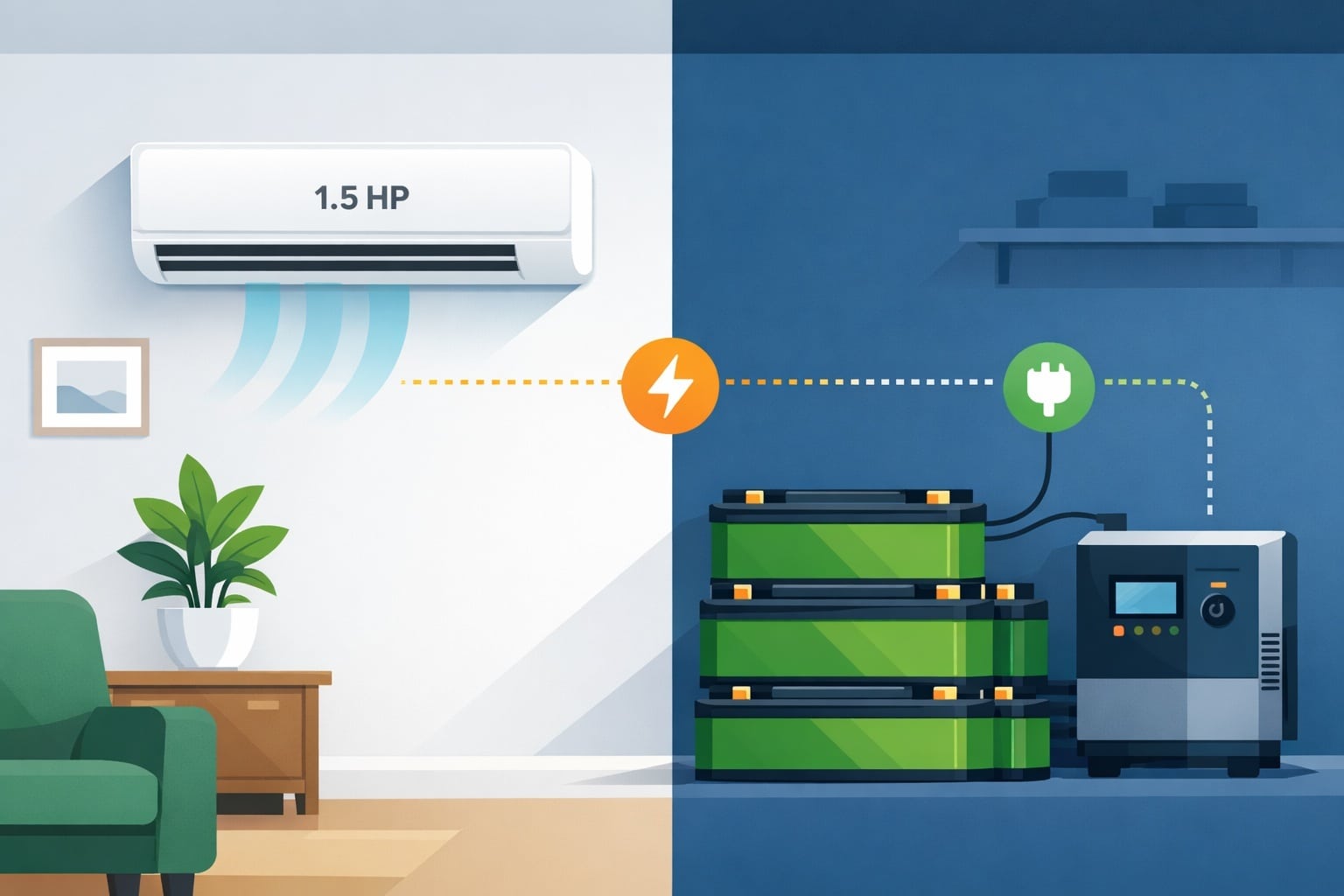
HOW MANY BATTERIES FOR 1.5HP AC IN NIGERIA
For a 1.5HP air conditioner, you need minimum 4 batteries (48V), but 8 batteries are strongly recommended. A 1.5HP AC draws 1,100 to 1,500W continuously with 2,500 to 3,500W startup surge. Four batteries give only 2 to 3 hours before premature battery damage. Eight batteries provide 4 to 6 hours with healthy battery life. Recommended inverter: 5.5kVA pure sine wave (a 3.5kVA can start an inverter-type AC, but runtime and headroom suffer). For the complete overview of running AC on an inverter in Nigeria, see our AC on inverter guide.
Not sure how many batteries YOUR home needs? Chat Mercury Direct on WhatsApp or call 0703 745 1701 for a free sizing assessment.
BATTERY SIZE FOR 1.5HP AIR CONDITIONER: WHAT YOUR INVERTER ACTUALLY NEEDS
| Parameter | Value |
|---|---|
| Running Power | 1,100 to 1,500 Watts |
| Starting/Surge Power | 2,500 to 3,500 Watts |
| Current Draw (220V) | 5 to 6.8 Amps |
| Hourly Energy Consumption | 1.1 to 1.5 kWh |
The startup surge is the critical factor with conventional (non-inverter) AC units. When a conventional compressor kicks in, it draws 2 to 3 times its running power for 3 to 5 seconds, demanding 3,500W+ surge capacity. This is why we always recommend inverter-type AC units for backup power. Their soft-start compressors eliminate the surge entirely, which means a 3.5kVA inverter handles startup with headroom. But starting the AC is not the goal. Keeping it running for hours is. A 1.5HP inverter AC still draws 800 to 1,200W continuously. On a 3.5kVA system with 2 batteries, that gives you barely 1 to 2 hours of cooling before the bank hits low-voltage cutoff. You need enough batteries to make the runtime worthwhile, which is why we recommend a 5.5kVA 48V system with 8 batteries: it gives you the battery capacity for 4 to 6 hours of actual cooling.
In the Nigerian power landscape, air conditioning sits at the top of the backup power hierarchy. Basic backup (lights, fans, TV) works with 2 to 4 batteries. Comfort backup (add fridge and computers) needs 4 to 6. But AC backup demands 8+ batteries or lithium. Most homeowners in Nigeria discover this the hard way, after spending over ₦1,500,000 on batteries that do not last a year. Their inverter starts the AC fine, but the batteries die within hours.
CAN 4 BATTERIES RUN 1.5HP AC? WHY THEY STRUGGLE
The calculation: 4 x 200Ah at 48V, 80% DoD, 85% efficiency = 6,528Wh usable. At 1,200W AC draw: 6,528 / 1,200 = 5.4 hours theoretical maximum. But in practice, the high discharge rate (C/4) reduces actual capacity to 70 to 75% of rated, and Nigerian temperatures (30 to 35°C) further cut capacity. Real-world result: 2 to 3 hours.
What does C/4 discharge mean in plain English? It means your batteries are being drained too fast. Battery manufacturers rate capacity at a slow, gentle 20-hour discharge. Pulling 1,200W from a 48V/200Ah bank is four times faster than that. At this rate, your “200Ah” batteries effectively become “140 to 150Ah” batteries. You are paying for capacity you cannot actually use.
Worse, repeated deep discharges kill lead-acid batteries in 6 to 12 months instead of 3 to 5 years. That is a ₦1,500,000+ replacement cost. Read how to increase battery lifespan to understand why discharge depth matters.
What Actually Happens: A Lagos Installation Story
A homeowner in Lekki installed a 5.5kVA inverter with 4 x 200Ah batteries specifically to run his 1.5HP bedroom AC during NEPA outages. The first three months were great: 2 to 3 hours of cooling per outage, batteries recharged when grid returned. By month six, runtime dropped to 90 minutes. By month nine, the AC triggered low-voltage alarms within 40 minutes. He replaced all four batteries at ₦1,600,000, then called us. We added a second string of four batteries. Two years later, the system still runs 4 to 5 hours of AC per outage with no battery degradation. The extra ₦1,600,000 upfront would have saved him ₦1,600,000 in premature replacements.
If your AC shuts down mid-operation, your runtime keeps dropping, or your batteries need replacing every year, your system is undersized. We can calculate the exact setup for your home. Chat with our team on WhatsApp or call 0703 745 1701.
THE BIGGEST MISTAKE NIGERIANS MAKE WITH AC BATTERY BACKUP
Here is the mistake we see every single week: a homeowner buys a 5kVA inverter with 4 batteries, connects the AC, watches it run for 2 hours, and thinks the system is working. It is not working. It is dying.
Those 4 batteries are being drained at C/4 rate, which means they deliver only 70 to 75% of their rated capacity. Every deep discharge chips away at the battery plates. By month six, you have lost 20 to 30% of your original capacity. By month twelve, you are shopping for new batteries.
The cost of this mistake? ₦1,600,000 in premature battery replacements within the first year. That money would have bought the extra 4 batteries you needed from the start, and you would still have a working system three years later.
Don’t skip this step, oga. Size your battery bank for the load you actually want to run, not the load you hope will work.
THE SOLUTION: 8 BATTERIES FOR 1.5HP INVERTER AC
Eight batteries (two parallel strings of four) double your capacity to 400Ah at 48V. At 80% DoD and 85% efficiency: (400 x 48 x 0.80 x 0.85) / 1,200 = 10.9 hours theoretical, 4 to 6 hours real-world. The discharge rate drops from C/4 to C/8, improving efficiency and extending battery life to 3 to 5 years.
The real benefit is not just longer runtime. At C/8 discharge, your batteries deliver 85 to 90% of their rated capacity instead of 70 to 75%. You get more from every naira you spent on batteries, and they last three to five times longer. That is the difference between replacing batteries every year and replacing them every four to five years.
BEST INVERTER SYSTEM FOR 1.5HP AC IN NIGERIA
| Option | Configuration | AC Runtime | Cost (₦) |
|---|---|---|---|
| 8 Lead-Acid Batteries | 8 x 200Ah + 5.5kVA | 4 to 6 hours | ₦4,440,000 to ₦5,140,000 |
| Solar Hybrid | 5.5kVA + 8 x 300W panels + 4 batt. | 6 to 8 hours (daytime) | from ₦4,010,000 |
| Lithium System | 5kVA + 10kWh LiFePO4 | 6 to 8 hours | from ₦3,500,000 |
Mercury 5.5kVA Solar Hybrid + 8 x 200Ah Deep Cycle Batteries + 8 x 300W Solar Panels. Runs your 1.5HP AC for 6 to 8 hours during the day on solar alone. Batteries kick in for evening and cloudy periods. Complete with professional installation, proper cabling, protection, and up to 2-year comprehensive warranty. Message us for a full installation quote.
LITHIUM VS. LEAD-ACID FOR AC BACKUP
| Feature | Lead-Acid (8 x 200Ah) | Lithium (10kWh) |
|---|---|---|
| Usable Capacity | 15.4 kWh (80% DoD) | 9.5 kWh (95% DoD) |
| Cycle Life | 500 to 800 cycles | 3,000 to 6,000 cycles |
| Performance at High C-Rate | Poor | Excellent |
| Weight | 480kg | 100kg |
| Lifespan | 3 to 5 years | 10 to 15 years |
THE PRACTICAL APPROACH
For many Nigerian homeowners, the smartest approach is: use AC on grid power or generator, and reserve your inverter for essentials (lights, fans, TV, fridge). A 3.5kVA system with 2 batteries handles those loads for 5 to 7 hours at a fraction of the AC backup cost. If you do want AC on backup, budget for 8 batteries or lithium.
Consider inverter-type AC units, which draw 30 to 40% less power and have soft-start compressors. This alone can double your backup time. For details on what different inverter sizes can handle, check our inverter buying guide.
IS AC BATTERY BACKUP RIGHT FOR YOU?
This setup is for you if:
- You want AC during NEPA outages: You are tired of sweating through Lagos or Abuja nights while your neighbours run generators.
- You are done with generator noise: You want silent, automatic cooling the moment power goes out.
- You are ready to invest properly: You understand that running AC on batteries requires 8 batteries minimum or lithium, and you are willing to budget ₦4,000,000+ for a system that works.
- You want long-term savings: As of early May 2026, market reports put petrol pump prices between ₦1,320 and ₦1,395 per litre across Nigeria. Fuel prices now move quickly, so the exact pump price may differ by location and week, but the direction is clear: every extra hour on generator is becoming more expensive. An inverter system pays for itself.
This setup is NOT for you if:
- You want the cheapest possible setup: AC backup done properly costs money. If your budget is under ₦2,000,000, focus on lights, fans, and fridge backup first with a smaller essentials system.
- You expect AC on 2 or 4 batteries: It will run for an hour or two, then destroy your batteries. We have explained why above.
- You are not ready for the real cost of AC backup: No judgement. Start with essential backup now, add AC capability later when your budget allows.
If you are serious about running your AC during outages, this is the minimum system that works. Anything less will cost you more in the long run. Not in theory. In real naira, spent on replacement batteries that should never have died.
HOW MANY BATTERIES FOR 1.5HP AC FAQ
Can I run a 1.5HP AC on a 3.5kVA inverter with 4 batteries?
With a conventional AC, no. The 3,000 to 3,500W startup surge will overload smaller systems. With an inverter-type AC (which we strongly recommend), the soft-start compressor eliminates the surge and a 3.5kVA system handles startup comfortably. But starting the AC is not the goal. The real problem is backup time. Two batteries at 24V on a 3.5kVA system give you barely 1 to 2 hours of cooling. Four batteries at 48V give you 2 to 3 hours. To get meaningful runtime (4 to 6 hours), you need a 5.5kVA 48V system with 8 batteries.
How long will 4 batteries run a 1.5HP AC?
Four 200Ah batteries at 48V give approximately 2 to 3 hours in real-world Nigerian conditions. Running to full discharge will significantly shorten battery lifespan.
Is it better to buy 8 batteries or upgrade to lithium for AC?
For regular AC backup, lithium is better long-term. Eight lead-acid batteries cost ₦3,000,000+ and last 3 to 5 years. Lithium (10kWh) costs more upfront but lasts 10 to 15 years with superior discharge performance.
Can an inverter AC unit reduce battery requirements?
Yes. Inverter-type AC units draw 30 to 40% less power and have soft-start compressors (no surge). This can reduce battery requirements from 8 to 4 for the same runtime.
What is the minimum inverter size for 1.5HP AC?
5.5kVA pure sine wave is the minimum for reliable AC backup. The 5,500W continuous and 11,000W surge capacity handles AC startup comfortably with headroom for other appliances.
How much does a complete AC backup system cost?
Budget: ₦4,440,000+ (8 lead-acid batteries + 5.5kVA). Solar hybrid: from ₦4,010,000 (Mercury 5.5kVA + 8 x 300W panels). Premium lithium: from ₦3,500,000 (Mercury 5kVA + 10kWh lithium).
Can 4 batteries run 1.5HP AC in Nigeria?
Technically yes, but only for 2 to 3 hours in practice. The high discharge rate (C/4) damages lead-acid batteries rapidly, often requiring full replacement within 6 to 12 months. Eight batteries is the practical minimum for reliable AC backup without destroying your battery investment.
What is the best inverter for 1.5HP AC in Nigeria?
The Mercury 5.5kVA Solar Hybrid Inverter with MPPT is the recommended choice. It provides 5,500W continuous power with 11,000W surge capacity, handles 1.5HP AC startup comfortably, and includes a built-in solar charge controller for future panel expansion. For the complete system guide, see what a 5.5kVA inverter can power.
STOP GUESSING. SIZE IT RIGHT THE FIRST TIME.
If you are serious about running your 1.5HP AC during outages, this is the minimum setup that actually works: Mercury 5.5kVA Solar Hybrid + 8 x 200Ah batteries + 8 x 300W solar panels. No guesswork. No dead batteries in 6 months. No ₦1.6 million replacement surprises. We size it properly for your home, your load, and your budget. Or go premium with 10kWh lithium for 10+ years of zero-maintenance AC backup. Call 0703 745 1701 or message us now.
Message Us on WhatsApp Now →
Great