
INVERTER FOR POULTRY FARM NIGERIA
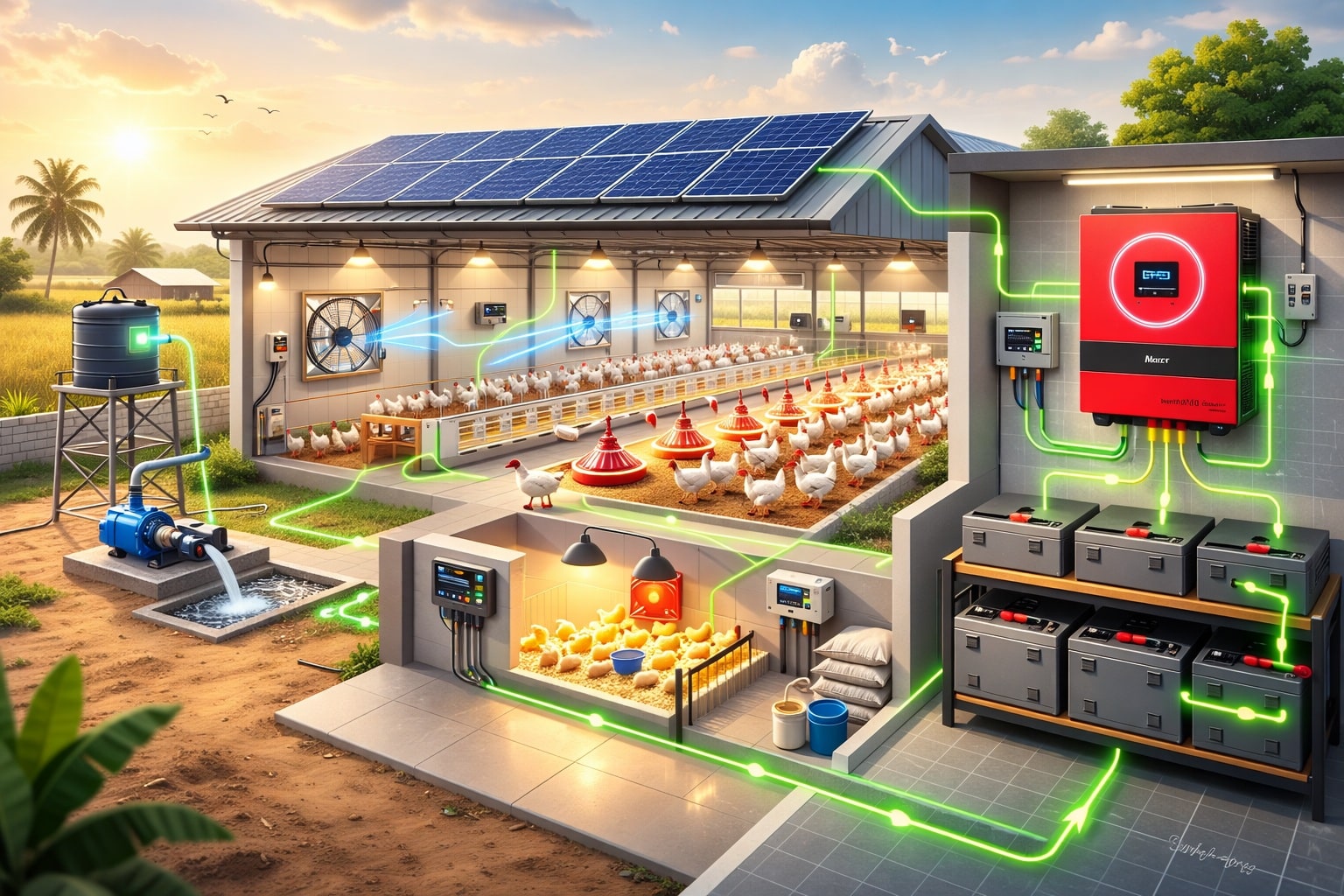
A 5.5kVA pure sine wave solar hybrid inverter is the right starting point for most Nigerian poultry farms running 500–2,000 birds. It powers your lighting programme (critical for egg production), ventilation fans, water pumps, and cold storage simultaneously — delivering 5,500W continuous with an 11,000W surge for motor startups. The Mercury 5.5kVA Solar Hybrid System (₦2,904,000) includes 4×200Ah GEL batteries on a 48V platform with built-in MPPT, giving you 6–8 hours of backup and the ability to add solar panels that slash your energy costs permanently.
WHY POULTRY FARMS IN NIGERIA NEED A DEDICATED INVERTER SYSTEM
If you’re running a poultry farm in Nigeria, you already know the pain: NEPA takes light at 2am, your brooding lamps go off, and by morning you’ve lost 30 chicks to cold stress. Or your ventilation fans stop mid-afternoon in March, temperatures hit 38°C inside the pen, and your layers start panting, which means fewer eggs for the next 10 days. Sound familiar?
The right inverter for poultry farm Nigeria operations isn’t a luxury. It’s the difference between profit and catastrophic loss. Poultry is one of the most power-dependent agricultural businesses because birds are biologically sensitive to three things that all require electricity: temperature, light cycles, and air quality. A 6-hour power outage that barely inconveniences a household can kill an entire flock of day-old chicks or crash egg production by 20% for weeks.
Generators have been the default solution, but at current petrol prices of approximately ₦850/litre (February 2026) and diesel at ₦880/litre, running a generator 8–12 hours daily destroys your margins. A 5kVA diesel generator consumes roughly 1.5 litres per hour. That’s ₦10,560 per day just in fuel. Monthly? Over ₦316,000. Meanwhile, a solar hybrid inverter charges from the sun during the day and from the grid (where available at current NERC Band A tariffs) at night, with zero fuel cost.
COMPLETE POWER LOAD ANALYSIS FOR NIGERIAN POULTRY FARMS
Before choosing an inverter for your poultry farm, you need to calculate your actual electrical load. The equipment varies depending on whether you’re running broilers, layers, or a hatchery, but the core power-hungry items are consistent across Nigerian poultry operations.
| Equipment | Typical Wattage | Hours/Day | Daily kWh |
|---|---|---|---|
| Brooding heat lamps (×4) | 250W each = 1,000W | 24 (first 2 weeks) | 24.0 |
| LED lighting programme (×20 bulbs) | 10W each = 200W | 16–18 | 3.6 |
| Ventilation/exhaust fans (×4) | 80W each = 320W | 12–18 | 5.8 |
| Water pump (0.5HP surface) | 370W | 2–3 | 1.1 |
| Feed mixer/grinder (small) | 750W | 1–2 | 1.5 |
| Egg storage fridge/freezer | 150–200W | 24 (cycling) | 2.4 |
| CCTV & security lighting | 100W | 24 | 2.4 |
| Office (laptop, router, phone charging) | 120W | 10 | 1.2 |
Peak simultaneous load: 2,000–3,000W during brooding phase (when heat lamps, fans, and lighting all run together). Outside brooding, typical continuous draw drops to 800–1,500W. The water pump adds a 3× startup surge (roughly 1,100W) that lasts half a second.
This is why a 3.5kVA system works for smaller operations (under 500 birds with no brooding lamps), but most farms with 500–2,000 birds need the headroom of a 5.5kVA system. If you’re unsure about your specific load, use our Battery Backup Time Calculator to plug in your exact numbers.
CHOOSING THE RIGHT INVERTER FOR YOUR POULTRY FARM SIZE
Not every poultry farm needs the same system. A backyard operation with 200 layers has completely different power needs than a commercial broiler farm running 5,000 birds with automated feeding. Here’s how to match your farm to the right Mercury system:
| Farm Size | Recommended System | Price |
|---|---|---|
| Small (100–500 birds) Layers, no brooding, basic lighting + fans | Mercury 3.5kVA Solar Hybrid + 2×200Ah batteries | ₦1,521,000 |
| Medium (500–2,000 birds) Broilers or layers, brooding lamps, ventilation, water pump, egg fridge | Mercury 5.5kVA Solar Hybrid 48V + 4×200Ah batteries | ₦2,904,000 |
| Large (2,000–5,000+ birds) Full automation, multiple pens, cold storage, heavy ventilation | Mercury 5kVA + 10kWh Lithium + 16×450W Solar | ₦5,538,000 |
Why the 5.5kVA for medium farms specifically? Two reasons. First, it runs on a 48V DC platform, which means lower current flow, less heat in the cables, and better efficiency than 24V systems when you’re running high loads for extended periods. Second, the 2× surge capacity (11,000W for 5 seconds) handles the simultaneous startup of your water pump and compressor fridge without tripping.
For a detailed breakdown of what different inverter sizes can power, check our 5.5kVA inverter load guide or the 3.5kVA guide for smaller farms.
WHY SOLAR HYBRID IS NON-NEGOTIABLE FOR POULTRY OPERATIONS
Here’s the thing about choosing an inverter for poultry farm Nigeria setups that makes them different from homes: your power consumption is predictable and continuous. Chickens don’t take breaks. Ventilation runs all day. Lighting follows a strict programme. This predictability is exactly what makes solar hybrid inverters perfect for poultry.
A solar hybrid system like the Mercury 5.5kVA MPPT charges from both the grid (when available) and solar panels. During daylight, when your farm’s power draw is highest, the solar panels feed power directly to your equipment. The batteries only carry the nighttime load. This dramatically extends battery life because you aren’t deep-cycling them twice a day like you would with a grid-only inverter.
The MPPT (Maximum Power Point Tracking) charge controller inside Mercury’s hybrid inverters squeezes up to 30% more energy from your panels compared to cheaper PWM controllers. On a poultry farm where every kilowatt-hour counts against your cost-per-bird, that 30% matters. You can start with the inverter-and-battery system now, then add solar panels later as cash flow allows. The 5.5kVA system with 8×300W panels is the full solar package if you want to go all-in from day one.
INVERTER FOR POULTRY FARM: GENERATOR COST COMPARISON (2026)
Let’s run the real numbers. Mr. Abubakar runs a 1,500-bird broiler farm in Ibadan. He currently uses a 6.5kVA diesel generator 10 hours a day. Here’s what it costs him versus switching to an inverter for poultry farm Nigeria use:
| Cost Item | Diesel Generator | Mercury 5.5kVA Hybrid |
|---|---|---|
| Upfront cost | ₦450,000 (generator) | ₦2,904,000 (complete system) |
| Diesel/fuel per day (10 hrs) | ₦13,200 (15L × ₦880) | ₦0 (solar) or ₦675 (grid charging) |
| Monthly fuel/energy | ₦396,000 | ₦20,250 (grid only, worst case) |
| Monthly maintenance | ₦25,000 (oil, filters, servicing) | ₦0 |
| Annual operating cost | ₦5,052,000 | ₦243,000 |
| Noise level | 75–85 dB (stresses birds) | Silent |
| Fumes near birds? | Yes — CO₂ risk | None |
Annual savings: ₦4,809,000. The Mercury 5.5kVA system pays for itself in roughly 7 months. By month 8, Mr. Abubakar is running his farm on effectively free electricity (especially with solar panels). And that’s before counting the hidden generator cost: bird mortality from noise stress and carbon monoxide exposure in poorly ventilated pen areas.
Research from Ogun State poultry farms confirms that generators in close proximity to poultry houses contribute to elevated stress indicators and reduced egg production. Silent power isn’t just convenient. It’s productive.
CRITICAL FEATURES YOUR POULTRY FARM INVERTER MUST HAVE
Not every inverter works as an inverter for poultry farm Nigeria conditions. Here’s what to look for, and what to avoid:
- Pure Sine Wave output: Non-negotiable. Modified sine wave inverters cause fans to buzz, motors to overheat, and egg incubators to malfunction. The mercury hybrid range delivers pure sine wave with under 3% Total Harmonic Distortion (THD).
- High surge capacity (2× rated power): Water pumps, compressor fridges, and feed grinders all draw 3–5× their rated wattage at startup. If your inverter can’t handle the surge, it trips and your birds lose power.
- MPPT solar charge controller: Built into Mercury’s hybrid range. This lets you add solar panels incrementally. Start with 4 panels, expand to 8 or 16 as your farm grows.
- Automatic transfer switch (ATS): When grid power returns, the system switches automatically. No farmhand intervention needed at 3am.
- 48V DC architecture (for 5.5kVA+): Higher voltage means lower current, which means less heat, less cable loss, and better efficiency for farms running heavy loads over long distances from the inverter to the poultry house.
- Configurable charging priority: Mercury inverters let you set Solar → Grid → Generator priority, so the system always uses the cheapest power source first.
BATTERY SIZING FOR 24-HOUR POULTRY FARM BACKUP
Your birds don’t sleep for long, and neither should your inverter for poultry farm Nigeria backup. Here’s how to calculate the right battery bank for your farm. The formula is straightforward:
Backup Hours = (Battery Voltage × Ah × DoD × Inverter Efficiency) ÷ Load Watts
For the Mercury 5.5kVA system with 4×200Ah batteries on a 48V bank:
Usable energy = 48V × 200Ah × 0.5 (GEL DoD) × 0.9 (efficiency) = 4,320Wh
At a typical nighttime farm load of 600W (LED lights on timer, ventilation fans, fridge, CCTV):
4,320Wh ÷ 600W = 7.2 hours of pure battery backup.
That covers a typical Nigerian night from 7pm to 2am comfortably. If you need true 24-hour autonomy (for farms in areas with extended outages), you can double the battery bank to 8×200Ah. For maximum cycle life and 95% depth of discharge, the 10kWh Lithium LiFePO₄ option delivers 2,000+ cycles compared to 600–800 cycles from GEL batteries. That makes it a better long-term investment for farms running daily discharge cycles.
Use Mercury Direct’s battery backup time calculator to plug in your exact farm load and get a precise runtime estimate.
INSTALLATION TIPS FOR POULTRY FARM INVERTER SYSTEMS
Installing an inverter for poultry farm Nigeria operations is different from a home setup. A few things to get right:
Location matters. Don’t install the inverter inside the poultry house. Ammonia fumes from droppings corrode circuit boards and battery terminals. Mount the inverter and batteries in a separate, well-ventilated room or weatherproof enclosure at least 5 metres from the pen. Keep the cable run to the pen as short as possible to minimise voltage drop. Use 10mm² or thicker cables for runs over 15 metres.
Earthing is critical. Nigerian poultry farms are often in rural areas with sandy soil and poor earth conductivity. A proper earth rod (1.8m copper-bonded, driven into moist ground) protects both your equipment and your birds from electrical faults. Don’t skip this step, oga.
Lightning protection. If your farm is in the south-west or middle belt, Harmattan-season lightning strikes can damage your inverter through the solar panel cables. Install surge protection devices (SPDs) on both the AC and DC sides of the system. Mercury Direct’s installation team includes SPDs as standard on commercial farm installations.
Timer circuits for lighting. Layer farms need precise light/dark cycles (typically 16 hours light, 8 hours dark) to maintain egg production. Wire your lighting circuit through a programmable timer connected to the inverter output. This way, the lighting programme continues automatically through power outages. No more manual switching.
Inverter for Poultry Farm Nigeria FAQ
What size inverter do I need for a poultry farm in Nigeria?
For farms with 100–500 birds doing basic lighting and ventilation, a 3.5kVA system is sufficient. For 500–2,000 birds with brooding lamps, water pumps, and cold storage, you’ll need a 5.5kVA system. Farms above 2,000 birds with full automation should consider a 5kVA system with lithium batteries and a large solar array to handle the continuous heavy loads.
Can an inverter for poultry farm Nigeria operations replace a generator completely?
Yes, with the right sizing. A solar hybrid inverter with adequate battery storage and solar panels can provide 24-hour power for a Nigerian poultry farm without any generator. The key is sizing the battery bank for nighttime loads and the solar array for daytime consumption. Many Mercury Direct customers run their farms entirely generator-free after installing a 5.5kVA system with 8×300W solar panels.
How much does an inverter for a poultry farm cost in Nigeria?
A complete inverter system for a Nigerian poultry farm ranges from ₦1,521,000 for a 3.5kVA setup (small farm, 2×200Ah batteries) to ₦5,538,000 for a premium 5kVA solar system with 10kWh lithium battery and 16 solar panels. The most popular choice for medium farms is the Mercury 5.5kVA complete system at ₦2,904,000, which includes the inverter, 4×200Ah GEL batteries, and MPPT charge controller.
Will a modified sine wave inverter work for my poultry farm?
Don’t risk it. Modified sine wave inverters cause problems with motor-driven equipment like water pumps, ventilation fans, and compressor fridges, all of which are essential on poultry farms. Motors run hotter, consume more power, and fail sooner. Egg incubators are especially sensitive. A modified sine wave can cause temperature fluctuations that reduce hatch rates. Always use a pure sine wave inverter for poultry farm operations. It’s not where you want to cut costs.
Can I add solar panels to my poultry farm inverter later?
Yes, that’s the advantage of a solar hybrid inverter. Mercury’s hybrid range has a built-in MPPT charge controller that accepts solar panel input from day one. You can start with just the inverter and batteries, then add 4, 8, or 16 panels as your budget allows. The 5.5kVA system supports up to 5,000W of solar array input. Adding panels reduces your grid charging costs to near zero and extends battery lifespan by reducing daily discharge depth.
How long do inverter batteries last on a poultry farm?
GEL deep-cycle batteries typically last 3–5 years on a poultry farm with daily cycling, assuming you maintain a 50% maximum depth of discharge. Lithium Iron Phosphate (LiFePO₄) batteries last significantly longer, around 7–10 years with 2,000+ cycles at 95% depth of discharge. For farms that cycle batteries heavily every day, lithium is the better long-term investment despite the higher upfront cost. Either way, adding solar panels extends battery life by reducing the depth of each daily cycle.
Power Your Poultry Farm — Not Your Generator
The Mercury 5.5kVA Solar Hybrid System (₦2,904,000) is built for Nigerian farms. Pure sine wave, 48V efficiency, built-in MPPT, and 4×200Ah batteries included. It ships same-day in Lagos with free installation and a 12-month warranty. For farms outside Lagos, Mercury Direct dispatches certified installation partners nationwide. Call 07037451701 or WhatsApp us for a free farm power audit.
Get Mercury 5.5kVA for Your Farm →