
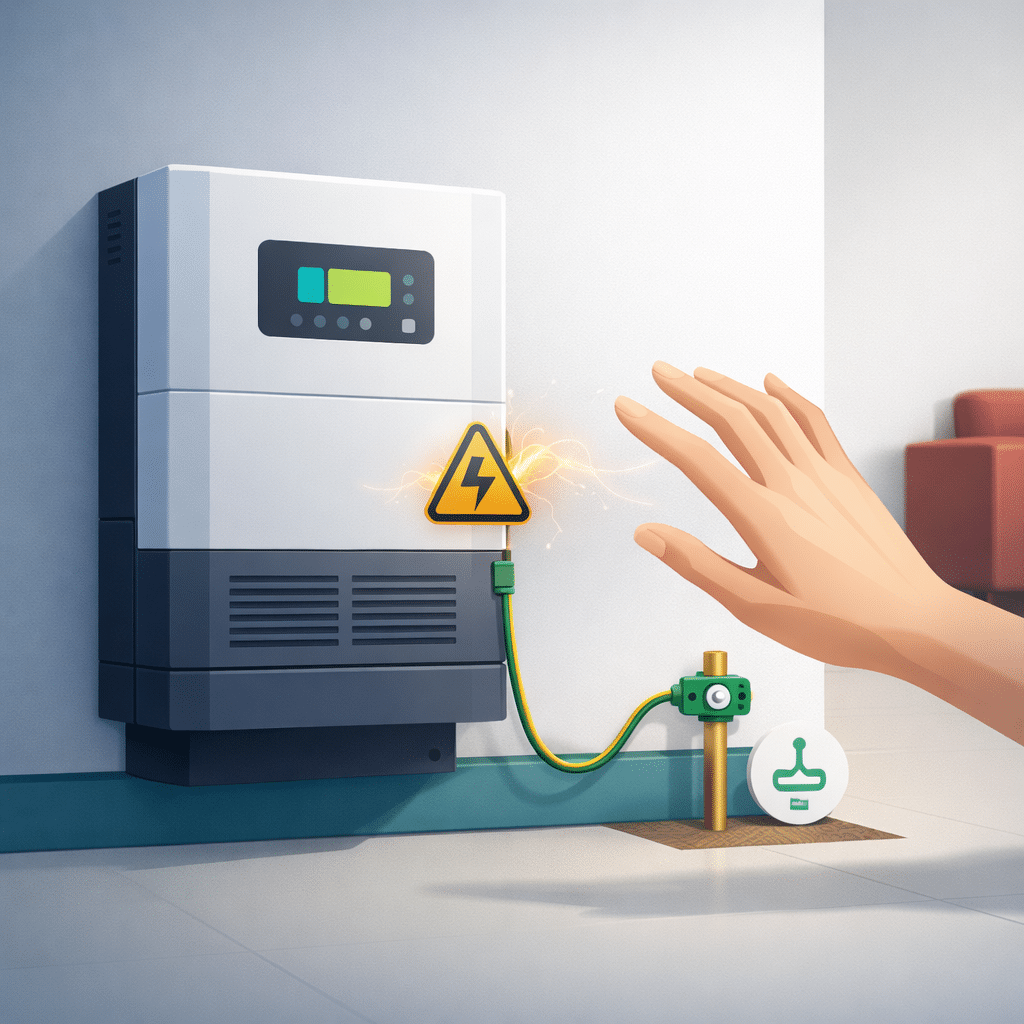
INVERTER SHOCK FROM CASING? WHY YOUR INVERTER IS SHOCKING YOU (AND HOW TO STAY SAFE)
If your inverter shocks you when you touch the casing, stop touching it immediately. Do not test it again. If you can isolate power safely without touching the inverter body again, switch off the output breaker or MCB feeding the inverter circuit, then switch off the main breaker or changeover supplying NEPA or generator to the inverter. Keep the system off and call a qualified electrician or inverter technician. The shock is usually caused by missing or faulty earthing, wrong neutral/earth wiring, installation faults, or less commonly an internal inverter fault. If you need a properly installed inverter system with correct earthing, see our inverter buying guide or message Mercury Direct on WhatsApp.
YOU TOUCHED THE INVERTER AND IT SHOCKED YOU
You reach out to press a button or lean on the inverter. Suddenly you feel a tingle, or a sharp “bite” that makes you jump back. Your first thought is: “Was that me? Is it normal? Can this thing kill somebody?”
Here is the thing. An inverter shock from the casing is never normal. Not even a small one. If you felt it, something is wrong with your earthing, your wiring, or (less commonly) the inverter itself. This guide explains why it happens in Nigerian homes, what you should do the moment it happens, and what only a professional should touch.
WHAT TO DO IMMEDIATELY IF YOUR INVERTER SHOCKS YOU
If your inverter gives you a shock from the body or casing, follow these steps in order. You do not need any tools for this.
- Step 1, Stop touching it: Do not keep “testing” the shock by touching the casing again. Make sure your hands and feet are dry. Do not stand in water or on a wet floor.
- Step 2, Isolate power at the breakers first: Go to your distribution board or changeover. Turn OFF the output breaker or MCB feeding the inverter circuit. Then turn OFF the main breaker or changeover that brings NEPA/gen into the inverter. If you can safely reach the inverter power button without touching the metal casing again, turn the inverter off as well. If you cannot reach it safely, leave it. The breakers are enough to isolate the system.
- Step 3, Switch off or unplug heavy loads: Once the breakers are off, unplug or switch off inverter-fed appliances (AC, iron, cooker, pump) so nothing draws power when the system is eventually re-energised for testing.
- Step 4, Keep it off: Do not switch back on “just to see if it still shocks.” Leave the system isolated until a professional checks it.
- Step 5, Note when shocks happen: Only on NEPA? Only on generator? On both battery and mains? Only when barefoot? This information helps the technician diagnose faster.
WHAT YOU MUST NOT DO
To protect yourself and your house, do not attempt any of the following.
- Do not open the inverter casing: Capacitors inside can store dangerous voltage even when the inverter is switched off.
- Do not touch internal parts or the PCB: This includes battery terminals under load.
- Do not “earth” the inverter yourself: Jamming wires into plumbing or random metal creates new fault paths and can make the shock worse.
- Do not bridge neutral and earth: Joining neutral to earth in the distribution board or changeover “to see if it stops” can cause electrocution or fire.
- Do not ask someone else to touch it: Asking a friend to “just try and see” puts them at risk.
If you do not fully understand earthing schemes and inverter wiring, do not experiment. This is professional work.
WHAT AN INVERTER SHOCK FROM THE CASING REALLY MEANS
The metal body, exposed screws, or frame of your inverter is not supposed to carry any voltage you can feel. If it does, one or more of the following is happening in your system.
- Leakage path to casing: Live voltage is finding a path from internal conductors to the metal body of the inverter.
- Missing or weak earthing: Your earthing (grounding) is absent, disconnected, or not effective enough to drain the leakage safely.
- Neutral and earth mis-wired: Neutral and earth may be bonded at the wrong point, or the neutral may be floating without a proper reference.
- Fault in building wiring or installation: Loose terminations, exposed conductors touching metal, damaged insulation, or DIY mounting that contacts the wrong points.
In most Nigerian homes, the root problem is earthing and wiring, not a defective inverter. The inverter is just where you notice the problem because you touch its casing.
LIGHT TINGLE VS STRONG SHOCK: BOTH ARE WARNINGS
People often say “it is just small body current” or “it only shocks me when I am barefoot on tiles.” That thinking is dangerous. Both levels of shock are telling you the same thing: something is wrong.
Light tingle (barefoot on tiles)
You feel a mild tingling when barefoot on a tiled or cement floor with your hand on the inverter casing. It sometimes disappears when you wear slippers. This means the inverter casing is sitting at a voltage above the floor or earth potential, and proper earthing is not present to drain it. The tingle feels small, but it confirms a live fault exists. It is not acceptable as “normal.”
Strong shock (even with slippers)
A sharp, painful shock that you feel even through slippers or from a quick light touch. This indicates a more serious leakage or a direct fault to the casing. The risk of injury depends on skin moisture, the path the current takes through your body, and how long you are in contact. This is urgent. The system must be shut down and checked before any further use.
WHY INVERTERS SHOCK PEOPLE IN NIGERIAN HOMES
There are four main reasons an inverter casing carries voltage in Nigeria. Understanding which one applies to your situation helps the technician fix it faster.
1. No earthing or fake earthing
Many Nigerian houses have no real earth rod or earth connection. Some use 2-pin sockets only. Others have “symbolic” earth wires that are not connected to a true earth. When there is no proper earth, any leakage to the inverter casing has nowhere to go. The casing sits at a live potential relative to the floor, and your body becomes the path to earth when you touch it. Proper earthing gives leakage a safe path away from you. Without it, you are the “earth.”
2. Wrong neutral to earth relationships
Common wiring mistakes include neutral and earth joined at the wrong place, floating neutral not referenced correctly, and generator/NEPA earth and neutral arrangements done incorrectly. The result is stray voltage on metal parts and casing shocks that may appear only on NEPA, only on generator, or on both. This is not something to trial and error. It needs a professional who understands inverter internal earthing design, building earthing schemes, and how generator neutral and earth should be handled.
3. Poor installation: cables and terminations
Even if earthing is present, loose terminations, exposed conductors touching metal, damaged insulation at the back of the inverter, and DIY mounting with metal brackets contacting wrong points can cause leakage from live conductors to the chassis. This is about the quality of installation, not the brand of inverter. Proper cable sizing and termination matter. If you are unsure about correct cable sizes, our connection guide covers this in detail.
4. Internal inverter fault (less common but serious)
Sometimes the inverter itself has failed internally: insulation breakdown, damage from surges or water ingress, or a manufacturing defect. If the inverter shocks regardless of location or wiring changes, and other checks suggest the wiring is fine, the unit may need to be opened by a qualified technician, tested with proper instruments, and repaired or replaced. Do not open it yourself. Capacitors inside can store dangerous voltage even when the inverter is switched off.
INVERTER SHOCK DIAGNOSIS: WHEN DOES IT HAPPEN?
The pattern of when shocks occur gives important clues about the root cause. Before calling your technician, note which of these describes your situation.
| When the Shock Happens | Most Likely Cause | Severity |
|---|---|---|
| Only on NEPA/grid supply | Earthing or neutral fault in NEPA wiring or changeover | High |
| Only on generator | Generator neutral/earth not bonded correctly | High |
| On both NEPA and generator | Building earthing missing or inverter installation fault | Very High |
| Only on battery/inverter mode | Inverter internal leakage, output wiring fault, or inverter-output neutral/earth handling issue | High |
| Only when barefoot on tiles | Low-level leakage with no earthing to drain it | Medium |
| Even through slippers or dry hands | Serious leakage or direct live fault on casing | Urgent |
Regardless of the pattern, keep the system off until a professional inspects it. Even “medium” severity means a live fault exists in your system.
PROTECTIVE DEVICES: RCD AND RCBO
A properly installed inverter system should also include suitable protective devices such as an RCD (Residual Current Device) or RCBO (Residual Current Breaker with Overcurrent protection) where appropriate. These devices detect leakage current and disconnect the circuit quickly, reducing the risk of a sustained shock. They do not replace good earthing or correct wiring, but they add a critical layer of protection when leakage faults occur. If your inverter installation does not include an RCD or RCBO, raise this with your electrician during the inspection.
TENANT VS HOMEOWNER: WHAT YOU CAN REALISTICALLY FIX
If you are a tenant
You may not be allowed to rewire the whole house, and the building itself may have no proper earth. What you can do is ensure your inverter installation is as safe as possible: correct cabling from the inverter to your own distribution board, localised earthing for the inverter system if feasible (professional only), and proper isolation breakers or MCBs that you control.
Press your landlord for a proper electrician inspection if shocks appear on other appliances, if metal windows or doors also give shocks, or if the building clearly has no earth connection. Do not start modifying building wiring you do not own, and do not make hidden changes that can create liability later.
If you own the property
Ownership gives you control and responsibility for the full safety of the setup. Install or verify a proper earth rod and earthing system. Have a professional check the main earthing and neutral arrangements, verify the changeover wiring for NEPA, generator, and inverter, and install an RCD or RCBO where appropriate. This is also a good time to redesign the inverter system with correct cable sizes, correct protection devices, and clean separation between inverter and non-inverter circuits.
WHY PROPER INVERTER INSTALLATION PREVENTS SHOCK PROBLEMS
Most inverter shock complaints are not about the inverter being “bad.” They are about the installation being incomplete. A properly installed inverter system includes correct earthing from day one, proper neutral treatment for the inverter type, clean cable runs with no exposed conductors, appropriate breakers and protection devices, and separation between inverter-fed and direct-supply circuits.
When you buy an inverter system and it is installed correctly from the start, casing shock is not something you ever deal with. The problem usually traces back to corners cut during installation, or a building that was never wired for inverter use in the first place.
If you are considering a new inverter system or replacing one that has given you problems, the Mercury Direct inverter buying guide covers what to look for. For battery selection, our battery comparison guide explains the differences between GEL, AGM, and lithium options. And if your current inverter is beeping continuously, that is another warning sign worth investigating before it becomes a shock issue.
SIGNS YOUR HOUSE MAY HAVE A POOR EARTH CONNECTION
Many Nigerian homes were wired without proper earthing, or the earthing has degraded over the years. If any of the following sounds familiar, your building probably has an earthing problem that needs professional attention.
- Inverter casing tingles when barefoot: You feel a mild shock from the inverter body when standing on tiles or cement without slippers.
- Shocks happen only on generator or only on NEPA: The shock appears or disappears depending on your power source, suggesting the neutral/earth arrangement differs between sources.
- Metal appliances or window frames tingle: Other metal surfaces in the house also give a mild shock, not just the inverter.
- Sockets have no earth pin connection: Your wall sockets are 2-pin only, or the earth pin exists but is not wired to anything.
- Your electrician says “it is just body current”: This phrase is a red flag. There is no such thing as harmless “body current” from a metal casing. It means leakage exists and earthing is not handling it.
If two or more of these apply, your building’s earthing needs to be tested and corrected before any inverter system can operate safely. A qualified electrician can measure earth resistance and check conductor continuity with proper instruments.
INVERTER SHOCK FROM CASING FAQ
Is it normal for an inverter to shock when I touch the casing?
No. A shock from the casing is a warning sign. Even a light tingle barefoot on tiles should be investigated and corrected. It usually points to missing or faulty earthing, wrong neutral/earth wiring, or a problem with the installation. Treat any shock from the inverter body as a problem that needs professional attention.
Why is my inverter shocking me even when everything is turned off?
If “off” only means you pressed the power button, parts of the circuit may still be live. There may also be earthing or wiring issues that energise the casing even when the inverter is not running. Turn off the breakers feeding and coming from the inverter, not just the power button, and have the full system checked by a qualified technician.
Can an inverter shock cause serious injury or death?
Yes. The danger depends on the voltage on the casing, the current path through your body, and the duration of contact. A casing that gives a sharp shock represents a serious risk, especially in wet environments or for children. It must be treated as a safety hazard, not “just body current.”
Does inverter shock mean there is a problem with earthing?
In most Nigerian cases, yes. Shocks from the casing usually point to earthing/grounding and wiring issues, either in the building, the changeover, or the inverter installation, though internal inverter faults can also be the cause. A professional needs to test the earth rod, earth conductor continuity, and the neutral/earth arrangement at the main panel. Read more about proper inverter installation.
How do I know if my house has proper earthing for an inverter?
You cannot reliably tell by looking. A professional needs to test the presence and integrity of the earth rod, continuity of earth conductors, the earthing arrangement at the main panel and changeover, and measure leakage or body voltage on the inverter casing using proper instruments.
Can I fix an inverter shock issue myself?
No, not beyond switching off and isolating the system. Fixing shock issues involves live wiring, earthing configuration, and sometimes internal inverter faults. It is professional work. The only safe action you can take is to isolate the system and call a qualified electrician or inverter technician.
STOP THE SHOCK. GET YOUR INVERTER CHECKED.
Most inverter shock problems trace back to earthing and installation, not the inverter itself. Mercury Direct provides full inverter safety audits, proper earthing solutions, and correctly installed inverter systems that do not shock. Call 0703 745 1701 or send us your photos on WhatsApp and we will tell you what is going on.
Message Us on WhatsApp →