
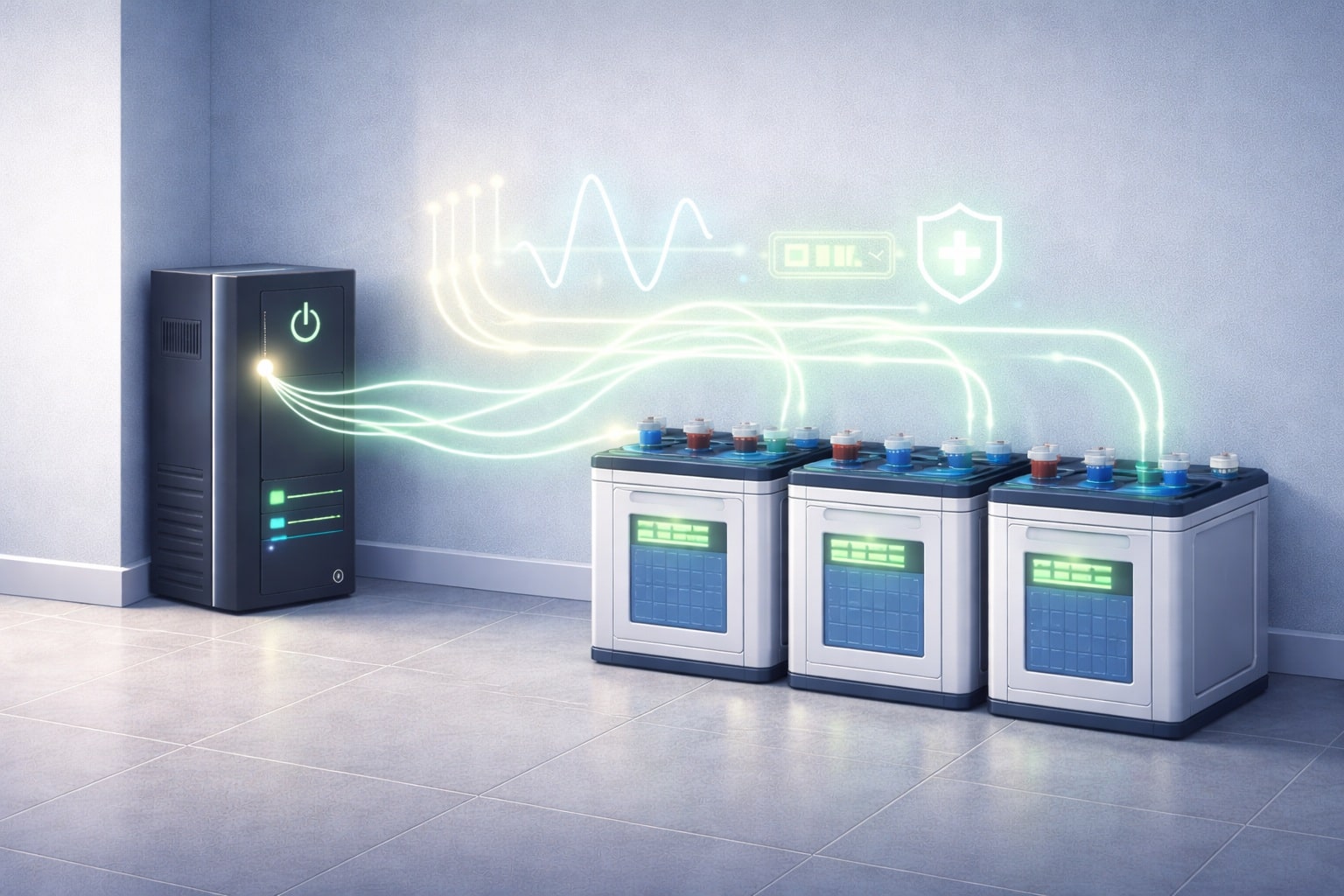
HOW TO FIX LOW VOLTAGE INVERTER BATTERY
If your 12V inverter battery reads 6V or less and your charger refuses to charge it, the battery has dropped below the charger’s Low Voltage Cutoff (typically 10.5V for a 12V system). You can often revive it using the parallel jump method: connect a healthy, fully charged 12V battery in parallel (positive to positive, negative to negative), which raises the combined voltage above the cutoff threshold and tricks the charger into starting. Once the dead battery reaches 10.5V to 11V, disconnect the healthy battery and let the charger complete the cycle. If the battery doesn’t respond after 2 hours, or shows swelling, leaks, or a rotten egg smell, it’s dead and needs replacing. Browse Mercury Deep Cycle Batteries if you need a replacement.
WHY YOUR CHARGER IS “IGNORING” YOUR BATTERY
You know this scenario. NEPA disappears for hours (or days in some areas), your inverter works overtime keeping the lights and fan running, and by the time grid power returns, your 12V battery is completely flat. You check it with a multimeter: 6 volts. Maybe less. You plug in the charger, wait for the charging light, and nothing happens. The charger won’t start. No light, no fan, no activity. It’s as if the battery doesn’t exist.
Your charger isn’t broken. It’s actually doing exactly what it was designed to do. Most modern inverters and smart battery chargers have a safety feature called Low Voltage Cutoff (LVC). For 12V systems (the most common in Nigerian homes), this cutoff is typically set around 10.5V. When your 12V battery’s voltage drops below this threshold, the charger assumes the battery is defective, shorted internally, or not connected at all, so it refuses to charge. This prevents unsafe charging of damaged cells, overheating, and potential fire hazards.
The result is a frustrating catch-22: your 12V battery is too discharged to be recognised by the charger, but it might still be perfectly salvageable if you can just get some charge into it. That’s where the parallel jump method comes in.
READING YOUR BATTERY VOLTAGE: WHAT THE NUMBERS MEAN
Before attempting any fix, you need to know what your multimeter is telling you. Here’s the voltage table for a standard 12V lead-acid inverter battery (the type used in most Nigerian inverter systems):
| Voltage Reading | Charge Level | What to Do |
|---|---|---|
| 12.7V to 12.8V | 100% (Fully charged) | No action needed |
| 12.4V | ~75% | Normal operating range |
| 12.2V | ~50% | Recharge now to protect battery life |
| 12.0V | ~25% | Deep discharge territory, recharge immediately |
| 10.5V to 11.8V | Near empty | Severe deep discharge, charger may still work |
| Below 10.5V | Below charger cutoff | Charger won’t charge. Use parallel jump method |
| 0V | Dead / internal short | Likely beyond repair. Replace the battery |
The critical threshold for a 12V battery is 10.5V. Above this, your charger or inverter will recognise the battery and charge it normally. Below this, you need intervention. The lower the voltage, the more damage has likely occurred inside the battery, but many 12V batteries reading 3V to 8V can still be revived if they have no physical damage.
THE PARALLEL JUMP METHOD: STEP BY STEP
This technique is used by professional battery technicians across Nigeria and worldwide. It works by temporarily connecting a healthy battery in parallel with your dead battery, raising the combined voltage above the charger’s cutoff threshold so it starts charging both batteries simultaneously.
What you need:
- A healthy 12V battery: Fully charged, reading 12.4V or higher. This can be another inverter battery, a car battery, or even a motorcycle battery. It just needs to be 12V and healthy.
- Jumper cables or heavy-gauge battery cables: At least 10 AWG (or thicker). The cables that came with your inverter work fine.
- A multimeter: To monitor voltage throughout the process.
- Safety glasses and gloves: Non-negotiable. Batteries contain sulphuric acid and produce explosive hydrogen gas.
- A well-ventilated area: Work outdoors or in a space with open doors and windows. Never do this in a sealed room.
The process:
- Step 1: Safety check. Put on safety glasses and gloves. Inspect the dead battery for swelling, cracks, leaks, or a rotten egg smell. If you find any of these, skip this method entirely and replace the battery. See the “When to Give Up” section below.
- Step 2: Position the batteries. Place both batteries side by side on a stable, flat surface. Make sure they won’t tip over.
- Step 3: Connect positive to positive. Attach the red cable from the healthy battery’s positive (+) terminal to the dead battery’s positive (+) terminal. Ensure a tight, secure connection.
- Step 4: Connect negative to negative. Attach the black cable from the healthy battery’s negative (-) terminal to the dead battery’s negative (-) terminal. This completes the parallel circuit.
- Step 5: Connect the charger. Connect your battery charger or inverter charging cables to the healthy battery’s terminals (not the dead battery). The charger now sees the combined voltage of both batteries.
- Step 6: Start charging. Turn on the charger or plug in the inverter. The charging indicator should light up. The charger is now pushing current into both batteries simultaneously.
- Step 7: Monitor every 30 minutes. Use your multimeter to check the dead battery’s voltage. You’re looking for it to reach 10.5V or higher. Watch for excessive heat (above 45 degrees Celsius), hissing, bubbling, swelling, or any burning smell. If you see any of these, stop immediately and disconnect everything.
- Step 8: Disconnect the healthy battery. Once the dead battery reaches 10.5V to 11V: turn off the charger, remove the negative cable first, then the positive cable. Reconnect the charger directly to the recovering battery.
- Step 9: Complete the charge. Let the battery charge fully to 12.6V to 12.8V. This may take several hours depending on the battery’s capacity and your charger’s amperage.
WHEN TO GIVE UP: RED FLAGS THAT MEAN REPLACE
The parallel jump method works for many deeply discharged batteries, but some batteries are genuinely dead and attempting to revive them is both pointless and dangerous. Stop immediately and replace the battery if you see any of the following:
- Swelling or bulging case: The battery case is misshapen, puffy, or expanded. This indicates severe internal damage, overheating, or frozen electrolyte. A swollen battery can rupture or explode during charging.
- Leaking electrolyte: Wet spots, acid puddles under the battery, or heavy white corrosion around the terminals. A leaking battery has a compromised case and cannot be safely charged.
- Rotten egg smell: A strong sulphur odour means the battery is releasing hydrogen sulphide gas. This indicates severe internal shorting or plate damage. Do not attempt to charge.
- Cracked or physically damaged case: Any visible cracks, holes, or punctures mean the battery is unsafe.
- Excessive heat during charging: If the battery becomes too hot to touch comfortably (above 45 degrees Celsius) during the parallel jump, disconnect immediately.
- No voltage increase after 2 hours: If you’ve been running the parallel jump for 2 hours and the dead battery’s voltage hasn’t risen above 10V, the battery has a shorted cell or severe plate damage. Further charging wastes electricity and poses a safety risk.
The 2-hour rule: If the voltage hasn’t increased meaningfully after 2 hours of parallel charging, it’s time to buy a new battery. The Mercury Deep Cycle Battery 200Ah is a direct replacement for most Nigerian inverter systems. Read our guide on which battery is best for an inverter to compare your options.
Disposing of dead batteries: Never throw batteries in regular rubbish. They contain toxic lead and sulphuric acid. Take them to a certified battery recycler or return them to your battery dealer. Many sellers in Nigeria offer trade-in discounts when you bring your old battery. Mercury Direct accepts old batteries for safe recycling.
HOW TO PREVENT DEEP DISCHARGE IN THE FIRST PLACE
The best fix for a low voltage inverter battery is never letting it get that low. Here are the habits that will keep your batteries healthy for 3 to 5 years (or longer for lithium):
- Follow the 80% Depth of Discharge rule: For GEL and AGM batteries in Nigerian deep-cycling conditions, do not routinely discharge below 20% remaining capacity (approximately 11.8V for a 12V battery). The deeper you discharge, the fewer total cycles you get. A battery discharged to 50% daily will last significantly longer than one discharged to 0% regularly. Read more in our battery lifespan guide.
- Reduce load during extended outages: When NEPA has been off for hours and your battery is getting low, disconnect non-essential appliances. Keep only lights and a fan running. This stretches your remaining battery capacity and prevents deep discharge.
- Recharge immediately after deep discharge: If your battery does get deeply discharged, recharge it as soon as power returns. Leaving a discharged battery sitting for days accelerates sulphation (hardened lead sulphate crystals on the plates), which permanently reduces capacity.
- Clean terminals regularly: Corroded terminals reduce charging efficiency and can cause false low-voltage readings. Clean with a baking soda and water paste every 1 to 2 months, then apply petroleum jelly to prevent future corrosion.
- Check water levels (flooded batteries only): If you have traditional flooded lead-acid batteries, check distilled water levels monthly. Never use tap water. Top up when the plates are exposed or water is below the minimum line.
- Add solar panels: Solar panels keep your batteries topped up during the day, even when grid power is off. This dramatically reduces the risk of deep discharge during extended outages. All Mercury Hybrid inverters have built-in MPPT solar charge controllers. See our solar panel connection guide.
- Consider upgrading to lithium: LiFePO4 (lithium iron phosphate) batteries tolerate 95% DoD safely, last 2,000 to 5,000+ cycles, charge faster, require zero maintenance, and have built-in battery management systems that prevent both over-discharge and over-charge. The Mercury 5kVA + 10kWh Lithium system is the premium option for those who want to eliminate battery maintenance entirely.
For a full rundown on battery runtime and how to calculate how long your system will last during an outage, use our battery backup time calculator. For wiring and installation details, see our battery connection guide and inverter installation guide. If you’re shopping for your first inverter system, start with our Inverter Buying Guide Nigeria 2026.
Low Voltage Inverter Battery FAQ
Can I use a car battery for the parallel jump?
Yes. Any healthy 12V battery will work for the parallel jump, including car batteries, motorcycle batteries, or another deep cycle battery. The key requirement is that it’s fully charged (12.4V or higher) and in good condition. You’re only using it temporarily to raise the voltage above the charger’s cutoff threshold. Once the dead battery reaches 10.5V, you disconnect the helper battery.
How long does the parallel jump method take?
Typically 1 to 3 hours to reach 10.5V, depending on how deeply discharged the battery is and your charger’s amperage. A battery at 6V will take longer than one at 9V. After disconnecting the healthy battery, the full charge to 12.6V to 12.8V may take an additional 4 to 8 hours depending on the battery’s capacity (a 200Ah battery takes longer than a 100Ah). If the voltage hasn’t risen meaningfully after 2 hours, the battery is likely beyond repair.
Is the parallel jump method safe for GEL and AGM batteries?
Yes. The parallel jump method works safely on all 12V lead-acid battery types: flooded, AGM, and GEL. The key safety rules are the same regardless of battery type: monitor for heat, swelling, and unusual smells. GEL and AGM batteries are sealed, so you won’t see electrolyte leaking unless the case is damaged. However, sealed batteries can still swell if internally shorted, so watch the case shape carefully during charging.
My battery voltage reads 0V. Can I revive it?
Almost certainly not. A 0V reading usually means the battery has a severe internal short, completely dead cells, or a broken internal connection. The parallel jump method is very unlikely to work. It’s time for a replacement. The Mercury Deep Cycle Battery 200Ah is a direct replacement for most 12V inverter systems, and our battery comparison guide covers all available types.
How do I prevent my battery from getting this low again?
Three things make the biggest difference: first, reduce load during extended outages by turning off non-essential appliances when battery is getting low. Second, add solar panels so your batteries charge during the day even when NEPA is off. Third, upgrade to lithium batteries which tolerate much deeper discharge without damage. Read our battery lifespan guide for the full maintenance checklist.
My inverter keeps beeping and shutting down during outages. Is the battery failing?
Probably. If your inverter beeps and shuts down much sooner than it used to, your battery has lost significant capacity. This usually means it’s reached the end of its cycle life, or it has been deeply discharged too many times. Check the battery voltage with a multimeter. If a “fully charged” battery reads below 12.4V, or if it drops rapidly under load, it’s time for a replacement. Read our guide on why your inverter is beeping for more troubleshooting steps.
Battery Beyond Repair? We’ve Got You Covered.
If the parallel jump method didn’t work, or if your battery shows signs of physical damage, it’s time for a replacement. Mercury Direct stocks 200Ah Deep Cycle GEL batteries and lithium battery systems with free installation and a 12-month warranty. We accept old batteries for safe recycling. Same-day delivery in Lagos, 48 hours nationwide. Call 07037451701 or WhatsApp us for a recommendation based on your system. More questions? Check our Inverter FAQ.
Shop Mercury Batteries →