
WHAT CAN 5.5KVA INVERTER POWER? COMPLETE LOAD ANALYSIS & HOME POWER GUIDE
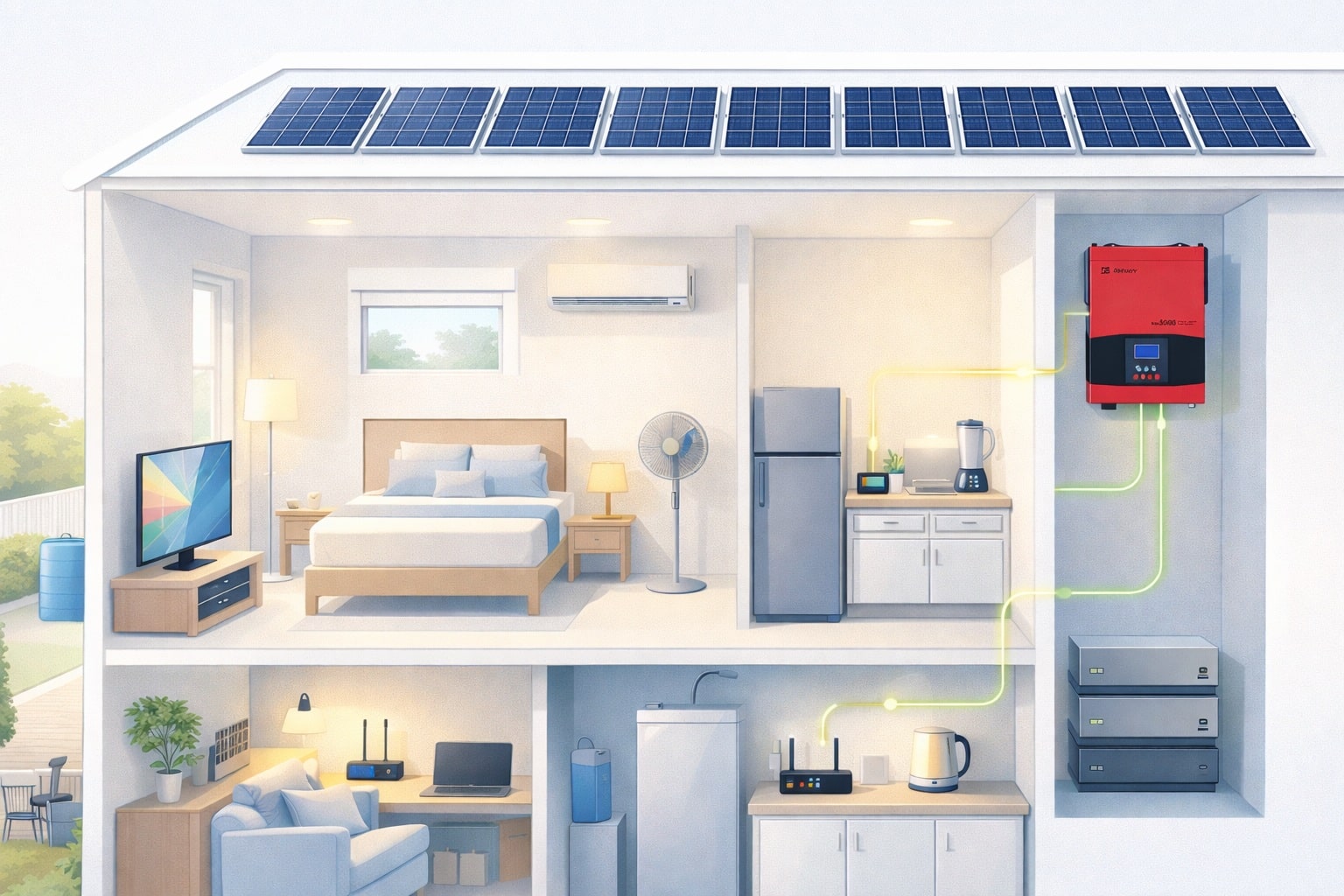
A Mercury 5.5kVA Solar Hybrid Inverter delivers 5,500 Watts of continuous pure sine wave power with an impressive 11,000VA surge capacity (2× rated power for 5 seconds). This system powers heavy inductive loads including a 1.5HP air conditioner, 1HP water pumping machine, double-door refrigerator, chest freezer, washing machine, and all essential lighting/electronics simultaneously, without load shedding or compromise. Ideal for 3-4 bedroom duplexes and premium residential estates requiring whole-home backup without the inconvenience of switching between heavy appliances.
TECHNICAL LOAD ASSESSMENT: 5.5KVA CAPACITY BREAKDOWN
In Nigeria’s evolving energy landscape, where grid reliability fluctuates between Band A and Band B classifications, understanding inverter capacity is essential for making an informed investment. When evaluating what can 5.5kva inverter power, we must examine both continuous running wattage and surge capabilities. The Mercury 5.5kVA PRO Series operates at a power factor of 1.0 (unity), delivering the full 5,500 Watts of real power from its 5,500VA apparent power rating.
This is significantly higher than standard inverters that use 0.8 power factor calculations. With a 48V DC architecture and built-in 100A MPPT solar charge controller supporting up to 6,000W of PV array power (120-450VDC range), this system represents the premium tier of residential solar hybrid technology. Whether you are powering a duplex in Lekki, a bungalow in Abuja, or a commercial office in Port Harcourt, the 5.5kVA capacity provides genuine whole-home energy independence.
Comprehensive Appliance Coverage: Simultaneous Power
To accurately answer what can 5.5kva inverter power, we analyze real-world Nigerian loading scenarios. Not laboratory figures, but how families in Lekki, Abuja, and Port Harcourt actually use their systems daily. The Mercury 5.5kVA delivers a full 5,500 Watts continuous with 11,000VA surge capacity, and the key to maximizing this power is understanding how appliances behave in practice.
Understanding Startup Surge vs Running Power
Every appliance with a motor (your AC, freezer, pumping machine) draws a brief spike of power when it first starts (typically 2-3× its running wattage, lasting 1-3 seconds). This is called startup surge or inrush current. The Mercury 5.5kVA is specifically engineered with 11,000VA peak surge to absorb these spikes effortlessly. Once the compressor is running, power consumption drops to its normal rated wattage. This means you can run heavy appliances. You simply avoid starting them all at the exact same second.
Primary Heavy Loads (Running Simultaneously)
- ✓ Climate Control: One 1.5HP Inverter Air Conditioner (1,200W running, 2,500W startup surge) plus 4-5 ceiling fans (300W total). The inverter AC’s soft-start compressor draws peak power for only 1-2 seconds, and the 11,000VA surge handles this comfortably without voltage sag or tripping.
- ✓ Water Systems: One 1HP pumping machine (750W running, 1,800W surge) for borehole or overhead tank filling. Best practice: start the pump before or after the AC compressor cycles on, not at the same instant. Once both are running, they draw only their rated wattage together (under 2,000W combined).
- ✓ Cold Storage & Kitchen: Double-door refrigerator (250W running), chest freezer (200W running), and washing machine (500W). These compressors cycle on and off naturally throughout the day, so they rarely all surge simultaneously in real usage.
- ✓ Living & Entertainment: 55-inch LED TV (150W), Home Theatre system (200W), DSTV decoder (30W), and gaming console (150W). These are resistive/electronic loads with no startup surge, so they draw exactly their rated wattage from the moment you switch on.
- ✓ Essential Infrastructure: 15-20 LED lighting points (200W total), security cameras & DVR (100W), and Wi-Fi routers (50W). These run 24/7 as your baseline load. Always on, always stable.
The Smart Loading Principle: 70-80% Continuous Target
Professional inverter installations worldwide follow a 70-80% continuous loading rule, meaning your typical running load should sit between 3,850W and 4,400W for a 5,500W system. This is not a limitation; it is engineering best practice that ensures three things:
- ✓ Headroom for Surge: The remaining 1,100-1,650W of continuous capacity absorbs the brief startup surges from compressors without approaching the inverter’s limit. Your AC starts, the pumping machine kicks in, and the system handles it seamlessly.
- ✓ Extended Component Life: Running any inverter at 100% continuously generates excess heat and accelerates wear on IGBT transistors and capacitors. At 70-80%, the Mercury 5.5kVA runs cooler, quieter, and lasts years longer. This is a critical advantage in Nigerian ambient temperatures that regularly exceed 30°C.
- ✓ Battery Efficiency: Higher continuous loads drain batteries faster and reduce round-trip efficiency. At 70-80% loading, your 48V battery bank delivers optimal backup duration per charge cycle.
Real-World Nigerian Usage: In a typical 3-4 bedroom duplex, your actual running load at any given moment is 3,500-4,200 Watts: AC cooling one or two rooms, fridge and freezer maintaining temperature (compressors cycling on/off), fans running, TV on, lights throughout the house, and the pumping machine filling the overhead tank periodically. This sits perfectly within the 70-80% sweet spot, with 1,300-2,000 Watts of headroom available for any appliance that starts up. You are not managing your loads with a checklist. You are simply living normally while the inverter handles the rest.
What This Means For You: The Mercury 5.5kVA does not ask you to choose between your AC and your freezer. It powers your entire home, simultaneously and reliably, when sized correctly with intelligent load awareness. The difference between this system and smaller inverters is exactly this: you think about your life, not your power.
Battery Architecture & Solar Integration
The Mercury 5.5kVA operates on a 48V nominal DC voltage, requiring four 12V batteries in series (typically 4× 200Ah GEL or AGM batteries). This configuration provides:
Energy Storage Math: 48V × 200Ah = 9,600Wh (9.6kWh) total capacity. At 50% Depth of Discharge (DoD) for lead-acid chemistry, you have 4,800Wh usable energy. At a moderate load of 800W (AC + fridge + lights), this delivers 6 hours of continuous backup. At a light load of 400W (fans, TV, lights), you achieve 12+ hours of autonomy.
Solar Charging Capability: The integrated 100A MPPT controller accepts up to 6,000W of solar panels ( Voc max 500VDC). With just 3,000W of panels (10× 300W), you achieve full battery recharge in 4-5 hours of good sunlight, eliminating grid dependency during daylight hours.
The Mercury 2.4kVA Alternative: Strategic Load Segmentation
While the 5.5kVA provides whole-home luxury, the Mercury 2.4kVA Solar Hybrid System offers exceptional value for optimized essential backup. Operating on a 24V architecture with two 200Ah batteries, it delivers 2,400 Watts, sufficient for refrigerators, fans, TVs, and lighting, but not simultaneous AC and pumping operations.
Choosing Between the Two:
- Select 5.5kVA if you require AC cooling during outages, have a water pumping machine, or want zero-compromise living without switching appliances on/off.
- Select 2.4kVA if your priority is essential appliance uptime (fridge, lights, entertainment) with faster ROI and lower initial battery investment.
Both systems utilize Pure Sine Wave output and MPPT technology. The difference is capacity, not quality. The 2.4kVA is not “inferior”; it is precisely engineered for a different load profile. Many customers install the 5.5kVA as the primary house inverter and the 2.4kVA for the boys’ quarters or home office, creating a scalable power ecosystem.
Economic ROI: 5.5kVA vs Generator Costs (2026)
With petrol at 998 NGN/Litre, powering heavy loads via generator is economically devastating. A 5.5kVA petrol generator consumes 1.5-2.0 litres/hour at 75% load. Running AC and fridge for 8 hours daily costs:
| Parameter | 5.5kVA Petrol Generator | Mercury 5.5kVA Solar Hybrid |
|---|---|---|
| Daily Fuel/Cost | 12-16 Litres @ 998 NGN = ~14,000 NGN | 0 NGN (Solar) or ~600 NGN (Grid) |
| Monthly Cost | ~420,000 NGN | ~18,000 NGN (mostly solar) |
| Annual Cost | ~5,040,000 NGN | ~216,000 NGN |
| Noise & Maintenance | High noise, monthly servicing | Silent operation, minimal maintenance |
The Verdict: The 5.5kVA solar hybrid pays for itself in under 6 months of heavy use compared to generator dependency. Over 5 years, you save over 24 Million NGN in fuel and maintenance costs, enough to purchase 4 additional inverter systems.
Installation Excellence for 48V Systems
Maximizing what can 5.5kva inverter power requires professional installation. For 48V systems pulling up to 115A at peak load:
1. DC Cable Sizing: Use 35mm² or 50mm² pure copper cables between batteries and inverter. Aluminum cables are unacceptable for this current level due to resistance losses and terminal corrosion.
2. Battery Bank Configuration: Four 12V batteries must be connected in series (positive to negative) to achieve 48V. Never parallel strings of different ages or capacities. Install batteries in a ventilated rack with 10cm air gaps. Nigerian heat reduces battery life by 50% for every 10°C above 25°C.
3. Protection Devices: Install a 150A DC breaker between batteries and inverter, plus DC surge protection for the solar array (Voc rating 600V minimum). The AC output requires a 25A breaker.
4. Solar Array Sizing: For the 6,000W maximum PV input, use 9× 330W panels in series (2,970W per string) × 2 parallel strings. This 5,940W array reaches full charge by 1 PM even on cloudy days.
Technical FAQ
What can a 5.5kVA inverter power in a Nigerian home?
The Mercury 5.5kVA Solar Hybrid Inverter delivers 5,500 Watts of continuous pure sine wave power at unity power factor (PF 1.0), with an 11,000VA surge capacity for motor startups. It comfortably powers a 1.5HP inverter air conditioner, 1HP water pumping machine, double-door refrigerator, chest freezer, washing machine, ceiling fans, LED lighting throughout the house, and all entertainment electronics simultaneously. This is the ideal whole-home backup solution for 3-4 bedroom duplexes and premium residences across Nigeria.
How many batteries does the Mercury 5.5kVA inverter need?
The Mercury 5.5kVA operates on a 48V architecture, requiring four 12V 200Ah batteries connected in series. This provides 9.6kWh total energy storage. At 50% Depth of Discharge (recommended for lead-acid longevity), you have 4,800Wh of usable capacity, delivering 6-8 hours of backup at moderate loads (AC + fridge + lights) or 12+ hours on lighter loads (fans, TV, lighting).
Should I choose the Mercury 5.5kVA or the Mercury 2.4kVA?
Both are premium Mercury Solar Hybrid systems with pure sine wave output and built-in MPPT controllers. The difference is capacity, not quality. Choose the 5.5kVA if you need air conditioning, water pumping, and full whole-home power on backup. Choose the 2.4kVA if your priority is essential appliances (refrigerator, fans, TV, lighting) with a compact 2-battery setup and faster return on investment. Many customers install both: the 5.5kVA for the main house and the 2.4kVA for the boys’ quarters or home office.
Can a 5.5kVA inverter run an air conditioner and freezer at the same time?
Yes. The Mercury 5.5kVA handles a 1.5HP inverter AC (1,200W running) and a chest freezer (200W running) simultaneously with over 4,000W of capacity remaining for other appliances. The 11,000VA surge capacity absorbs compressor startup spikes without tripping or voltage sag. For optimal performance, simply avoid starting the AC and pumping machine at the exact same moment. Once both are running, the system handles them effortlessly.
How long will the Mercury 2.4kVA system last on batteries?
With the Mercury 2.4kVA Complete Bundle (2× 200Ah GEL batteries, 24V architecture), you get approximately 8-12 hours of backup on a typical essential load of 300-400 Watts (LED TV, ceiling fans, LED lights, phone charging). On lighter loads, backup extends even further. Adding a refrigerator or freezer brings the range to 4-6 hours, which is still excellent for overnight coverage or bridging grid outages.
Is the Mercury 5.5kVA inverter better than running a generator?
Significantly better in every measurable way. At current petrol prices (approximately ₦900-1,000/litre), a 5.5kVA generator costs over ₦400,000 per month to run 8 hours daily. The Mercury 5.5kVA Solar Hybrid costs under ₦20,000 monthly (mostly solar-powered), operates silently, requires minimal maintenance, and pays for itself in under 6 months. Over 5 years, you save over ₦24 million in fuel and servicing costs.
How many solar panels does the Mercury 5.5kVA system support?
The built-in 100A MPPT charge controller supports up to 6,000W of solar panels with a maximum open-circuit voltage of 500VDC. A recommended configuration is 8-10 panels of 330W each (approximately 3,000-3,300W), which achieves full battery recharge in 4-5 hours of Nigerian sunlight. This eliminates daytime grid dependency entirely and keeps your batteries topped up for evening and overnight use.
Secure Your Energy Future
Choose the Mercury inverter that matches your power lifestyle: whole-home luxury with the 5.5kVA or optimized efficiency with the 2.4kVA.
Explore All Systems