
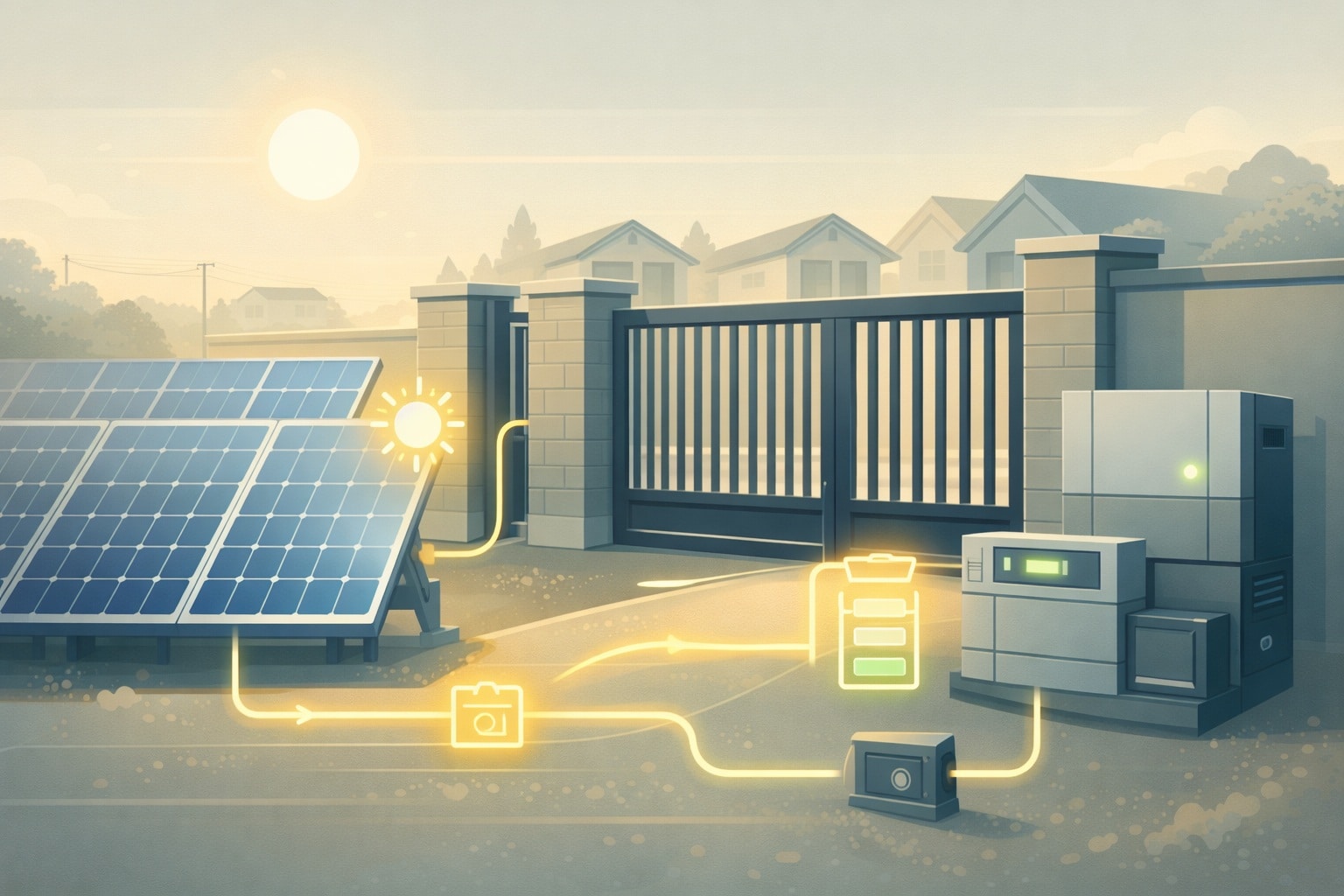
Calculate Solar Needs for Estate Security Gates (2026)
Ensuring Uninterrupted Perimeter Security
In the context of Nigerian estate management, power reliability at the entry point is non-negotiable. Security personnel and automated systems require consistent energy to maintain access control and surveillance. Understanding how to calculate solar panel needs for estate security gate infrastructure is the first step toward eliminating vulnerability gaps caused by grid instability.
An under-sized system leads to battery depletion during critical night hours, while over-sizing results in unnecessary capital expenditure. This guide provides a precision-based framework for dimensioning your solar array, ensuring your electric fences, automated barriers, and CCTV systems remain operational regardless of DISCO availability.
Load Profiling for Security Infrastructure
Accurate solar sizing begins with a granular audit of the security gate’s energy footprint. Unlike residential loads, security gates have a distinct profile characterized by constant low-power draws (cameras, energizers) and intermittent high-current surges (gate motors).
Critical Load Components
To determine the necessary PV array size, we must aggregate the daily watt-hour consumption of typical 2026 standard equipment:
- Surveillance (CCTV): An 8-channel NVR and cameras typically draw 40W-60W continuously. Over 24 hours, this equates to roughly 1.44kWh.
- Perimeter Defense (Electric Fence): Standard energizers (e.g., Nemtek) consume between 20W and 40W. This adds another ~0.96kWh daily.
- Access Control (Gate Motors): While a slide gate motor may be rated at 500W, it operates for seconds at a time. A gate cycling 100 times a day accumulates approximately 0.2kWh, but requires high instantaneous surge capacity from the inverter.
- Lighting: Four 50W LED floodlights running for 12 hours create a significant 2.4kWh load.
Total Estimated Daily Load: Approximately 5kWh per day for a fully equipped gatehouse. This baseline establishes the minimum energy the solar array must harvest within Nigeria’s average of 4.5 peak sun hours.
The Solar Harvest Equation
The calculation formula for the solar array is: (Total Daily Load x 1.3 System Loss Factor) / Peak Sun Hours.
For a 5kWh load: (5000Wh x 1.3) / 4.5h = 1,444 Watts. This indicates a requirement for a solar array capable of generating roughly 1.5kW to keep the battery bank charged and the load powered.
Recommended System Configuration
For the load profile described above, the Mercury 2.4kVA Solar Hybrid Inverter acts as the central intelligence unit, managing power flow between the solar array, the battery bank, and the grid.
Mercury 2.4kVA Solar Hybrid Inverter System (2x 200Ah BUNDLE)
This bundle is engineered to handle the specific inductance of gate motors while providing ample reserve for static loads like CCTV.
- Inverter Capacity: 2400VA (24V System). Provides sufficient headroom for motor startup surges which can spike up to 3x rated power.
- Battery Storage: 2x Mercury 200Ah GEL Deep Cycle Batteries provide a total of 4.8kWh storage capacity. At 50% Depth of Discharge (DOD), this offers 2.4kWh of backup, sufficient for overnight operations if lighting loads are managed efficiently.
- Solar Controller: Built-in MPPT integration ensures optimal charging from the PV array, protecting the battery bank from over-voltage.
PV Array Recommendation: To support this bundle, install 4x 350W Monocrystalline Panels (1400W Total). This aligns with the calculated 1444W requirement, ensuring the batteries reach full saturation daily.
Why Mercury Direct is the Industry Standard
Mercury Direct has powered Nigerian infrastructure for decades. Our systems are not generic imports; they are calibrated for the harsh voltage fluctuations typical of the Nigerian grid and the high thermal conditions of our environment.
The Mercury 2.4kVA Solar Hybrid Inverter features a robust transfer switch
that ensures seamless changeover. When the grid fails, your electric fence and cameras do not blink. This millisecond transfer speed is critical for security data integrity.
Additionally, our 200Ah Deep Cycle Batteries utilize thick-plate technology, designed to withstand the frequent cycling required by nightly discharge protocols. Unlike automotive batteries often wrongly applied in these scenarios, Mercury batteries maintain capacity integrity over hundreds of deep cycles.
Financial Efficiency: Solar vs. Diesel Generators
Operating a diesel generator for low-load security gates is financially inefficient due to “wet stacking” and high fuel consumption relative to the small load. In 2026, with diesel prices averaging high rates across Nigeria, the operational expenditure (OPEX) is significant.
The Cost of Diesel Dependency
Running a 5kVA generator for 12 hours nightly to power a 400W average load consumes approximately 10-15 liters of diesel. Over a month, this amounts to over N400,000 in fuel costs alone, excluding maintenance. The generator operates at poor efficiency because the load (security gate) rarely utilizes the generator’s full capacity.
Solar Return on Investment (ROI)
The Mercury 2.4kVA Bundle represents a Capital Expenditure (CAPEX). However, with zero fuel costs, the break-even point is typically reached within 4 to 6 months compared to diesel operation. Furthermore, solar systems eliminate the noise and fumes associated with generators, improving the environment for security personnel.
For current energy tariff structures and regulatory standards, refer to the Nigerian Electricity Regulatory Commission (NERC) guidelines on renewable energy integration.
Calculate Solar Needs for Estate Security Gates Frequently Asked Questions
Can the 2.4kVA inverter handle a heavy sliding gate motor?
Yes. The Mercury 2.4kVA inverter provides sufficient surge capacity to handle the startup current of standard residential and light-commercial sliding gate motors (up to 1HP), provided the total concurrent load does not exceed the inverter’s maximum output.
How many solar panels do I need for a 24V gate system?
To effectively calculate solar panel needs for estate security gate setups using a 24V system, we recommend a minimum of 1000W to 1400W of PV power (e.g., four 350W panels). This ensures the battery bank fully recharges during the day even after a night of discharge.
What happens during the rainy season?
Solar production decreases during heavy cloud cover. However, the Mercury 2.4kVA Hybrid Inverter can supplement solar charging with grid power (if available) or generator input to keep batteries topped up, ensuring zero downtime.