
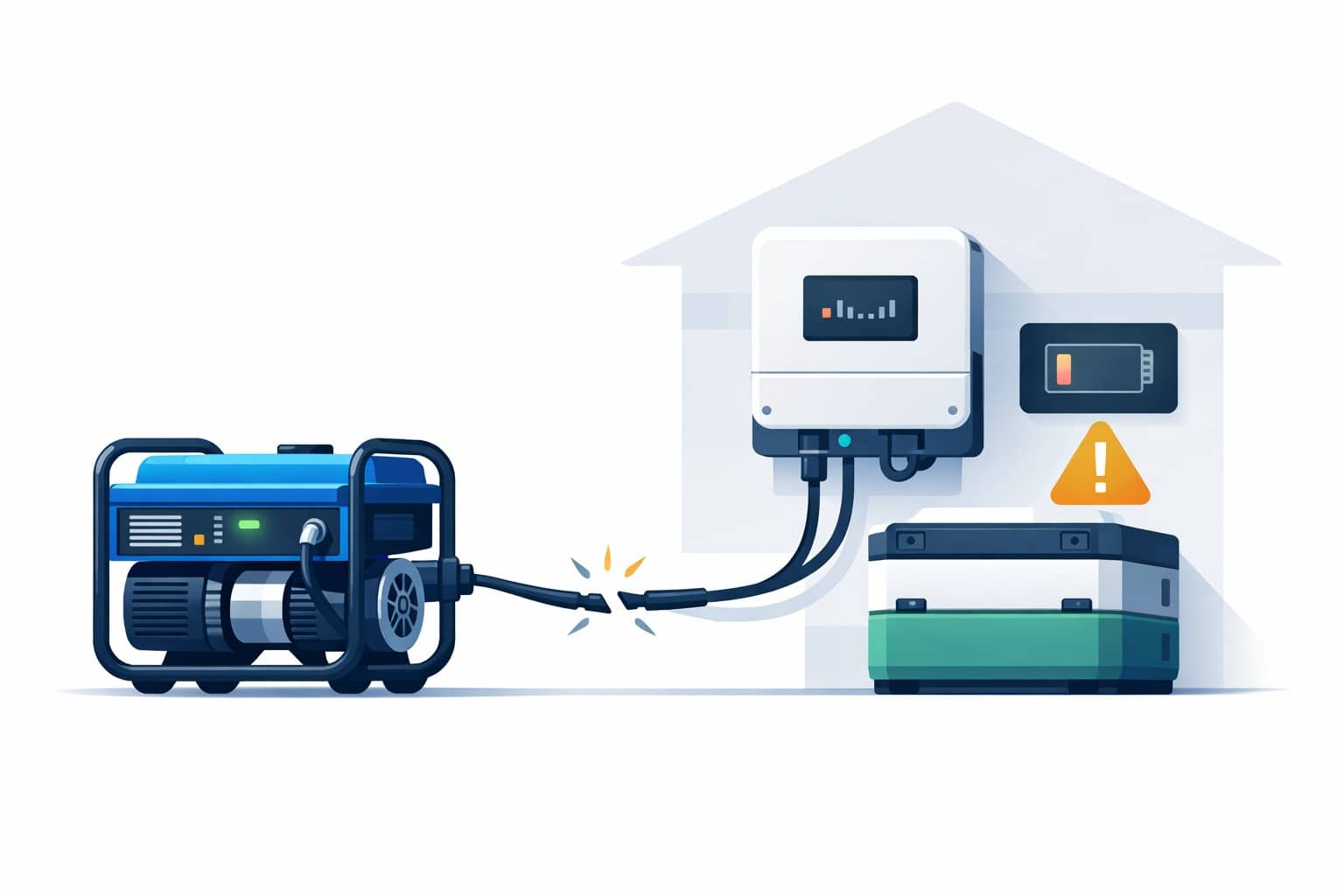
GENERATOR NOT CHARGING INVERTER? HERE’S WHY (NIGERIA GUIDE)
Reviewed by Mercury Direct Technical Team · Practical inverter troubleshooting for Nigerian homes and businesses
If your generator is running but your inverter is not charging, the most common cause in Nigerian homes is that the generator is too small, overloaded, or producing power the inverter does not trust. Small 0.9 to 1.2kVA generators are especially poor charging sources for inverter systems, even when they can run a few household loads. Other causes include wiring or changeover faults, charger settings that are too low or disabled, or an internal inverter or battery fault. A quick test: turn off most house loads and leave only the inverter input connected to the generator. If charging starts, the generator is undersized. If the inverter still rejects it, the power quality is likely too poor. Chat with Mercury Direct for proper diagnosis.
THE PROBLEM: FUEL IS BURNING BUT BATTERIES ARE NOT MOVING
If your generator is not charging your inverter, the problem is usually not mysterious. This is a common pattern in Nigerian homes. NEPA is unreliable, so you bought an inverter for quiet light and fans. You kept the generator for backup. In your mind: “If I turn on the generator, it will charge the batteries.”
Then you check the inverter while the generator is running. The battery level is the same, or creeping up so slowly it barely matters. Fuel is burning. Money is going. But the batteries are barely charging, or not charging at all.
This guide explains why your generator and inverter are not working together the way you expected, and what you can do about it.
Important: In many cases, the inverter may show a charging icon without delivering meaningful charging. If the battery level barely improves after hours of generator use, the setup is still not charging properly in any practical sense. A charging icon on the display does not mean the batteries are actually gaining useful charge.
Key diagnostic clue: If your inverter charges normally on NEPA but not on generator, the inverter charger itself is probably fine. The problem is more likely generator output quality, generator overload, poor voltage stability, or charger settings that reject generator-quality power.
QUICK CHECKS BEFORE YOU BLAME THE INVERTER
Before assuming the inverter is faulty, run through these checks. They do not require opening any panels.
Check 1: Is the Inverter Seeing the Generator at All?
When the generator is running, look at the inverter display. Does it show “AC IN”, “LINE”, “CHG”, or any charging icon? Do any indicator lights change when you start the generator?
If the inverter behaves as if nothing is connected, the issue is in the path between the generator and the inverter input:
- Generator output not wired to inverter input: The generator may be connected to circuits that do not feed the inverter.
- Changeover in wrong position: The manual changeover may not be set to the position that connects the generator to the inverter line.
- Breaker or fuse off/blown: The MCB or fuse between the generator and inverter input may be off or damaged.
- Bad socket, plug, or extension: If you are using a plug-in connection, a faulty socket or extension can break the path.
Trace the path: generator to changeover/MCB to inverter AC input. If you are not comfortable with electrical panels, stop here and call a technician.
Check 2: Is the Generator Strong Enough?
This is the most common cause. A typical Nigerian setup: 0.9 to 1.2kVA “Tiger” generator with the full house plugged into it, and the inverter also connected, expected to charge batteries in the background.
The generator is already struggling to run basic loads alone. There is nothing left for charging.
Simple test: Turn off or unplug most house loads from the generator (fridge, freezer, AC, pump, pressing iron, kettle). Leave only the inverter input and maybe a few low-watt bulbs. Start the generator and watch the inverter. Does it now show “charging”? Do the battery bars start moving?
If charging starts only when you remove other loads, the generator is too small or overloaded for what you are asking it to do. That is not an inverter fault. That is a generator capacity issue.
Check 3: How Does the Inverter Behave on Generator Power?
With the generator on and connected, watch the inverter closely. Does it click on and off repeatedly? Show “AC input” for a few seconds then drop? Flash error codes related to input or voltage?
This behaviour usually means the generator voltage is too low under load, or the power is too unstable for the inverter to accept safely. The inverter is rejecting the input to protect itself and the batteries.
WHY YOUR GENERATOR IS NOT CHARGING THE INVERTER
1. Generator Too Small or Overloaded
An inverter charger needs a certain amount of power to operate. If the generator is small and already loaded with house appliances, there is nothing left to charge the batteries.
Consider a typical scenario: a 1kVA Tiger generator running a fridge, lights, TV, maybe a small pump, plus the inverter charger trying to pull continuous charging power from the generator. The generator struggles, voltage drops, and the inverter either senses bad conditions and drops charging, or the installer has already set the charger current very low to avoid overloading the generator.
If your test in Check 2 showed that charging only works when you remove house loads, the limitation is generator capacity. A small generator cannot do big generator work, no matter the settings.
2. Low Voltage or Unstable Power from the Generator
Most inverters expect voltage within a certain range (typically 200V to 240V AC) and reasonably stable frequency (50Hz in Nigeria). Many small or old generators in Nigeria drop voltage significantly when loaded (160V to 180V instead of 220V to 230V), have poor or no AVR (automatic voltage regulation), and produce a rough waveform under load.
Frequency is just as important as voltage. Most inverters accept a narrow frequency window, typically 47Hz to 53Hz. Small generators often run at 52Hz or higher when unloaded and drop to 48Hz or lower under load. If the generator “hunts” (you can hear it revving up and down, unable to settle at a steady speed), the frequency is swinging outside the inverter’s acceptable range. The inverter will never lock in and accept charging under those conditions. This is one of the main reasons quality inverters reject small generators, even when the voltage looks acceptable on a meter.
The inverter sees unstable voltage or frequency as unsafe, so it clicks in and out of charging or refuses to charge at all. In practical terms, the generator is producing dirty power, and the inverter is protecting itself and your batteries.
You can sometimes improve this with a generator that has proper AVR and a governor that holds steady frequency under load. A stabiliser between the generator and inverter can help with voltage, but it does not fix frequency instability. If the generator is hunting, no external device will stabilise the frequency for it. You need a better generator.
3. Wiring, Breaker, or Changeover Issues
Even if the generator is strong enough and the power is clean, the inverter may not see it if the generator is wired to a circuit that does not feed the inverter input, the manual changeover is not in the correct position, or a breaker or fuse on the generator-to-inverter path is off or faulty.
The typical sign: the generator is running, other parts of the house have light, but the inverter shows nothing. No AC input, no charging icon.
What to do: Confirm which sockets and lines are on the generator circuit, and which line the inverter input is actually connected to. If there is a visible MCB labelled “INV” or similar, check it is on. If you are not sure which circuit feeds the inverter, stop and call an electrician to trace the circuit properly.
4. Charger Settings Too Low or Disabled
Some inverters, especially hybrids and higher-end models, have settings for charging current from AC (NEPA or generator) and input voltage window. Installers sometimes reduce charging current to avoid overloading a weak generator, set a very narrow input voltage range, or even turn off AC charging entirely.
To the owner, this looks like “generator no dey charge inverter” or “it is taking forever to charge”. The charger may be limited to a very small current (for example, 5A) or disabled for generator input altogether.
What to do: Have a professional check the inverter menu and parameters, match the charging current to your generator size, and adjust the input voltage range appropriately without risking damage to the inverter or batteries.
5. Battery or Inverter Internal Fault
If your generator is confirmed strong and stable, wiring and changeover are correct, charger settings are appropriate, but the inverter still refuses to charge from any AC source (NEPA or generator), then you may be dealing with a charger board fault inside the inverter, or a battery bank fault: very weak or sulphated batteries, a bad cell dragging the bank down, or the charger shutting itself down to avoid overheating or overcurrent.
At this point, there is no safe DIY fix. The system needs proper diagnosis by a technician, and possible workshop repair or replacement of parts.
GENERATOR + INVERTER DIAGNOSTIC SUMMARY
| Symptom | Most Likely Cause | What To Do |
|---|---|---|
| Inverter shows nothing when gen starts | Wiring, changeover, or breaker fault | Trace the gen-to-inverter path, check MCBs |
| Charges only when house loads are removed | Generator too small or overloaded | Reduce loads or upgrade generator |
| Inverter clicks on and off on gen | Low voltage, unstable frequency, or dirty power from generator | Reduce load, check for hunting/surging, add AVR if needed, or upgrade gen |
| Charging is very slow (hours for minimal gain) | Charger current set too low | Have a technician adjust inverter settings |
| No charging from any AC source (NEPA or gen) | Internal charger or battery fault | Call a technician for diagnosis |
WHY “SMALL TIGER + INVERTER” DOES NOT WORK
This is one of the most common Nigerian power mistakes: buying a small Tiger generator to “manage”, then later adding an inverter and expecting the generator to quietly recharge batteries in the background. In practice, that small generator is usually already close to its limit before charging even starts.
The Tiger is already at its limit running a fridge, lights, TV, maybe a small pump. Asking it to also charge batteries is adding another constant, heavy load on top of what is already too much. So either the installer limits the charger to a very low current to avoid tripping the generator, or the generator struggles, voltage drops, and the inverter keeps rejecting it.
If you want your generator to charge your inverter effectively, that combination must be planned from the start, with a generator sized to handle both house loads and charging current. Plugging them together after the fact and hoping for the best is how you end up burning fuel with nothing to show for it.
WHAT SIZE GENERATOR CAN CHARGE AN INVERTER PROPERLY?
The generator must be sized to handle the inverter’s charging current plus any house loads running at the same time. But sizing is not just about wattage on paper. The generator must also hold stable voltage and frequency under continuous load. In Nigerian conditions, with real generators (not lab units), that means sizing more conservatively than pure maths suggests.
Practical Sizing Rules
- 0.9 to 1.2kVA generator: Not a proper charging generator for most inverter systems. Even if the inverter shows charging briefly, the generator is usually too weak and too unstable for sustained, meaningful charging.
- Charging only (no house loads on generator): Size the generator to at least 125% to 150% of the battery charger’s power draw. This gives headroom so the generator is not running at full capacity.
- Charging + house loads at the same time: Add the charger’s wattage to the total running wattage of your appliances, then add a 20% safety buffer on top.
- Continuous operation (over 5 hours): Keep the total load to 60% to 75% of the generator’s rated capacity. Running a generator at or near maximum for hours causes overheating and shortens its life.
Practical Generator Sizing for Common Nigerian Inverter Setups
| Inverter Size | Battery Bank | Practical Minimum Generator | Notes |
|---|---|---|---|
| 1.2 to 1.5kVA | 1 x 200Ah (12V) | 2.0kW to 2.5kW | Small loads + charging, AVR recommended |
| 2.4kVA | 2 x 200Ah (24V) | 3.5kW to 5.0kW | Most common Nigerian home system |
| 3.5kVA (24V) | 2 x 200Ah (24V) | 5.0kW+ | Mid-range home, needs AVR generator |
| 3.5kVA (48V) | 4 x 200Ah (48V) | 6.5kW+ | Larger battery bank, higher charging demand |
| 5.0 to 5.5kVA | 4 x 200Ah (48V) | 7.5kW+ | Larger systems, dedicated charging circuit |
These are practical starting points for Nigerian installations, not exact engineering limits. Actual generator size depends on charging current setting, battery bank voltage, generator quality, and whether other loads are running at the same time. When in doubt, go one size up.
Key Sizing Considerations
Charging rate: For lead-acid and tubular batteries, a safe charging rate is typically one-tenth of the battery capacity. For a 200Ah battery, that is about 20A. Make sure your inverter’s charging current setting matches what your generator can actually deliver after accounting for house loads.
Inverter efficiency: Inverters are typically 80% to 95% efficient. Factor in a 15% to 20% loss when calculating total wattage. If the charger draws 1,000W from the AC side, roughly 800W to 850W actually reaches the batteries.
Power quality: The generator must provide stable voltage (220V to 230V in Nigeria) and stable frequency (50Hz). If the power is unstable, the inverter will reject it regardless of whether the generator is big enough. Generators with AVR (automatic voltage regulation) are strongly recommended for inverter charging.
Why a Small Generator Still Fails (Even When the Maths Looks Possible)
A homeowner has a 24V inverter system with 2 x 200Ah batteries and expects a small generator to charge it while also running lights, TV, and a fan.
On paper, the charging demand may not look impossible at a reduced charge current. But in Nigerian conditions, the problem is not wattage alone. The generator must also hold stable voltage and frequency while the inverter charger is pulling power continuously. Small generators, especially 0.9 to 1.2kVA units, often sag badly under this kind of sustained demand. The result is familiar: the inverter clicks in and out, charging is extremely slow, or the inverter rejects the generator completely.
That is why small generators are poor charging partners for inverter systems, even when they seem manageable on paper. At Mercury Direct, this is one of the most common generator-and-inverter complaints we see in Nigerian homes.
SMARTER OPTIONS: SIZED GENERATOR OR SOLAR
Option 1: Properly Sized Generator + Inverter System
If you want to keep using a generator as a charging source, choose one with enough kVA to run your essential loads and feed a reasonable charging current to the batteries, and with AVR for stable voltage. Have your installer set a realistic charging current based on that generator size, and wire and protect the generator-to-inverter path properly.
The result: batteries charge faster when the generator is on, less fuel wasted on failed charging attempts, and fewer trips, clicks, and strange inverter behaviour.
Option 2: Move Most Charging to Solar
Instead of making the generator your main charger, install solar panels with a proper charge controller or hybrid inverter. Use sunlight for most daily charging, NEPA to top up when available, and the generator only as backup during long cloudy periods or extended outages.
The benefits are significant: fuel cost drops sharply, the generator runs fewer hours (less wear, less noise), and the batteries get more consistent, gentle charging from solar. For many Nigerian homes and small businesses, this is the long-term answer. The generator becomes occasional backup, not the daily charging engine.
WHEN TO CALL A PROFESSIONAL IMMEDIATELY
Stop experimenting and call a technician or Mercury Direct support if:
- Generator sound changes badly: If the generator keeps “dragging” or surging when the inverter tries to charge, something is overloading it or the power quality is dangerously unstable.
- Voltage indicators going wild: If the generator or inverter voltage readings are fluctuating erratically when connected together, disconnect and get professional help.
- You have already tried the basics: If you have reduced house loads, checked obvious wiring and changeover issues, confirmed the generator is not undersized, and there is still no charging, the fault is deeper than surface checks can reach.
At that point, the goal is no longer “let me try one more thing.” It is: protect your equipment and your money.
GENERATOR NOT CHARGING INVERTER FAQ
Can a small Tiger generator charge an inverter?
In Nigerian conditions, a small 0.9 to 1.2kVA Tiger generator is usually not a reliable charging source for an inverter system. Even when it can show a charging icon briefly, voltage drop, overload, and poor power quality often make the charging too weak or too unstable to be useful. For proper inverter charging, you typically need a generator of at least 2.5kVA with AVR, and larger if you are running house loads at the same time.
My inverter clicks on and off when the generator is running. Why?
The generator voltage is likely dropping too low, or the frequency is unstable (you can hear it as the generator revving up and down). The inverter detects unsafe power and disconnects to protect itself and the batteries. A generator with AVR and a stable governor can help, but only if the generator is also adequately sized for the total load.
Will a stabiliser fix my generator-to-inverter charging problem?
A stabiliser can help if the problem is low or unstable voltage from the generator. It will not help if the generator is simply too small to handle the total load plus charging current, and it cannot fix frequency instability (the generator revving up and down). A stabiliser improves voltage quality, but it does not create additional power capacity or stabilise frequency.
How do I know what size generator I need to charge my inverter?
Add up the wattage of the loads you want to run on the generator, then add the inverter’s charging power draw (check the manual for maximum charge current in amps, multiply by voltage). Add a 20% safety buffer to the total. For continuous running, keep the total load to 60% to 75% of the generator’s rated capacity. See the sizing table above for practical Nigerian setups: a 2.4kVA inverter with 2 x 200Ah batteries typically starts from around 3.5kW, with 5.0kW often giving better performance, especially if other loads are running. A 5.0 to 5.5kVA system needs 7.5kW or more.
Is it better to charge my inverter with solar or generator?
Solar is better for daily charging because it is free after the initial investment, gentle on batteries, and runs silently. Generator charging is faster in a pinch but costs fuel every time and wears the generator. The ideal setup for most Nigerian homes is solar as the primary charger, NEPA when available, and generator only as emergency backup.
My inverter charges fine on NEPA but not on generator. What does that mean?
This confirms that the inverter charger works. The problem is with the generator output: either the voltage is too low or unstable, the generator is overloaded, or the charger settings have been configured to reject generator-quality power. Have a technician check the generator output voltage under load and compare it to the inverter’s acceptable input range.
STOP BURNING FUEL FOR NOTHING
If your generator is running but your batteries are not charging, the setup needs to be reviewed, not just the inverter. Send us a WhatsApp message with your generator size and brand, inverter size (kVA), and battery bank details. We will tell you if the problem can be fixed with settings and wiring, or if you need a properly sized generator + inverter system or a solar-first setup that charges reliably without burning fuel every day. Call 07037451701 or chat on WhatsApp.
Chat With Mercury Direct →