
Inverter Not Charging? The #1 Fix Takes 2 Minutes
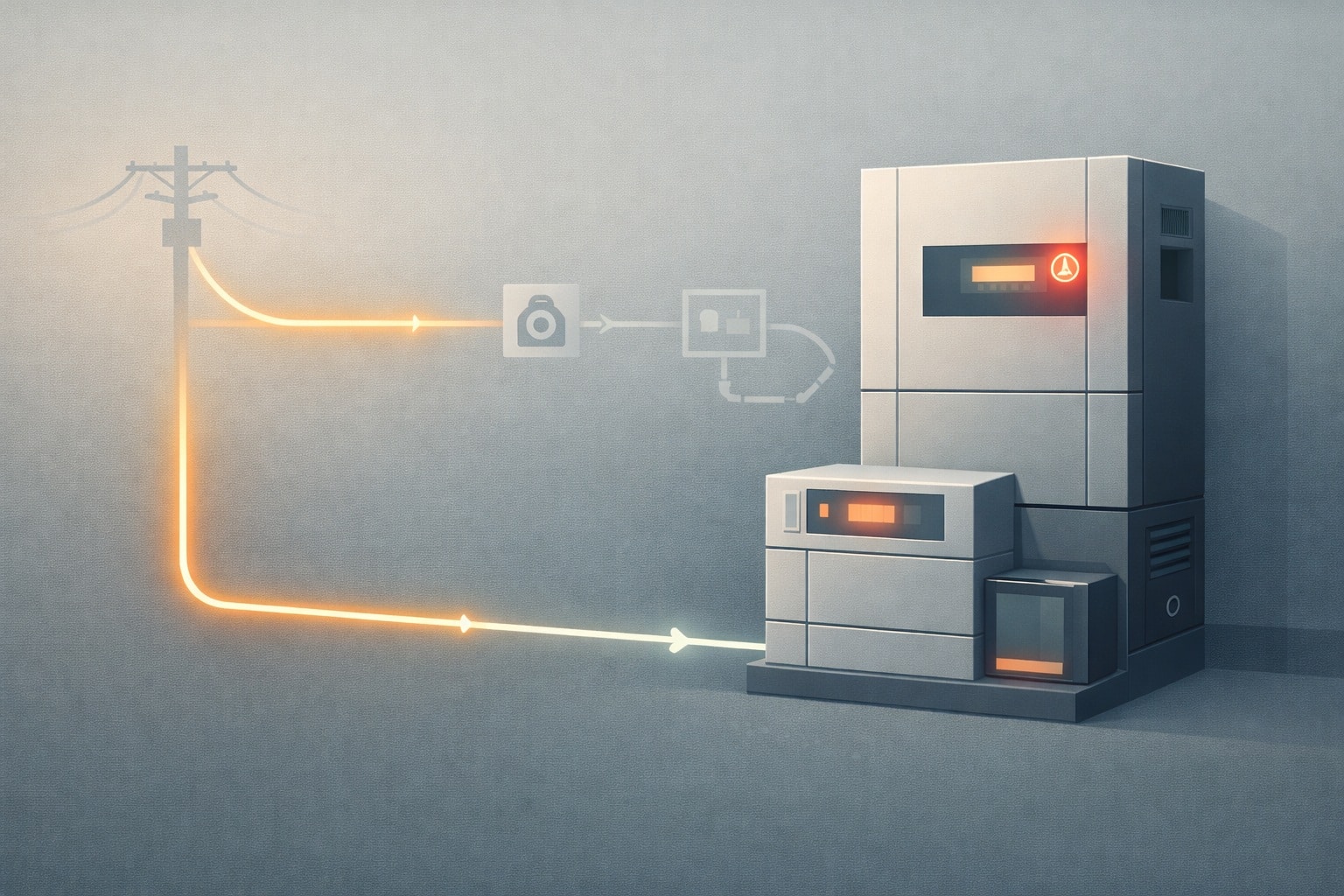
The most common reason your inverter won’t charge is a tripped breaker. There are usually two breakers to check: the AC charging breaker in your distribution board (DB) that supplies mains power to the inverter, and a separate input breaker on the inverter itself, sometimes mounted externally beside it. Reset both. Flip the DB breaker fully back to ON, then press the inverter’s reset button firmly until you hear or feel a click. If the charging indicator comes on, you’ve just saved yourself ₦15,000 to ₦50,000 on an unnecessary technician visit. In fact, well over half of “dead” inverter complaints are resolved by this single step.
The 4-Minute Self-Diagnosis (Try These First)
Before you spend money on a technician, work through these four checks in order. Our service team at Mercury Direct has found that the vast majority of inverter charging failures come down to one of these causes. If you are not yet sure which inverter suits your home, start with our Inverter Buying Guide Nigeria 2026 for a complete sizing walkthrough.
1. Check the Circuit Breaker (40% of Cases)
There are typically two breakers in the charging path, and either one can kill charging silently. First, check the AC charging breaker in your distribution board (DB) — this is the breaker that feeds mains power from the grid to your inverter’s input. It is usually labelled “Inverter”, “UPS”, or “Backup”. Flip it back to ON if it has tripped. Second, check the separate input breaker on or near the inverter itself — many installations have an external isolator switch or miniature circuit breaker (MCB) mounted on the wall beside the inverter, and some models also have a built-in breaker or reset button on the rear panel. When power surges hit during grid restoration, either or both of these breakers can trip to protect the circuit. If the inverter display lights up and the charging indicator begins to blink after resetting, your unit is fine and the breakers simply did their job. Nigerian grid power is notorious for sudden voltage spikes when supply returns after an outage, which is why this is the number one cause of charging failures across the country.
2. Check the Input Fuse (25% of Cases)
Locate the fuse compartment near the AC input terminal, usually on the rear panel. Remove the fuse and hold it up to light — a blown fuse will have a visibly broken metal strip inside the glass tube. Replace it with one of the identical rating, typically 10A or 15A depending on your model. Check your inverter user manual for the exact fuse specification. Never use a higher-rated fuse as a workaround; this bypasses overcurrent protection and risks permanent damage to the charger board.
3. Check Battery Voltage (20% of Cases)
Set your multimeter to DC volts and place the probes on the battery terminals. A healthy 12V deep-cycle battery should read at least 11.5V. If the reading drops below 10.4V, the battery is too deeply discharged for the inverter’s built-in charger to activate. This is a safety feature — attempting to charge a severely depleted battery at full current can cause dangerous overheating. Batteries in this state need professional boost-charging with a specialised external charger, or outright replacement if the cells are damaged. Use our Battery Backup Time Calculator to verify whether your battery capacity still matches your actual load.
4. Check the Charging Mode (15% of Cases)
Most inverters have a UPS/INV mode selector switch on the rear panel. UPS mode enforces a strict input voltage window of 170V–280V. If your area receives grid power below 170V, the inverter will refuse to charge even though the supply is technically present. INV (wide-range) mode accepts input from 90V–280V, making it far more tolerant of the voltage fluctuations common in many parts of Nigeria. The Nigerian Electricity Regulatory Commission (NERC) sets service standards, but real-world delivery varies enormously by feeder and location. Switch to INV mode if your area consistently receives low voltage.
Still Not Charging? Advanced Troubleshooting
If the four-step diagnosis above did not resolve your issue, the problem is likely internal or related to your battery bank. Here are the remaining causes our technicians encounter regularly.
Error Code F5: Fan Failure
Your inverter has shut down charging to prevent overheating. Ensure at least 20cm clearance on each side and 50cm above the unit. Clean dust from the ventilation grilles with a dry cloth. If the fan still does not spin after clearing obstructions, the fan motor needs replacement by a qualified technician. Running an inverter with a dead cooling fan will eventually destroy the MOSFET transistors on the charger board, turning a ₦5,000 repair into a ₦50,000 one.
Wrong Charging Current Setting
Many inverters have a 10A/20A charging current selector. The 10A setting is designed for batteries of 100Ah and smaller. The 20A setting is for batteries above 100Ah. If you are running a 200Ah battery bank on the 10A setting, charging will be painfully slow and the inverter may appear not to charge at all under load. Conversely, pushing 20A into a small 100Ah battery can reduce its lifespan through excessive heat generation.
Corroded Battery Terminals
Look for white or green powder forming around the battery terminal posts. This corrosion creates a resistive barrier that prevents adequate current flow between the charger and the battery. Disconnect the cables (negative first, then positive), scrub the terminals with a wire brush or a paste of baking soda and water, then reconnect firmly (positive first, then negative). The high humidity levels across southern Nigeria accelerate this corrosion significantly, making it a maintenance task that should be performed monthly.
Why Your Generator Won’t Charge the Inverter
If your inverter charges normally from grid power but refuses to charge from your generator, the issue is almost always one of the following. Your generator may be too small — a 2.4kVA inverter requires at least a 3kVA generator to provide stable charging current. The voltage output may be too unstable, in which case switching the inverter to INV (wide-range) mode often resolves the issue. The generator’s frequency may be off — let the generator run for two to three minutes to stabilise before connecting. Some cheaper generators also produce “dirty” power with distorted waveforms that sophisticated inverter chargers reject as unsafe. According to the U.S. Energy Information Administration’s Nigeria energy analysis, grid infrastructure challenges remain widespread, reinforcing why properly configured backup systems are essential.
Error Code Quick Reference
| Error Code | Meaning | Quick Fix |
|---|---|---|
| F1 | Battery overvoltage | Disconnect battery, reconnect after 2 minutes |
| F2 | Output short circuit | Check connected appliances for faults |
| F3 | Overload | Reduce connected load below rated capacity |
| F5 | Fan failure | Clear ventilation, clean dust from grilles |
| F8 | Battery under-voltage | Battery needs boost-charging or replacement |
Prevention: How to Avoid This Next Time
Monthly: Clean battery terminals with a wire brush and apply petroleum jelly to prevent corrosion.
Monthly: Check and clear inverter ventilation grilles of dust and debris.
After every outage: Reset the circuit breaker if the inverter does not resume charging automatically.
Quarterly: Top up distilled water in tubular lead-acid batteries, ensuring electrolyte covers the plates by at least 10mm.
Always: Use a surge protector between the wall socket and your inverter. A voltage stabilizer absorbs grid spikes before they trip your breaker.
When to Call a Technician
Stop troubleshooting and call 0703-745-1701 if none of the above fixes worked, you detect a burning smell or see visible damage to the circuit board, error codes other than F5 appear repeatedly after resets, or the inverter was struck by lightning. Diagnostic visit costs ₦5,000 and is waived if you purchase a replacement unit from us. Lagos customers receive same-day service. Visit our Contact page or send a WhatsApp message with a photo of your inverter and the error code displayed.
Solar Charging Issues
For homeowners running solar hybrid inverter systems, charging failures can also originate from the photovoltaic side. Dust accumulation on solar panels during harmattan season can reduce output by 20% to 40%. Clean panels monthly with a soft cloth and clean water. Verify that the PV input voltage on the inverter display reads within the expected range for your panel configuration. If it reads zero, inspect the MC4 connectors for loose connections or water ingress. Even partial shading on a single panel in a series string can dramatically reduce the output of the entire array.
Inverter not charging FAQ
How do I know my inverter is fully charged?
Battery indicator bars stop blinking and show solid bars. Most models display “100%” on the LCD or the charging LED switches from blinking to steady green. You can also confirm with a multimeter — a fully charged 12V battery reads between 12.8V and 13.2V at the terminals.
Can I use an inverter with my generator?
Yes. The inverter stores generator power in the batteries, allowing you to run the generator for just two to three hours instead of all night. Ensure your generator’s rated output exceeds the inverter’s input requirement by at least 30%. For a 2.4kVA inverter, use a minimum 3kVA generator. Switch the inverter to INV mode for best compatibility.
My inverter shows “Low Battery” very quickly after charging. Why?
The battery is either weak due to age, or one battery in your bank has failed while the others still hold charge. A single dead cell in a battery bank drags the entire system down. Test each battery individually with a multimeter under load. Replace any battery reading below 10.4V after a full charge cycle. Visit our deep-cycle battery range for replacement options.
How long should an inverter battery last on a single charge?
A 200Ah battery powering a typical household load of 400W–600W should last approximately four to eight hours, depending on the appliances connected. Use the formula Time = (Battery Voltage × Ah × Depth of Discharge) ÷ (Load ÷ Inverter Efficiency) for a precise estimate, or try our Battery Backup Time Calculator for instant results.
Can I charge my inverter with solar panels instead of grid power?
Yes, if you have a solar hybrid inverter. These systems accept both grid AC and solar DC input, charging the battery from whichever source is available. Solar charging eliminates generator fuel costs entirely and reduces your dependence on increasingly expensive grid electricity. Mercury hybrid inverters include an inbuilt MPPT charge controller for maximum solar harvest.
Secure Your Energy Future
Mercury Direct provides high-performance , , and complete tailored for the Nigerian climate. Every product includes a minimum 12-month warranty and free professional installation. Have questions f…
inverters