
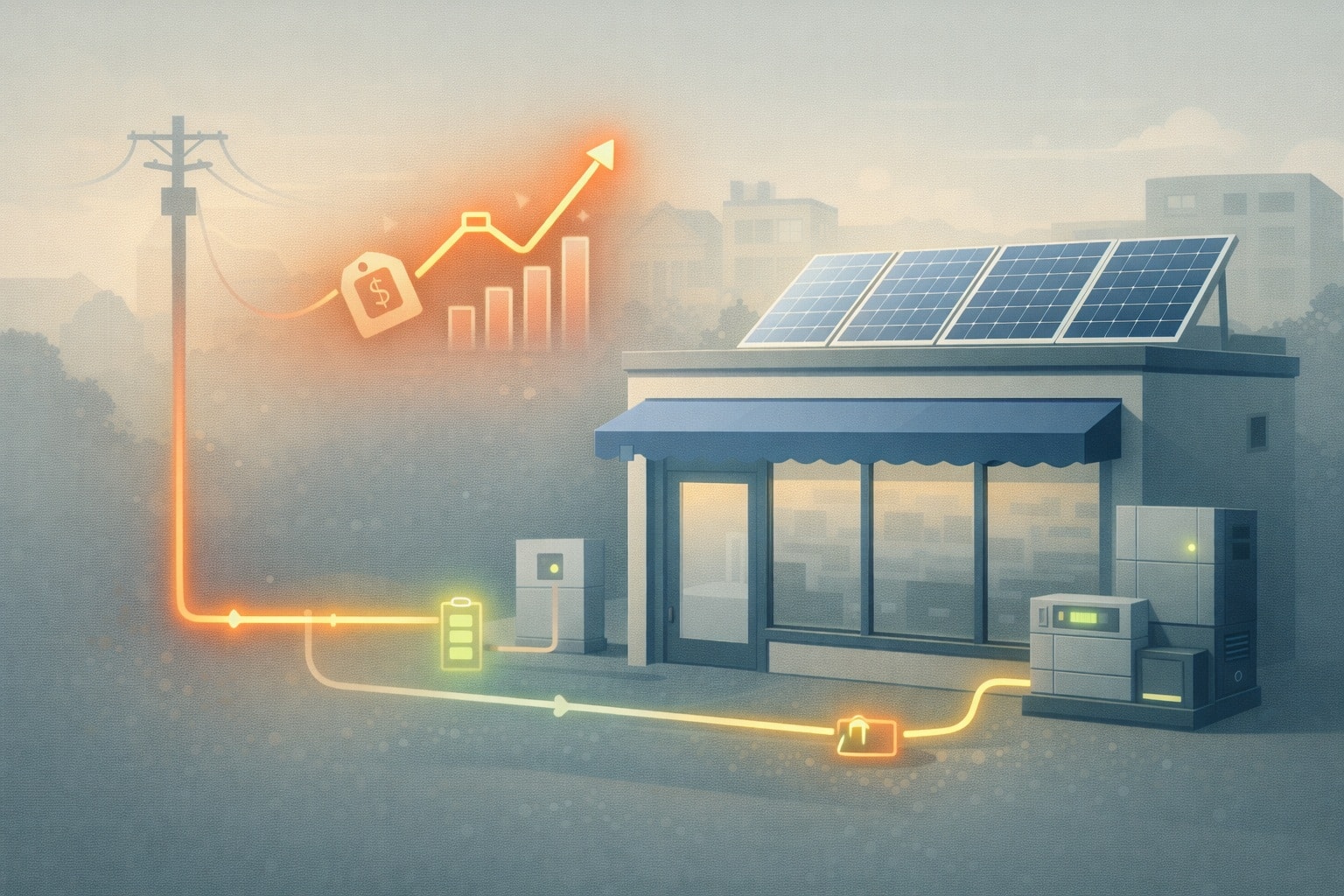
Impact of Disco Tariff Hike on Small Business Solar ROI (2026)
Nigeria’s 2026 Band A tariff of ₦209.5/kWh has drastically shortened the ROI for small business solar investments to under 14 months. Transitioning to a Mercury 2.4kVA hybrid system now provides immediate OpEx relief against rising grid and fuel costs.
Navigating Nigeria’s 2026 Energy Landscape
For Nigerian SMEs, January 2026 has ushered in a sobering reality: the days of subsidized power are definitively over. With the NERC-approved Band A tariff now stabilizing around ₦209.5/kWh, the operational expenditure (OpEx) for running a business center, salon, or remote workspace has nearly tripled compared to previous baselines. The impact of disco tariff hike on small business solar roi is no longer a theoretical debate—it is a survival metric. Business owners are realizing that the grid, once a cheaper alternative to diesel, is fast becoming a premium luxury.
The convergence of ₦1,000/litre fuel prices and the removal of electricity subsidies has created a perfect storm. Small businesses can no longer afford to treat power as a variable cost. To maintain profitability, energy independence is required. This guide dissects the financial mechanics of switching to solar in this new tariff regime and positions the Mercury 2.4kVA Solar Hybrid Inverter System as the strategic asset for stabilizing your bottom line.
Technical Analysis: Grid Parity vs. Solar Autonomy
In the context of 2026 Nigeria, “Grid Parity” has shifted. Previously, solar was competing primarily against the high cost of generators. Today,solar Levelized Cost of Energy(LCOE)—calculated over a 5-year cycle—is significantly lower than the Band A grid tariff. The technical superiority of a hybrid system lies in its ability to arbitrage these costs.
The Mercury 2.4kVA system operates on a 24V DC architecture, a critical “sweet spot” for efficiency. Unlike 12V systems that suffer from higher amperage heat losses, the 24V configuration ensures that energy transfer from the 2x 200Ah Deep Cycle GEL batteries to the inverter output is optimized. This reduces thermal stress on internal MOSFETs, extending the system’s lifespan in Nigeria’s high-ambient-temperature environment.
The system’s Pure Sine Wave output is non-negotiable for modern electronics. The “chopped” waveform of cheaper, modified sine wave inverters causes overheating in inductive loads like fans and failure in sensitive power supply units of computers. The Mercury Hybrid inverter guarantees a Total Harmonic Distortion (THD) of less than 3%, ensuring that your business equipment runs as cool and efficiently as it would on the best grid supply.
Mercury 2.4kVA Solar Hybrid Bundle
The ideal energy security solution for Nigerian SMEs facing Band A tariff hikes in 2026.
- 2.4kVA Hybrid MPPT Inverter (24V)
- 2x 200Ah Deep Cycle GEL Batteries
- Pure Sine Wave Technology
The Mercury Direct Advantage
In a market flooded with generic imports, Mercury Direct stands apart through a commitment to engineering integrity and after-sales support. We do not just sell boxes; we architect power security.
True Deep Cycle Technology
Our Mercury Elite 200Ah GEL Batteries are engineered for the Nigerian discharge profile. Unlike standard flooded batteries that degrade rapidly under deep discharge, our GEL technology withstands the rigorous charge/discharge cycles mandated by current load shedding schedules.
Localized Support Infrastructure
Every Mercury system is backed by a Lagos-based technical team. Should you need to expand your system or require maintenance, you are not dealing with an anonymous overseas vendor. We offer direct access to replacement parts and upgrades, ensuring your system grows with your business.
ROI Calculation: The 2026 Tariff Reality
The impact of disco tariff hike on small business solar roi is best understood through a direct comparison of monthly energy costs. We assume a standard small business operating 6 days a week with an average load of 500W for 10 hours daily.
| Energy Source | Cost Metric (2026) | Monthly OpEx (Approx) |
|---|---|---|
| Petrol Generator (3.5kVA) | ₦1,000/Litre (8L/day) | ₦208,000 |
| Grid (Band A) | ₦209.5/kWh | ₦27,235 |
| Mercury Solar Hybrid | Zero Marginal Cost | ₦0 (After Install) |
With a system investment of approximately ₦1,427,000 (bundle price), the payback period depends on what you are replacing. If you are replacing a generator running just 4 hours a day, the savings are over ₦100,000 monthly. This yields a full ROI in under 14 months. Even against the grid, the solar system locks in your energy price, immunizing you against future inflation detailed by NERC.
Frequently Asked Questions
How does the NERC Band A tariff affect my inverter choice?
With Band A tariffs exceeding ₦200/kWh, charging batteries solely from the grid is expensive. A Solar Hybrid inverter allows you to charge via solar panels during the day, drastically reducing your grid consumption.
Can the 2.4kVA system run a freezer?
It can handle a small, energy-efficient chest freezer along with light loads. However, for sustained cooling loads, we recommend a dedicated solar array to prevent rapid battery depletion.
What happens if the tariff hikes continue in 2026?
Your solar investment becomes more valuable. Once installed, your cost of power generation is effectively zero. Higher grid tariffs only accelerate your Return on Investment (ROI).